Minotaurs
PiranesiThe Minotaurs are recurring statues in the House, most strikingly the eight colossal figures that fill the First Vestibule. They function both as fixtures of its monumental architecture and as a point of recognition linking Piranesi’s mapped world to James Ritter’s confused account of captivity and flooded halls.
Form and Setting
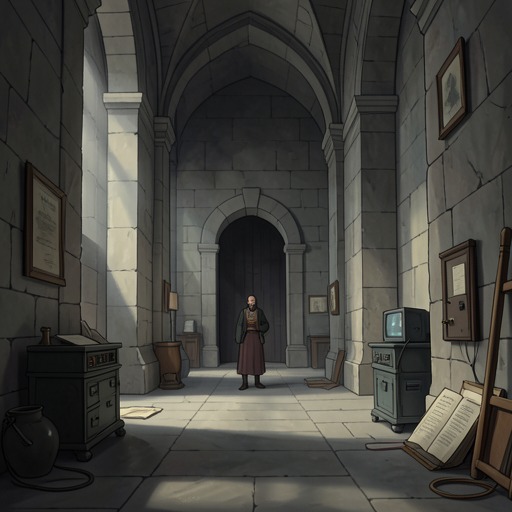
The First Vestibule is larger and gloomier than most vestibules, and eight Minotaurs, each about nine metres tall, dominate it. Their bulk darkens the pavement; massive horns project into empty air, and their solemn, inscrutable animal expressions make them an imposing presence rather than incidental ornament.
The statues also help define the Vestibule as a threshold. At its south-eastern corner, the shadows between two Minotaurs seem to extend into a corridor, with a distant patch of misty light beyond. The apparent passage is accompanied by a draught, a smell of rain, metal, and petrol, and faint sounds like vibration and irregular rushing water. The Minotaurs thus frame a boundary whose significance Piranesi gradually investigates.
A Landmark in Piranesi’s World
Piranesi’s account of the House presents statues as pervasive: halls, vestibules, staircases, and passages are crowded with them, although empty plinths and other absences are mysterious in their own right. The Minotaurs of the First Vestibule stand out within this immense sculptural environment because their number, scale, and position make them easy to identify and remember.
That familiarity matters when Piranesi reads the old journal entry concerning Ritter. He recognizes the entry’s reference to the Minotaurs as a clear description of the First Vestibule, and matches its account of a translucent, cave-like space beneath a staircase to a real feature there. He concludes that Ritter had eaten crisps and fish fingers in that space. The statues help turn a seemingly disordered record into a route-specific account of someone else’s presence in the House.
Ritter’s Recollection and Narrative Significance
After Ritter is found imprisoned behind a fake wall in Laurence Arne-Sayles’s house, he describes spending much of his time in another house containing statues, with rooms flooded by the sea. Even in hospital, he becomes agitated that he must return to the Minotaurs because they will have his dinner. His recollection persists despite medication for his delusions, while he often seems to believe he is still in the flooded, statue-filled house.
Ritter’s story leaves open how much of his account arose from his own experience, illness, or Arne-Sayles’s influence. For Piranesi, however, the specific correspondence between the Minotaurs, the staircase, and the cave-like space gives the account a concrete location in the House. The statues are therefore more than a visual motif: they are a stable landmark through which the narrative connects the labyrinth’s geography with the uncertain history of a prisoner.