Fish
PiranesiFish are a staple of the House’s ecology and a foundation of Piranesi’s practical independence. Their availability depends on the Tides, the location and condition of the Halls, and the skill to catch and preserve them; that dependence makes fishing both a daily necessity and a source of risk. Fish also mark the contrast between Piranesi’s learned self-sufficiency and the Other’s reliance on supplies the House provides.
A resource shaped by the House
The Lower Halls are the Tides’ domain, and their waters provide fish alongside crustaceans and sea vegetation. This is not a uniform or easily controlled larder. Piranesi descends staircases to the ocean’s edge for food, where the force of the waves frightens him, and he learns that a Tide may be bright, clean, and empty when he expected fish and sea plants. Food therefore requires knowledge of when and where to search, not merely access to the water.
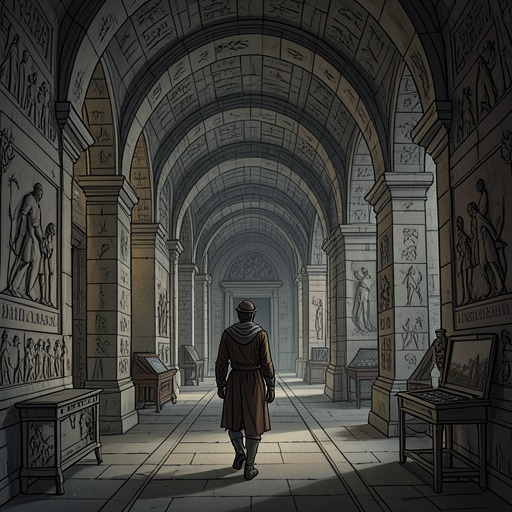
The waters of the Drowned Halls offer an alternative. They are still, and fish are plentiful there, making them less frightening to Piranesi than the wave-beaten Lower Halls. But those halls are encircled by dereliction. Reaching them means travelling through the Upper Halls and descending through wreckage and great rents in the floors. Abundance comes with a difficult route: the House’s geography distributes food unevenly and makes access part of the work of survival.
Fishing, skill, and vulnerability
Piranesi’s understanding of the Tides develops through observation. He recognizes that their movements are not random and begins recording them in a table, hoping to predict their arrival. At first, however, he assumes one Tide is much like another. An unexpectedly empty visit shows the limits of that early knowledge, while hunger presses him to explore further and discover the fish-filled Drowned Halls. The table is thus not abstract record-keeping: it grows out of the practical need to make food less uncertain.
Fishing requires equipment as well as environmental knowledge. Piranesi carries nets and a lobster trap made from an old bucket, and on one outing he catches seven fish and four lobsters, keeping the entire catch. Fish are part of a wider subsistence practice: he also gathers seaweed for food and fuel, dries and stores it, and cures fish skins into leather useful for other purposes. His relationship to fish extends beyond catching an immediate meal to making materials and provisions last.
That competence does not remove risk. When the route to the One-Hundred-and-Ninety-Second Western Hall lies through a region frequently flooded with debris, Piranesi explains that sharp fragments of broken marble can cut bare feet and expose a person to infection. He once had shoes for such passages, but no longer does. The episode makes visible the bodily cost of moving through the House to reach necessities: the right route and the knowledge of the waters cannot substitute for lost equipment.
Uncertainty, warning, and communal life
A flock of birds once leads Piranesi to consider whether animal behaviour may carry useful knowledge. After some birds perch on statues associated in his mind with industriousness, he treats their apparent warning as a reason to fish. He catches seven fish and four lobsters that day. That night a western wind brings an unexpected storm; the turbulent Tides drive fish from their customary Halls and out to sea, leaving no fish there for the following two days. The catch proves consequential because it provides food before the interruption.
The incident does not establish that fish can always be predicted from signs, or that the birds deliberately communicated a forecast. Piranesi’s account remains tentative: he wonders whether wisdom may reside in a flock rather than an individual, but recognizes that testing the idea would require months or years of careful observation. For the moment, the practical result is clearer than the explanation. A catch secured before the storm protects him from hunger when the usual source fails.
Provisioning and the contrast with the Other
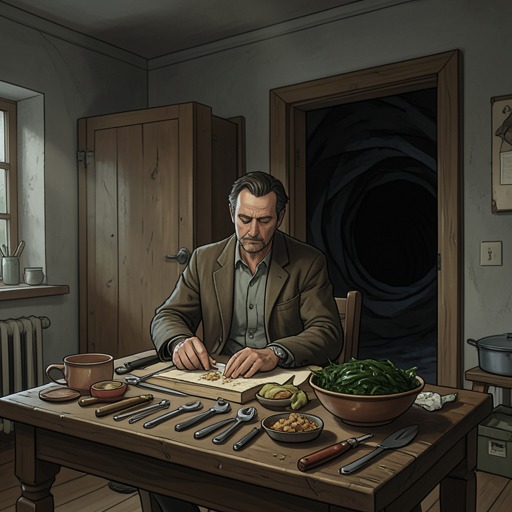
Fish also reveal an asymmetry in the relationship between Piranesi and the Other. Piranesi notes that the Other receives a greater variety of objects from the House, including sleeping bags, shoes, bowls, sandwiches, notebooks, and Christmas cake, whereas Piranesi mostly receives fish. He interprets this difference through their abilities: he can fish, gather and preserve seaweed, and turn fish skins into leather, while the Other does not know how to fish or perform those tasks. Without provisions, Piranesi supposes, the Other might die—or Piranesi would have to spend much of his time caring for him.
This contrast is not simply between scarcity and plenty. Piranesi is grateful for what the Other gives him, including equipment that makes life warmer and safer, yet he understands himself as more practiced at maintaining his own life within the House. Fish stand at the center of that practical distinction: for Piranesi they are food obtained through learned work and uncertain conditions; for the Other, they belong to a system of provision that he does not know how to reproduce himself.
Significance
Fish bind the House’s immense spaces to ordinary bodily needs. Their movement with the Tides shapes Piranesi’s routes, his records, his equipment, and his exposure to hunger; their scarcity can turn a routine fishing ground into a threat, while a successful catch can carry him through days without food. The fish also help define the difference between living by environmental knowledge and relying on supplies from elsewhere. In this way, the House’s ecology is not decorative background: it governs what its inhabitants can eat, how they move, and how much care they can offer one another.