Sanctuary
PleasureSanctuary is the Shadowdwellers’ religious house and temple complex, a place of worship, education, healing, and religious judgment under Magnus’s leadership. Its authority stands apart from the royal household and common law: that independence gives it a distinct role in the city, but also makes its control a consequential prize. Nicoya’s attempted coup nearly captures that power, turning a house associated with order and spiritual protection into a site of betrayal, injury, and political struggle.
Institution and Sacred Authority
Sanctuary serves more than one purpose. It is the Shadowdwellers’ religious house, but it also educates children entering adolescence. Its halls therefore bring priests, handmaidens, students, healers, and worshippers into a shared institution. The temple’s sacred ground is marked by a decorative tile line, separating it from the larger Sanctuary around it. That small boundary gives physical form to distinctions the institution maintains in law and practice: the temple is holy ground, while Sanctuary encompasses the broader religious community and its daily work.
The institution’s jurisdiction is not simply an extension of royal power. Sanctuary and religious law function independently of the royal household and common law, and no one has full authority over the city unless they control both. This separation makes Sanctuary more than a spiritual refuge. Its leadership carries institutional power that cannot be reduced to the crown’s ordinary legal reach. Nicoya’s effort to place her daughter in Magnus’s religious position thus threatened a separate source of authority, not merely a court appointment.
Religious law also defines Sanctuary’s response to wrongdoing. Its priests may pursue those deemed sinners, demand repentance, and impose final judgment if repentance is refused. The prohibition against using Dreamscape for harmful or selfish purposes is identified as one of the institution’s gravest rules. When Acadian abuses Dreamscape, Magnus regards the offense as grounds to seek penance and pursue her under religious law, even where common courts may be unable to prove a crime. Sanctuary’s sacred authority consequently entails both protection and punishment.
A House Under Attack
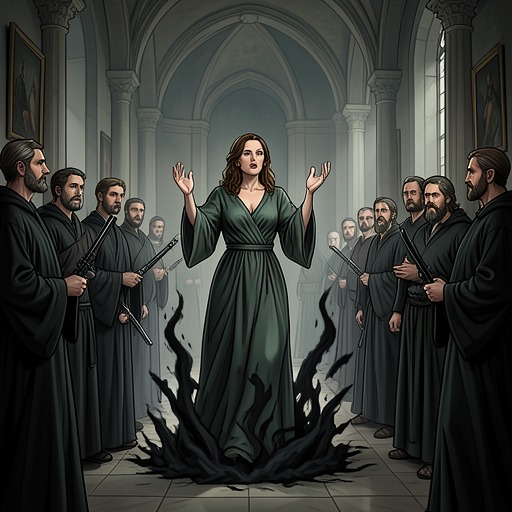
Nicoya’s coup brings that authority into direct danger. She attempts to seize control of Sanctuary by killing some priests and turning others to her will; students also become victims. The assault cuts a broad path of damage through the religious house and includes the disappearance of Sagan, one of its leading penance priests. Her plans extend beyond Sanctuary itself: the wider conspiracy includes assassins hired to target Trace’s wife and child. The institution becomes one front in a campaign against the royal family and its allies.
Sagan’s capture makes the attack personal as well as institutional. Poisoned weapons leave him gravely weakened after Nicoya wounds him, and Acadian’s agents drag him away. His recollection later narrows to fragments: he remembers running through Sanctuary’s halls to aid Magnus’s handmaiden, Daenaira, and a student, then being attacked by two Shadowdweller males and bound. The poison’s trauma erases the intervening events from his memory. His disappearance is eventually treated as presumed death, despite his escape and return.
When Sagan reaches the research station guarding the entrance to the exhausted mines converted into the Shadowdwellers’ winter city, his priest’s uniform identifies him to the guards. They try to take him inside for care, but he refuses and walks directly toward Sanctuary, stopping only at its threshold. He confronts the tile marking the temple’s holy ground and recognizes that concealing his broken priestly vow would itself be a dishonest omission. Sanctuary is therefore the place where his return becomes a moral reckoning: he cannot separate the institution’s teachings about repentance from his own obligation to speak truthfully.
Recovery and Renewed Work
Magnus and Daenaira bring Sagan across the boundary into Sanctuary. A day later he is recovering in the healers’ clinic, quiet and more withdrawn than usual. The healers believe the trauma of the poison erased his memories; he can say only that he remembers nothing of fighting Nicoya, her insurrection, or how he was poisoned. His recovery takes place within the institution whose attempted seizure led to his disappearance, linking its work of care to the violence it has endured.
After Sagan leaves the infirmary, Magnus takes him into a rear courtyard. The large space is empty because the students are in class, a brief return to Sanctuary’s ordinary educational rhythm after the disruption of the coup. There Sagan tells his superior that he has defied one of the tenets of his priesthood. Magnus remains calm rather than reacting with the recrimination Sagan expects. Sanctuary’s authority is represented here not only by rules and punishment, but also by the possibility of facing a breach openly before a superior.
Sanctuary remains a place its priests must return to even when events elsewhere pull them away. During the crisis surrounding Daenaira’s imprisonment in Dreamscape, Magnus and Guin move between planes and reappear in the temple in Sanctuary. Their sudden arrival and dishevelment draw attention from people at prayer, but they ignore the questions and hurry to Magnus’s rooms. The temple’s public worship and the private emergency within the priest’s quarters occupy the same complex, placing communal religious life beside immediate personal peril.
Protection, Loss, and Political Meaning
Sanctuary’s protective purpose is especially visible in Magnus’s work. He has guarded Dreamscape against abusers for centuries, using the power of that realm against those he hunts; the protection of the different planes is part of his priestly responsibility. After Acadian’s assault on Daenaira and the loss of their child, however, that duty becomes painfully inadequate in practice. Magnus keeps a guard outside his quarters until Acadian is caught, while Daenaira, devastated and afraid to sleep, remains in their rooms. The institution’s mission to protect dreamers stands in stark contrast to the harm that has reached its own leader’s household.
Daenaira’s grief also exposes the limits of religious consolation. She cannot accept a handmaiden’s anticipated words of faith about where the child has gone: she has seen the blood on the sheets and knows the child is lost. Magnus rejects her self-blame and identifies Acadian as responsible, while affirming that Daenaira saved hundreds of lives and futures by killing Nicoya before the coup could consume the institution. Sanctuary’s religious world offers a framework for judgment and duty, but it does not make bereavement simple or erase the consequences of violence.
The threat reaches Sanctuary’s organization as well as its people. Most of Acadian’s spies there are destroyed or driven out; only weeks earlier, she had been close to installing Nicoya in the religious seat of power. The near miss makes clear why control of Sanctuary matters: because its laws and leadership are independent, capturing it would have given Acadian’s faction influence that royal authority alone could not provide. The house’s damaged state is therefore both a consequence of the coup and evidence of how close the conspiracy came to changing the city’s balance of power.
Sanctuary’s significance rests in this tension between sanctuary and vulnerability. It educates children, treats the injured, houses worship, and gives its priests authority to demand repentance; at the same time, its independence invites political capture, and its protective duties cannot prevent every harm. The tile line at its temple entrance marks sacred ground, but the events around it show that sacredness does not place the institution outside history. Sanctuary must be defended, repaired, and inhabited by people who continue to face the costs of its laws and its failures.