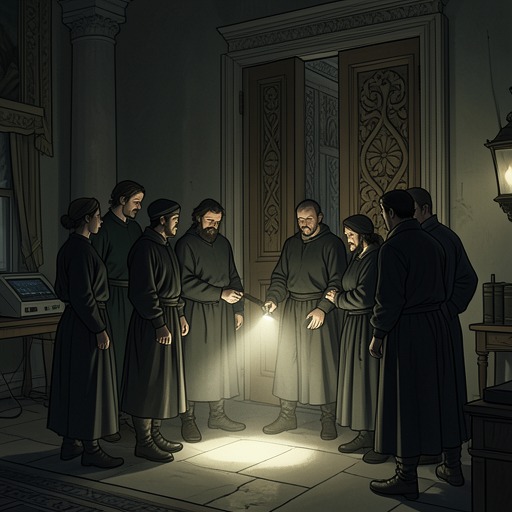
Shadowdweller winter city
PleasureThe Shadowdweller winter city is a refuge fashioned from exhausted mines, but for Sagan its entrance marks more than the end of a dangerous journey: it is the threshold of a reckoning he cannot evade. After crossing the wilderness in severe exposure and exhaustion, he reaches the city and goes straight toward Sanctuary, where the warmth that restores his body also gives pain and remorse room to surface.
Setting and Access
A research station guards the entrance to the former mines transformed into the Shadowdweller winter city. Sagan arrives without supplies or proper clothing after a difficult return to Elk's Lake; storms and the need to avoid sunlight have prolonged his journey. At one point, lacking shelter, he crosses into Shadowscape for protection. That refuge is only safe for two days, and its different passage of time makes a return to his schedule uncertain. His priest's uniform identifies him to the guards at the station gate. They try to escort him into the nearest building so that they can tend to his exposure and exhaustion, but Sagan refuses their help and walks on into the city. The uniform that grants him immediate recognition also makes clear that he is returning not as an anonymous traveler, but as a priest whose conduct has religious consequences.
Sagan's Arrival
The city's significantly warmer surroundings begin to thaw Sagan from near-frozen conditions. In the wilderness, the demands of survival had kept his attention fixed on staying alive and continuing onward; as his body warms, pain rushes into his extremities and his heart and soul. The change in temperature therefore accompanies a change in what he can face: once the immediate struggle for survival recedes, his breach of his vow comes back into view. Sagan does not stop at the guards' offer of care. He presses into the city until he is about to step into Sanctuary, making his arrival a direct approach to the institution whose judgment he expects. The account places him at the entrance rather than describing any welcome or formal hearing there; the decisive action is his refusal to turn aside from the place where he must answer for what he has done.
The Temple Boundary and the City's Significance
A line of decorative tile marks the holy ground of the temple and distinguishes it from the larger Sanctuary that contains it. At this boundary, Sagan recognizes that concealing his wrongdoing had never seemed a real option. He considers silence an omission that would amount to dishonorable deception: although he broke his vow, he does not regard himself as a hypocrite, having spent ages teaching religious law and its consequences and preaching that repentance is necessary for forgiveness. His judgment of his own conduct is divided. He admits that breaking the vow was wrong, but regrets the vow alone, not what followed from breaking it; Sanctuary and temple law, by contrast, will not make that distinction. The city thus becomes the setting for a sharp passage from physical exposure to moral exposure. Its warmth brings Sagan back from the edge of bodily collapse, while the tile boundary confronts him with the standards he has taught and the consequences he expects to face.