Victorian Restrictions on Women Writers’ Subjects and Abilities
PossessionVictorian Restrictions on Women Writers’ Subjects and Abilities names the gendered limits Christabel LaMotte confronts as a writer: women are judged against a male standard, confined to supposedly proper subjects, and treated as if their creative work were secondary to their expected social responsibilities. The novel makes these limits concrete through LaMotte’s account of a dismissive literary judgment, her insistence on women’s intellectual and emotional range, and the later disputes over who may control her writing and letters.
The limits imposed on women’s authorship
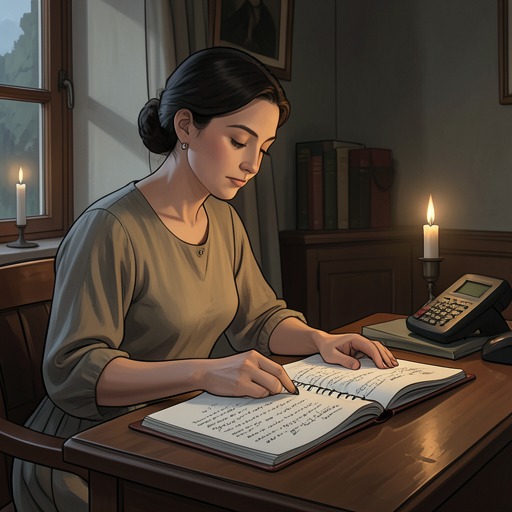
In a letter to Randolph Henry Ash, LaMotte rejects the notion that her interest in her own work might be an intrusion. She explains that the productions of the “Female Pen” are commonly met with qualified approval—good, but only “for a woman”—and that women are also told there are subjects they may not treat and things they may not know. She acknowledges that some people claim men possess a greater scope or power, but contests the boundaries drawn from that assumption: women are not merely vessels for virtuous thoughts, she argues, but think, feel, and read.
The letter presents restriction not simply as a ban on publication but as a system that defines women’s capacity in advance. LaMotte identifies Ash’s apparent failure to understand that system as part of what sustains their correspondence: his ignorance, whether genuine or assumed, gives her an occasion to explain what a woman is presumed capable of being. Her argument turns the exchange into a space where she can claim intellectual authority rather than accept the narrow role assigned to female writers.
Critical judgment and the value of creative work
LaMotte recalls sending a small selection of poems, chosen with trepidation, to a celebrated poet and asking whether they were poems and whether she possessed a voice. His answer was courteous but condescending: they were pretty, imperfectly regular, and insufficiently decorous, though he would encourage her moderately. He suggested that they might occupy her until she acquired “sweeter and weightier responsibilities.” The phrase reduces authorship to a temporary pastime, implicitly subordinated to a woman’s presumed future duties.
LaMotte’s response gives that dismissal material consequences. Writing is not an ornamental interest that can be set aside when a more socially approved responsibility arrives; she describes the need to make words as essential to her life. Her comparison is to a spider that must spin its silk because it constitutes home, safety, sustenance, and life itself. If the work is attacked or destroyed, the spider must begin again. The image makes creative persistence at once necessary and potentially fierce: the writer’s production is not a decorative supplement to existence but the means by which she sustains it.
Manuscripts, rights, and control
The novel carries the question of women’s authorship from critical reception into the material and legal custody of writing. When Maud Bailey is asked who owns the copyright in LaMotte’s poems and stories, she distinguishes the family’s claim to those rights from the manuscripts themselves, which have been deposited at the Women’s Studies Resource Centre in Lincoln. The holdings include the manuscripts of Melusina and the City of Is, two books of fairy tales, and scattered lyrics. The family also acquired Blanche Glover’s journal privately at a Sotheby’s sale, without others recognizing its importance.
A discovered will makes LaMotte’s intentions more specific. Dictated to her sister Sophia Bailey on May 1, 1890, when she was too weak to write clearly, it leaves her books, papers, and copyrights to Maia Thomasine Bailey, in the hope that Maia may become interested in poetry. The will also directs smaller bequests of money and personal property. Its provisions establish a line of inheritance for LaMotte’s literary work, while the later discovery and deposit of the manuscripts show how that inheritance becomes a question of preservation and access as well as family ownership.
The legal discussion distinguishes ownership of the physical letters from copyright in their words. Manuscripts belong to the recipient, while copyright belongs to the sender; in this case, the evidence presented is that LaMotte asked for her letters back and Ash returned them. Euan MacIntyre argues that Maud is heir to the physical letters and likely to the manuscripts of Ash’s letters, while copyright in Ash’s writing remains with his heirs. The distinction prevents the claims over the correspondence from collapsing into a single, uncomplicated notion of ownership.
From silenced voice to contested inheritance
The contrast between LaMotte’s complaint about women’s restricted literary authority and the later legal debate is significant. In her letter, the question is whether a woman may claim a voice and write beyond prescribed subjects; in the later scenes, the question is who possesses the documents that preserve that voice, who holds copyright, and where the manuscripts should remain. LaMotte’s will gives her a direct role in that future by naming Maia as the beneficiary of her papers and copyrights, but the correspondence’s divided ownership leaves control unsettled.
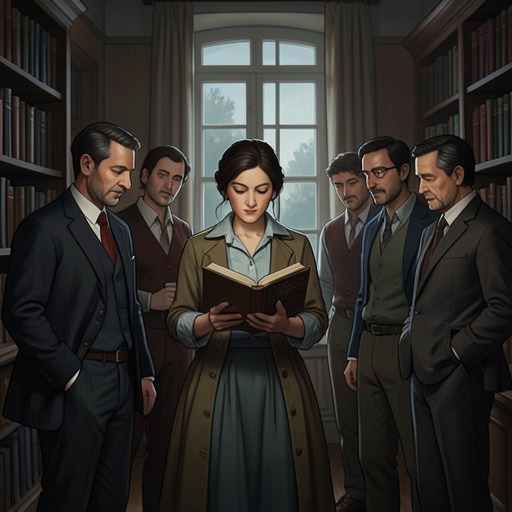
The novel also stages the difference between possessing evidence and having the right to use it. When Maud asks where the originals are, Roland admits that he found the letters in a book and took them. Later, Euan asserts that Maud can prove legal ownership of both sides of the manuscript correspondence, then insists that the box under dispute is separate from her claim. These exchanges echo the earlier restriction on women’s writing: the papers can be read, collected, sold, inherited, or institutionally preserved, but each act of control shapes which part of a woman writer’s work becomes available and on whose terms. The issue is therefore not only whether LaMotte wrote, but whether her writing can remain hers in the hands of those who inherit and interpret it.