Sylvie
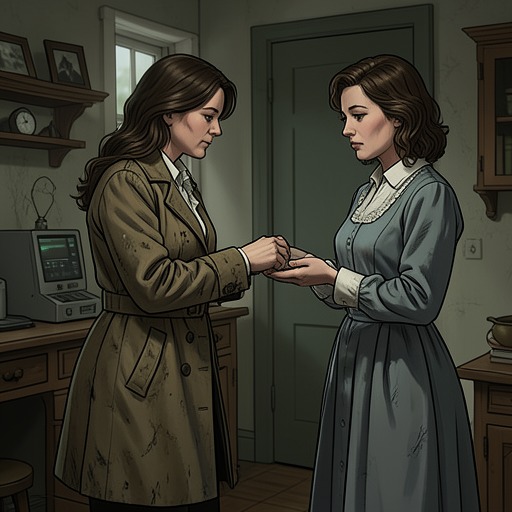
QueenieSylvie is Queenie Jenkins’s mother, a woman whose relationship with her daughter is marked both by early affection and by a painful separation. Queenie first encounters her again at Christmas after moving back in with her grandparents: Sylvie arrives late to midnight mass, takes the space Queenie makes for her on a crowded bench, and tries to speak with her. Their reunion is tentative. Queenie faces forward and keeps her answers brief; later, when Sylvie reaches to touch her leg, Queenie sharply moves away. Sylvie withdraws her hand and apologizes, recognizing that Queenie does not like being touched. The small exchange makes their distance visible, while Sylvie’s careful response suggests that she wants contact without forcing it.
Identity and Early Relationship
Sylvie is described as light-skinned, short, slim, and physically delicate in appearance, with long, soft curls and hazel eyes. Queenie contrasts her mother’s coloring and hair with her own darker complexion and tighter curls, and notices that Sylvie seems to search for goodness in other people. The contrast is not only physical: Queenie has understood her mother through the fact of her absence, while this portrait begins to make visible the person and vulnerability behind that absence.
Their earlier closeness is recalled as a real part of their shared history. Sylvie and Queenie wore matching outfits until Queenie was eight, and Sylvie repeatedly told her daughter that she was strong enough to be a queen. Those memories sit uneasily beside Queenie’s experience of being left behind. They establish that Sylvie’s love was present before her departure, but do not make the separation harmless or resolve its consequences.
Separation, Roy, and the Court Case
During Queenie’s stay with her grandparents, she overhears Sylvie telling Maggie that she is not as tough as others assume and that she has been good at pretending. Sylvie thanks Maggie for looking after Queenie, but insists that she is Queenie’s mother. She regrets having left her daughter alone and connects that decision to Roy’s influence over her. Maggie urges her to move forward and rebuild the relationship rather than remain fixed on what cannot be changed; Sylvie fears that the closeness they once had may already be lost.
The conversation also exposes the ongoing cost of Sylvie’s relationship with Roy. She tells Maggie that seeing him in connection with the court case makes her feel sick. The proceedings have continued for two and a half years, and Sylvie is embarrassed by the material the lawyers repeatedly bring up. She has lost considerable weight during this period. The discovery of Roy’s private bank account, where money from her house had been placed, offers a limited prospect of recovery, but she doubts she will get the money back. Queenie overhears these details and cries, yet resists feeling sorry for her mother; in her view, Sylvie made mistakes, and both of them must live with them. Her response preserves the injury of abandonment even as she learns more about the pressure and harm surrounding Sylvie’s choices.
Sylvie explains that after Queenie’s father left, she was frightened of being alone and believed nobody else would want her. When Roy entered her life, she idealized him. She describes herself as having abandoned Queenie despite loving her, and says she should not have left her daughter alone under his influence. The account does not undo the rupture, but it shifts the story from simple maternal rejection toward a history in which fear and manipulation also shaped Sylvie’s decisions.
Why She Named Queenie
At a later family gathering, Sylvie tells Darcy Betts how she chose her daughter’s name. As a girl, Sylvie imagined being a princess and pictured someone rescuing her from the room beneath the attic in her family’s large Victorian house. She recalls that her father had worked night and day to afford the home, and that her family were the first Black people on their street. Her childhood princess fantasies continued into adulthood; when she met Queenie’s father, she imagined him as her prince.
The meaning of the name changes with Queenie’s birth. Sylvie remembers placing a finger in her newborn daughter’s hand and feeling the baby squeeze it tightly. Instead of seeing a delicate princess, she saw a powerful child who would grow up strong and brave, and named her Queenie. The story gives the name a maternal origin in hope and admiration. It also creates a poignant contrast with the daughter who later struggles to feel loved and safe: Sylvie’s original vision of Queenie’s strength was affectionate, but strength could not protect the child from the damage of separation.
Reconnection and Resolution
When Sylvie later tells Queenie that the court case is over, she reports that she has won after almost three years. She cannot recover the house or most of the money because Roy has spent the majority of it, but she has been awarded what remains. Roy will not go to prison. Queenie responds politely, while privately noticing that the news does not bring the immediate relief she expected. The legal result matters to Sylvie, but it cannot by itself repair the family relationship or give Queenie an uncomplicated feeling of release.
Sylvie has brought a folded check in her handbag and begins to offer it to Queenie, though the scene does not establish its amount or purpose. The gesture belongs to the same uncertain movement toward her daughter as her Christmas questions and her attempt to sit beside her at church: Sylvie wants to make contact, but the history between them cannot be settled by a single offer. Her role in Queenie’s story is therefore neither that of an absent mother reduced to a villain nor that of a victim whose suffering cancels the harm she caused. Queenie’s growing understanding holds both truths together: Sylvie loved her, left her, endured Roy’s abuse, and is trying to rebuild a bond that remains damaged.