Veronica
QueenieVeronica is Queenie Jenkins’s grandmother, a Jamaican-born matriarch whose care is direct, practical, and often inseparable from blunt instruction. Her memories complicate the toughness she expects from Queenie: she has lived through abandonment and heartbreak herself, but interprets endurance as the proper response. When Queenie seeks psychotherapy, Veronica’s insistence that suffering must be borne rather than discussed turns that inherited survival code into a source of conflict between them.
Family Presence and Everyday Care
In a childhood memory, Veronica takes Queenie to a Jamaican bakery, where she greets the woman behind the counter warmly and jokes with the shopkeepers while ordering a large bun, hard dough bread, bulla, and pound cake for her husband. The woman gives Queenie the heavy bag and remarks that she should help her grandmother while she is still around. Veronica later complains to Queenie that Jamaicans can be too familiar. The contrast captures her ease in the community and her resistance to other people’s intimacy: she can exchange affectionate banter, yet bristles when familiarity becomes personal or morbid.
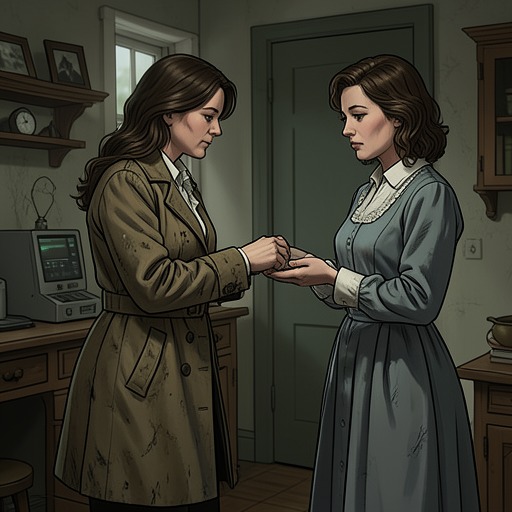
Her care for Queenie is more intimate when Queenie is distressed and alone in the bath. Tom is absent, and Veronica comes into the bathroom to wash her granddaughter’s back. Queenie objects that she is no longer a baby, but Veronica treats the act as a continuation of the care she gave her in infancy. She uses a bar of Imperial Leather soap and continues despite Queenie’s initial embarrassment. The scene makes care physical and routine rather than verbally reassuring: Veronica offers comfort through an old caregiving gesture, even as her words urge Queenie to move on with life.
The Heartbreak She Remembers
During that bath, Veronica explains that she also knows heartbreak. Her account begins when she became pregnant at fourteen by the man who would become Queenie’s grandfather. He disappeared, leaving Veronica in Jamaica with her daughter Maggie and her grandmother. In his absence, she fell in love with Albert, a kind man who helped her carry sugarcane home and cared for both her and Maggie. Their relationship remained secret because Veronica feared bringing further shame after her first pregnancy.
Albert made Veronica a gold necklace bearing the initial V, and she remembers his generosity and the way he waited for her at the end of the lane. The object preserves a relationship that had to remain unspoken: Veronica still wears her wedding ring in the present, but the account of Albert reveals an earlier attachment that her family apparently never knew about. She cannot say what became of him. When her first partner returned from London, where he had been finding work and saving money in a bedsit in Mitcham, he took Veronica and Maggie to London. A year later, Veronica was pregnant with Queenie’s mother, Sylvie. She presents the unresolved loss of Albert as evidence that heartbreak is not unique to Queenie, but something the family has repeatedly learned to live with.
Endurance as an Inheritance
Veronica’s response to Queenie’s request for psychotherapy exposes the limits of that lesson. When Queenie tells her she feels unwell, has lost her job, and needs to speak to someone, Veronica rejects the idea. She invokes the pain she carried through her youth and adulthood, and imagines that her own mother would have regarded seeking psychotherapy as madness. Her objection is not simply a denial that suffering exists: Veronica describes pain as something everyone in the family bears, and therefore something no one should single out for treatment.
She points to Sylvie’s hardship as further evidence for endurance, recalling that Queenie’s mother has been left living in a hostel after a man abused her and took her money. Veronica also blames Queenie for losing her job because she could not hold herself together. Her response places responsibility on Queenie to withstand distress, rather than treating the distress as a reason to seek help. The standard comes from Veronica’s own history, but its effect is to make Queenie’s request sound, to her, like a rejection of family strength.
Conflict, Change, and Significance
The disagreement escalates at the kitchen table. Veronica switches into strongly expressed Jamaican patois, strikes the table, and declares the discussion settled by forbidding Queenie to go. When Queenie says she may stay with friends, Veronica insists that being the first in the family to achieve educational and professional milestones does not exempt her from the family’s expectations; she recasts psychotherapy as another first that must not happen. Her anger is visible in her forceful departure to wash dishes, while the arrival of Queenie’s grandfather, leaning on his walking stick, interrupts the confrontation. Veronica tells him to let Queenie explain, and Queenie hands him the letter about the referral. The evidence does not settle the outcome of that exchange, but it shows that the conflict has moved beyond private disagreement into a moment requiring another family member’s attention.
Veronica’s resistance is set against her capacity for tenderness, not instead of it. She washes Queenie’s back when her granddaughter is vulnerable, recalls Albert with grief, and sustains a family history shaped by displacement and difficult choices. Yet the same account that lets her recognize heartbreak also supplies the rule she presses on Queenie: life continues, so pain must be endured. At Queenie’s twenty-sixth birthday, Veronica slides an unsealed envelope across the kitchen table with twenty pounds inside and suggests that Queenie buy herself a top. The small, practical gift fits her mode of affection, just as the later ban on therapy shows its constraint. Through Veronica, the novel presents resilience as both a resource passed between generations and an expectation that can obstruct a different form of care.