Future Memory and Cognitive Dissonance
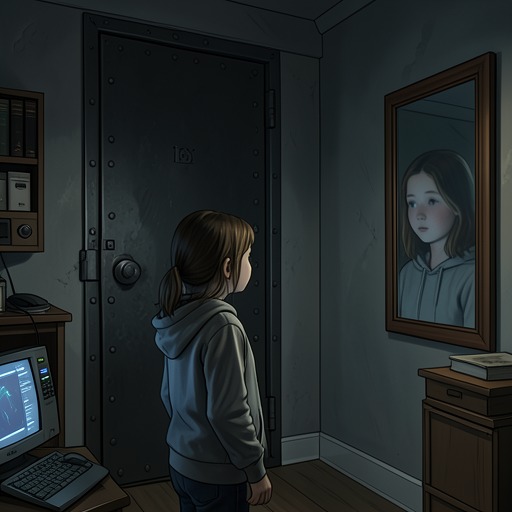
REFuture-memory dissonance names the central psychological conflict created when Tabitha Moore returns from 2045 to 1998 carrying memories of an entire adult life while inhabiting her thirteen-year-old body. Her knowledge gives her an unusual capacity to anticipate danger and recognize patterns, but it does not restore the agency, emotional stability, or social authority of adulthood. Instead, the mismatch repeatedly makes her question which feelings belong to the past, which belong to the altered present, and whether experiences that resemble dreams can be trusted at all.
Definition and Origin
The condition begins with the prototype MRI machine. In 2045, Tabitha recognizes that the malfunctioning device resembles the machine involved in the 1998 incident at the Emsie St. Juarez Pediatrics ward and concludes that her mind has been sent forty-seven years backward. The earlier machine’s catastrophic failure produces a painful temporal displacement: she awakens in an outdated hospital as a fat thirteen-year-old girl, discovers that the year is 1998, and sees that Alan Moore is alive. The shock is not simply chronological. It forces an adult consciousness back into the body and social identity she had spent her first life rejecting.
Her first response is therefore bodily as much as intellectual. She recognizes herself as “YOUNGER” and immediately associates the returned body with the self-hatred, poverty, and humiliation of her earlier life. The knowledge that she has already survived these years does not make their repetition easier; it makes the prospect more terrifying because she remembers what the old life felt like and believes she may have to endure it again. Future memory is consequently both a survival resource and a burden, offering information without offering escape from the conditions that produced the original suffering.
Memory Against Present Experience
Tabitha initially treats her memories as an objective explanation for her social failures. After several weeks at school, however, she realizes that becoming thinner and prettier has not automatically produced the friendships she expected. She had retrospectively attributed her earlier loneliness and social estrangement almost entirely to weight and appearance, yet the changed timeline leaves her with only one friend. This discovery breaks a simple causal story: appearance mattered to her self-image, but it was never a complete explanation for the isolation of her first life.
The same instability appears in her account of the second timeline. She tells Alicia Brooks and Elena Seelbaugh that she has already lived a life extending beyond 1998, while stressing that the future she remembers is not necessarily the future now developing. Her knowledge can identify broad patterns, but altered choices and new relationships continually disturb the expected sequence. Reports at school that Matthew Williams asked Tabitha out, kissed her, and took her to Louisville collide with her own memory that he never asked her out. The rumor may even confuse Officer Darren MacIntire with Officer Williams, demonstrating how quickly remembered events can be distorted when other people interpret them through the new timeline.
The dissonance becomes more severe after Tabitha is attacked at the Williams family lake house. She believes Erica Taylor may have killed her and then experiences another restart in the MRI, returning once more to May 1998. The repetition confirms neither a stable rule nor a simple resurrection. It leaves her trying to determine whether she has died, traveled through time, entered a dream, or suffered a brain injury. Her explanation to Alicia includes a Perkins restaurant, bullying middle-school apparitions, an abandoned F-22 fighter jet, a return to 2045, and a dying future self, but she admits that she cannot distinguish with certainty between factual time travel and dreamlike neurological experience.
Trauma, Fragmentation, and Emotional Regression
The condition is expressed through emotional volatility as well as uncertainty about facts. Tabitha tells Alicia that she has experienced an emotional breakdown almost every day for weeks, with constant crying, impulsive decisions, and rapidly shifting moods. She contrasts this with her first life, in which she rarely cried and maintained an emotional distance from both suffering and happiness. The earlier detachment had been lonely, but it had also protected her from feeling overwhelmed. The second life gives her greater attachment and more opportunities for connection while removing the emotional numbness that once kept pain at a distance.
Tabitha understands that her memories carry unresolved injuries. She says that she did not choose which parts of her former life would return with her: a thirteen-year-old mind and body now contain memories accompanied by old problems and emotional associations. She cannot decide whether feelings produced by the previous timeline remain valid after circumstances change. When the new life contradicts the remembered one, she experiences cognitive dissonance rather than clean correction. Improving events does not erase the psychological baggage attached to the earlier versions of those events; it can instead make the baggage seem less intelligible.
The second timeline also destabilizes her sense of agency. Tabitha says she is not merely remembering adulthood but psychologically conforming to the role of a thirteen-year-old girl. Her “software” may be more advanced, yet the “hardware” is a vintage adolescent body whose emotions are intensified. She increasingly feels that she is sinking into the expected social role because being an ordinary teenage daughter can bring happiness she never possessed before. This regression is voluntary only in part. It offers access to a desired childhood, but it also limits her ability to act on adult knowledge and makes her anger, fear, and dependence feel humiliatingly childish.
Social and Family Consequences
Future-memory dissonance repeatedly collides with institutions that recognize only Tabitha’s chronological age. She insists that being thirteen means she should no longer be treated as a small child and asks Alan Moore to teach her budgeting, meal planning, time management, and money management. Later, when she withdraws from Springton High School, she speaks to Pamela Cribb of the school board in formal, administrative language, explaining that she needs to justify absences and obtain accreditation for homeschooling before being declared truant. Her knowledge and planning ability exceed the expectations attached to her age, but she must still negotiate through adults who possess the legal authority to determine her education.
Family relationships become equally difficult because the remembered future supplies emotional judgments before the present versions of people have completed their actions. When Lisa Moore returns, Tabitha knows enough about Lisa’s drug use and treatment of her sons to feel that much of her anger is warranted, yet she also recognizes that some of her reaction is an overstatement produced by accumulated memory. She feels trapped between teenage outrage, adult responsibility, and the expectation that Lisa must be treated as family. The knowledge that she will be forced into an adult confrontation does not make the confrontation easier; it makes her resent the loss of the simple childhood she had briefly begun to enjoy.
The same problem shapes her relationship with Elena. Tabitha remembers Elena as a source of middle-school cruelty, yet the current Elena can become her friend. When Tabitha reveals that she has lived through a different life beyond 1998, the disclosure turns a private burden into a shared interpretive problem. Elena and Alicia must decide whether to understand Tabitha’s account as truth, delusion, trauma, or some unstable combination, while Tabitha must speak about an experience whose very evidence is constantly changing.
Identity Crisis and Narrative Function
By the time Tabitha’s room is described as neither a budding girl’s space nor an old woman’s living quarters, her identity problems have reached an explicit crisis. The sparse room becomes an image of temporal and psychological limbo: it contains no settled record of the future adult she remembers and no uncomplicated expression of the child she is expected to become. Thirteen should mark a transition toward adulthood, but Tabitha experiences the transition backward. Her adulthood is located in the past, while her childhood is newly unfolding and therefore cannot be recovered simply by memory.
This conflict also makes the narrative’s reality unstable. The MRI’s screech, the power failure across Jefferson County, Tabitha’s apparent death, the broken cast, shifting windows, disappearing mobile homes, and the vision of a sixty-year-old body inside an F-22 all blur the boundary between physical event and neurological nightmare. The small hand that catches Tabitha as she falls leaves her suspended in darkness after the fighter disappears, an image of consciousness held between timelines rather than securely returned to one. The uncertainty is not an incidental puzzle: it reproduces Tabitha’s own inability to establish a single authoritative account of what happened.
The butterfly effect compounds that instability. Tabitha knows enough of the first life to expect certain events, but every intervention creates new surprises, including social rumors, altered friendships, and family crises. As the changes spread, the remembered future becomes less like a reliable map and more like a damaged reference point. Future-memory dissonance therefore governs both Tabitha’s inner life and the book’s structure: repetition offers recognition, divergence destroys certainty, and each attempt to repair the past creates a present that must be understood on its own terms.