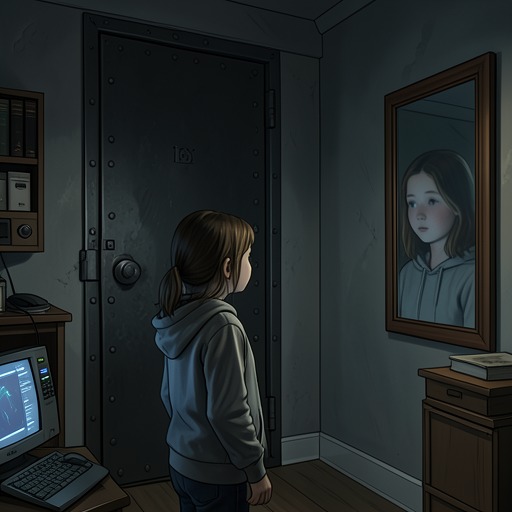
Timeline Reset and Branching
RETimeline reset and divergence is the governing paradox of Tabitha Moore’s story: returning to 1998 gives her a second chance to alter the life she remembers, but every alteration threatens to erase the relationships and hard-won understanding that made that second chance meaningful. The mechanism turns time travel into both rescue and punishment, forcing Tabitha to live through an apparently repeated adolescence while carrying memories that belong to another body, another future, and possibly more than one timeline.
The First Displacement and the Recognition of 1998
Tabitha’s temporal crisis begins when the prototype MRI machine in 2045 malfunctions. She recognizes the machine as the same device involved in the earlier disaster and realizes that it has sent her mind back forty-seven years, to the children’s hospital in 1998. The recognition is not abstract: a doctor identifies the date as May seventh, 1998, while Tabitha stares at the small, chubby hands of her thirteen-year-old body. Her father, Alan Moore, is alive; her mother, Shannon Moore, is presumably alive; and the adult life she had just inhabited has been replaced by a childhood she believed was finished.
The reset therefore joins historical knowledge to bodily estrangement. Tabitha remembers herself as a sixty-year-old woman in 2045, yet must occupy the “fat” adolescent body she had spent decades hating. Her first reaction is not wonder but dread. She fears that the MRI has merely damaged her brain and that the apparent return is a death seizure, but the date and physical evidence make the past increasingly difficult to dismiss. The temporal rupture is also an emotional reversal: the living parents she had lost to time are suddenly present, while the adult self, habits, and accumulated life she knows are inaccessible.
Repetition, Loss, and the Second Reset
The later reset reveals that the first return did not produce a stable, singular replacement history. After the altered course of events, Tabitha is killed, or believes she is killed, when Erica Taylor attacks her with a baseball bat at the Halloween party. She wakes again in the MRI in May 1998, back at the beginning. In her account, the second start is confirmed by the same impossible temporal pattern: after blacking out on the floor of the Williams family lake house, she finds herself once more in the hospital and once more inside the younger body.
This repetition is more devastating than the original displacement because Tabitha now knows what can be lost. In the previous version of events, she developed friendships with Alicia Brooks and Elena Seelbaugh and worked through an unusually difficult relationship with Shannon Moore. The reset removes those achievements as lived history. Alicia and Elena do not remember the experiences that made them friends, and Tabitha understands that she cannot simply reproduce the same intimacy by following a formula. The altered timeline has transformed friendship into evidence of divergence: the smallest changes can prevent a relationship from arising, while deliberate attempts to recreate it feel morally and emotionally wrong.
The repeated return also produces a crisis of endurance. On the school bus and at Laurel Middle School, Tabitha sees the familiar setting not as a beginning but as a sentence. She wonders whether she can survive the same sequence a third time and anticipates severe clinical depression, because foreknowledge cannot protect her from the pain of losing people again. Her despair is sharpened by the possibility that she was violently murdered in the prior timeline. A blow to the temple appears to end a life instantly, yet the reset makes death both final within one history and strangely reversible across histories. The result is not reassurance but terror: if death can restart the story, existence becomes a cycle from which neither knowledge nor suffering guarantees escape.
Divergence and the Butterfly Effect
Tabitha later explains to Alicia Brooks and Elena Seelbaugh that the second timeline did not merely repeat the first. Tiny differences escalated into major consequences. After she was pushed on the bus loop and suffered a fracture, she confronted realities about herself that she had previously avoided. She began to tell the truth, including information about Ashlee Taylor’s bruises, when a school-board representative came to discuss her withdrawal from school. The disclosure apparently led to Ashlee’s removal from her family while the abuse was investigated.
That intervention changed the danger surrounding the Halloween party. Erica Taylor panicked and went to the party where Tabitha was expected to be, although Elena acknowledges that Tabitha was not actually supposed to attend and that Elena had mistakenly told others she would. In this version of events, Tabitha’s attempt to protect Ashlee helps produce the circumstances that place her in Erica’s path. The divergence thus refuses a simple moral equation in which good action automatically yields safety. Tabitha’s confession is an act of responsibility, but its consequences spread through the social network and alter who is present, who is exposed, and who becomes vulnerable.
The same process affects public interpretations of Tabitha’s earlier rescue of Officer Darren MacIntire. In one timeline, schoolgirls claim that Matthew Williams asked Tabitha out and kissed her after driving her to Louisville to visit his injured father; Tabitha knows that this never happened in her remembered version and suspects that other people are confusing Officer MacIntire with Officer Williams. The discrepancy demonstrates how divergence changes not only events but also the stories characters tell about them. A rescue can become rumor, romance, fraud, or public suspicion depending on which timeline supplies the surrounding facts.
The Boundary Between History and Dream
The second reset eventually becomes inseparable from uncertainty about what counts as a timeline and what belongs to a dream. Tabitha experiences nosebleeds, migraines, and what she believes was an aneurysm while speaking with Shannon Moore. Reality seems to stutter, and she describes the aftermath as a dreamlike “making-of” montage rather than a continuous return. She remembers sitting in a Perkins restaurant from the future and speaking with her friend Julie, being chased through an endless parking-lot nightmare by girls who bullied her in middle school and high school, and escaping in a junkyard F-22 fighter jet.
Tabitha believes that the fighter sequence may have carried her back to 2045, where hospital staff were trying to remove her from the failing MRI, but she cannot distinguish certainty from interpretation. She admits that she does not know which experiences were dreams and which were genuine temporal events. Her uncertainty is structurally important: the narrative gives the reader a branching temporal model without granting an authoritative map of every branch. Even Tabitha’s strongest conviction—that the timeline truly restarted—exists alongside the possibility that hemorrhage, trauma, and dream imagery distorted her account.
The image of the F-22 makes the instability physical. As Tabitha plunges through darkness, a small hand catches hers; she watches the fighter fall away and glimpses a sixty-year-old body going still inside the MRI cockpit. The scene offers an apparent return to the original future, but it does not settle whether that future is restored, imagined, or merely witnessed from a collapsing consciousness. The hand that saves her prevents a final disappearance without explaining the rules of the world that contains her.
Meaning, Responsibility, and Unfinished Escape
Timeline reset and divergence gives the novel its central ethical pressure. Tabitha’s future knowledge allows her to recognize dangers and act earlier, especially in relation to Ashlee Taylor, but knowledge also makes every consequence more painful. She cannot treat the past as a fixed script because her interventions produce new outcomes; nor can she treat each new outcome as wholly free of the earlier history, because memories, guilt, and bodily damage continue to cross the temporal divide.
The mechanism also converts confession into a form of temporal repair. After Mrs. Cribb asks why the bullying girls seemed to hate Tabitha with such unusual intensity, Tabitha realizes that she must finally reveal what she did to the childhood friend she abandoned. She has carried that guilt for forty-seven years, and the recurrence of the injury beneath her cast becomes a physical reminder that the past has not been escaped merely because the calendar changed. With Alicia’s support, she identifies a concrete next objective: find Ashlee Taylor, help her, apologize, and ask forgiveness. The reset therefore does not erase responsibility; it gives responsibility another route toward action.
The ending remains deliberately unresolved. Tabitha may have returned to 2045, may have died there, may have been drawn into another timeline, or may have passed through a hemorrhage-induced dream before hearing Hannah MacIntire call to her. What the repeated resets establish with certainty is not a complete cosmology but a changed relation to time. The past is no longer a closed record, and the future is no longer a secure destination. Between them, Tabitha must act under conditions of partial knowledge, carrying the grief of erased friendships and the obligation to make different choices even when no branch can guarantee survival.