The Burden of Future Knowledge
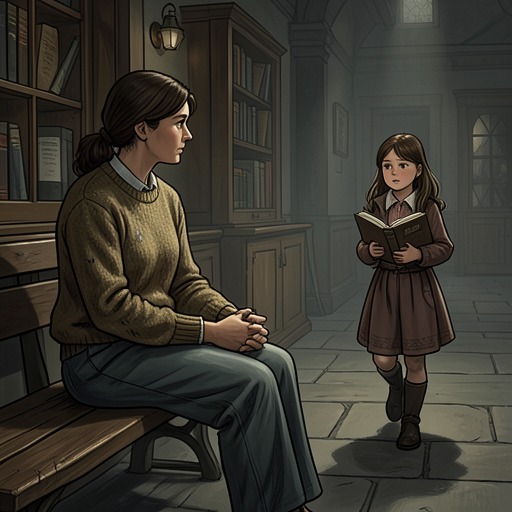
REThe Burden of Future Knowledge names the central paradox of Tabitha Moore’s second chance: knowledge of what once happened gives her the power to intervene, but every intervention makes the remembered future less dependable. Her memories promise orientation while steadily destroying it. The result is not mastery of time but an unstable existence between an adult life already lived and a thirteen-year-old identity she is forced to inhabit again.
Origin in Time Displacement
The burden begins when Tabitha recognizes that the prototype MRI machine has returned her mind to 1998. She remembers the machine from 2045 and realizes that she herself had been inside the earlier device when it malfunctioned forty-seven years before. The recognition joins the two timelines through a personal wound: the impossible event is not distant history but the explanation for her own presence in the past. At the same time, the knowledge carries immediate emotional devastation. Her father, Alan Moore, and her mother, Shannon Moore, are alive again; her body is once more that of an overweight adolescent; and the life she had already endured seems to await her from the beginning.
The first return therefore produces knowledge without comfort. Tabitha fears that the experience may be a fatal brain event rather than time travel, and she resists the prospect of becoming the self she remembers hating. The physical setting reinforces the uncertainty: the MRI’s violence, the blackout, smoke, and the catastrophic electrical failure make the event resemble both technological accident and supernatural displacement. Later, after another collapse, she sees a sixty-year-old body inside the falling Dream F-22 while a small unseen hand catches her in darkness. The image leaves the boundaries between bodily death, temporal passage, and hallucination deliberately unstable.
Knowledge Undermined by the Butterfly Effect
Tabitha initially possesses a vague map of future events, but the map becomes less useful whenever she acts. Her rescue of Officer Darren MacIntire, her involvement in other people’s crises, and her attempts to alter the social and family circumstances surrounding her create consequences that were absent from the life she remembers. The rumors about Matthew Williams make this problem personal: classmates claim that Matthew asked Tabitha out, kissed her, and drove her to Louisville to visit his injured father, even though none of those events occurred in the life she recalls. Tabitha cannot tell whether the rumor confuses Officer MacIntire with Officer Williams or whether the altered timeline has generated a genuinely new relationship.
These discrepancies turn future knowledge into a source of vulnerability. Tabitha calls the unexpected changes “butterfly effect” surprises because each small ripple can spread outward until her remembered history loses authority. Lisa Moore’s sudden return is especially destabilizing: it is not merely an unwelcome family development but proof that the future is no longer unfolding according to the sequence Tabitha believes she knows. As divergence accumulates, she fears that her memories will cease to describe the world around her and become only remnants of a hypothetical timeline.
The Psychological Cost
The knowledge produces a severe identity crisis because Tabitha must use an adult consciousness inside a child’s body while living through a childhood that is both familiar and unprecedented. She understands that thirteen should be a period of transformation, yet her own transformation runs backward: adulthood has become her past, while childhood has become the uncertain present. Rational intelligence cannot fully control the emotional regression created by that reversal. The gap between what she knows and what she feels repeatedly overwhelms her decisions.
Her physical injuries intensify the doubt. Puberty, rapid weight loss, malnutrition, a head injury from the Taylor family’s trampoline assault, a fractured wrist from school violence, and renewed head trauma at the Halloween party leave her wondering whether the memories of the future are actually symptoms of brain damage. Stitches and a shaved patch of red hair become visible reminders that the body carrying her knowledge remains injured, adolescent, and medically vulnerable. The more extraordinary her memories become, the more plausible it seems to her that they might be hallucinations caused by trauma.
The crisis reaches its bleakest formulation when Tabitha imagines the loss of all temporal authority. If the altered timeline eventually bears no meaningful relation to the future she remembers, she will no longer be a person from the future with useful information. She will be, in her own fearful description, merely a thirteen-year-old with irrelevant knowledge and added instability. Future memory thus threatens the identity it was supposed to preserve: it prevents her from being simply Tabitha Moore in the present, but cannot guarantee that the older Tabitha Moore still exists as a reliable self.
Ethical Responsibility and Agency
Future knowledge also imposes moral obligations. Tabitha cannot passively watch a known tragedy occur once she understands that intervention could save someone. She later explains that Officer MacIntire would have died if she had done nothing, and that this possibility made inaction morally unacceptable. Her knowledge therefore functions less like a privilege than a demand. To know what is coming is to become implicated in the consequences of refusing to act.
Yet intervention exposes an ethical contradiction. Tabitha recognizes that many events in the revised timeline were neither deliberately caused nor entirely accidental. By entering situations, defending herself, seeking connection, and trying to help others, she exercises agency in places where the earlier version of her life might have remained unnoticed. She compares this to placing a hand in flowing water and then objecting when the current forms ripples. The metaphor captures both her guilt and her insight: she understands that changing history makes her responsible for disturbance, even when the original current was unjust.
Her conflict is especially sharp around social visibility. Tabitha wants to be attractive, popular, and noticed, but she also wants the protections of remaining detached from social life. She sees the resulting bullying and conflict as connected to her attempt to have both recognition and isolation without fully building a place among other people. The burden of knowledge therefore merges with the burden of choice. Knowing a possible future does not tell her how much of that future she is entitled to prevent, or whether a better outcome can be pursued without producing new harm.
Family, Loss, and the Limits of Knowing
The return of Shannon Moore makes future knowledge painful rather than consoling. At Thanksgiving, the family celebrates Shannon’s return, and Samuel Moore and Aiden Moore cling to her with joy. Tabitha alone knows that Shannon previously abandoned her children and that her return is tied to money rather than restored devotion. She wishes she could forget this knowledge because it isolates her from the happiness shared by everyone else. The event demonstrates how memory can become a barrier to family reconciliation: the others experience reunion, while Tabitha experiences the return of a future betrayal.
Her uncertainty finally drives her toward Karen Williams for help after she steals Lisa Moore’s purse and leaves home. Outside the Williams residence, the tidy lawns, mailboxes, shrubs, and white picket fence appear orderly but oppressive, as if the setting demands silence and obedience. Tabitha wonders whether calling Mrs. Williams is truly the right action and admits that her previous life offered little practice in confronting conflict. Knowledge of what people may become has not made her emotionally prepared to manage the present.
Karen Williams responds by sheltering her rather than judging her. After Tabitha breaks down, Karen changes her clothes, tucks her into Matthew Williams’s room, and treats her with the care she would give Hannah MacIntire. Karen also names the accumulating disasters: the shooting, the broken wrist, persistent bullying, the Halloween attack, and the latest crisis. Tabitha answers that another life might have allowed these events to pass unnoticed, but that her choices disrupted their ordinary resolutions. Her confession turns future knowledge into a form of testimony. She is not only predicting events; she is trying to explain what it means to live among consequences that she remembers and has helped reshape.