Lisa Moore's Heroin Use and Possession
RELisa Moore's Heroin Use and Possession is the crisis that turns Lisa Moore's destructive return to the Moore household into an immediate danger to children and a matter for police intervention. Tabitha Moore finds Lisa using drugs in the bathroom, takes the suspected heroin and associated implements, and carries them to Karen Williams as proof. The episode exposes the physical reality of Lisa's addiction while also revealing the limits of acting alone: Tabitha protects her family, but by removing the evidence herself, she may have weakened the possession case against Lisa.
Discovery in the Bathroom
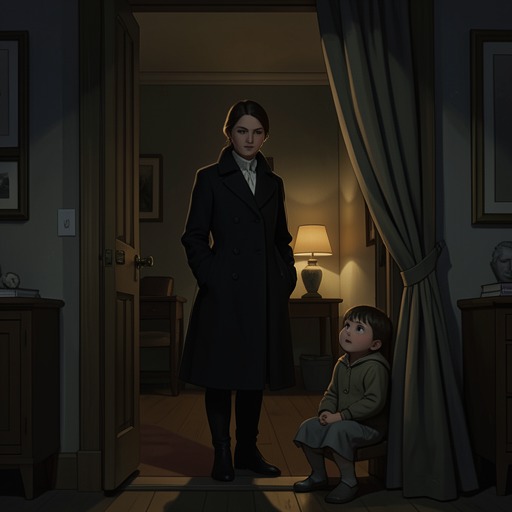
The discovery is staged as a deliberate nighttime intervention. After Lisa Moore has spent nearly half an hour in the bathroom and starts the shower, Tabitha Moore waits in darkness with a flathead screwdriver from the kitchen's junk drawer. She has only one good hand, yet she quietly opens the locked bathroom door while the shower noise masks the small sound of the tool against the doorknob. The action is neither an accidental observation nor a passive witnessing; Tabitha has already decided that the timing of the shower gives her the opportunity to find out what Lisa is hiding.
Lisa's purse lies open and unattended on the counter. Beside it are a faded Batman thermos, a disposable lighter, a blackened spoon, and a syringe. The ordinary objects have become suddenly conspicuous: the thermos, apparently borrowed long ago from one of Lisa's sons' lunch boxes, is no longer a harmless household container, while the spoon and lighter form a recognizable preparation apparatus and the syringe supplies the most immediate sign of injection. Tabitha also notices a puncture mark at Lisa's vein. The scene converts domestic space and familiar possessions into visible evidence of addiction.
Lisa Moore pulls back the shower curtain just as Tabitha Moore picks up the syringe and places it in the open purse. Tabitha then adds the spoon and lighter, before putting the Batman thermos inside as well. She feels something shift within the thermos; it does not seem to contain liquid, but rather clumps resembling dirt. Tabitha believes the substance is heroin, although she knows at that moment that she cannot verify it herself. Lisa's reaction is immediate and violent in its intensity: she shouts from the shower, tears curtain rings from the rod, and lunges at Tabitha after emerging naked from the bath. The confrontation makes the objects physically dangerous as well as evidentiary, because recovering them means provoking the person who has guarded them.
From Suspicion to Confirmed Heroin
Tabitha escapes with Lisa's purse and brings the contents to Karen Williams, but she presents her account with an unusual degree of caution. She says Lisa was shooting up heroin in the bathroom and that she has the evidence, yet she admits that she cannot be certain without professional confirmation. Her reasoning rests on several concrete observations: the puncture mark, the thermos filled with an unidentified substance, the syringe, the lighter, and the blackened spoon used to heat something. The distinction between what Tabitha believes and what she can prove gives the episode a legal and ethical tension beyond the family emergency.
Tabitha explains that obtaining the objects was difficult because Lisa would not let the purse out of her sight. Lisa even slept with it tucked beneath her. For Tabitha, that possessiveness reinforces the conclusion that the purse contains a drug supply rather than ordinary belongings. She also links the discovery to Lisa's treatment of her children. Lisa has struck her eight-year-old son across the face during the family's early Thanksgiving dinner, and that act becomes the point at which Tabitha decides that observation and private fear are no longer enough. She tells Karen that Lisa must be kept away from the Moore family and from her children.
Karen Williams initially reacts with disbelief and alarm. She brakes the car when Tabitha names heroin, because the drug seems incompatible with the respectable small-town image Karen associates with Springton. The revelation forces Karen to recognize the darker conditions concealed within the low-income neighborhood and the gap between public familiarity and private crisis. Her shock is not only about Lisa; it is about how easily a community can mistake a charming daytime appearance for knowledge of the people living inside it.
At Karen Williams's house, Tabitha Moore lays out the recovered objects on the dinner table. She places the faded Batman thermos on napkins and then removes the disposable lighter, blackened spoon, and used syringe one at a time. The arrangement resembles an improvised exhibit: ordinary household goods and personal effects sit beside the objects that may establish criminal possession. The physical display makes the accusation difficult to keep abstract, and it draws the household into the emergency before a police officer arrives.
Officer Williams eventually examines the spread, including Lisa's purse, wallet, cigarettes, makeup, and other personal belongings. He unscrews the thermos and inspects its contents. His conclusion confirms Tabitha's central suspicion: the substance is heroin. The confirmation transforms Tabitha's interpretation into an identified drug, but it does not resolve the procedural problem created by her intervention.
The Evidence Problem
Officer Williams tells Tabitha Moore that the good news is that she was correct about the thermos. The bad news is that taking the evidence away from Lisa Moore has placed the case in a difficult position. If the officer had caught Lisa with the heroin, possession charges would have had a clearer foundation; because Tabitha removed the material first, the police may have to find a way to make the charge stand. The episode therefore separates moral certainty from legal sufficiency. Tabitha has discovered a genuine danger, but the manner in which she responds may prevent the evidence from functioning as simply as she hopes.
This complication reflects a recurring pattern in Tabitha's time-displaced life. She remembers crises that once passed without effective intervention and tries to correct them before they become irreversible, but foreknowledge encourages her to act outside ordinary procedures. Her action is driven by the need to protect children and secure proof, yet the same urgency contaminates the chain of possession. The Batman thermos, syringe, spoon, and lighter are materially persuasive, but their route from Lisa's bathroom to Karen Williams's table has become part of the legal question.
The episode also places the question of responsibility across several levels. Lisa Moore is responsible for possessing and apparently using heroin in a home shared with children. Tabitha Moore assumes responsibility for stopping the immediate danger, despite being a thirteen-year-old with a broken hand and only one good hand available for the theft. Karen Williams becomes the adult witness who contacts her husband, and Officer Williams becomes the authority who can identify the substance and assess the possibility of charges. The response develops from private discovery to communal witnessing and finally to institutional judgment.
Family Breakdown and Consequences
Lisa's heroin use is not isolated from the wider Moore family collapse. Her return has already intensified conflict inside the mobile home, and the drug discovery gives Tabitha a concrete reason to resist treating Lisa's presence as merely an unpleasant family complication. The evidence links addiction to neglect, violence, and the vulnerability of Lisa's sons. Lisa's alleged use is especially threatening because it occurs in a shared bathroom, within reach of children, while she keeps the drug-related objects close enough to sleep on the purse containing them.
The episode's consequences extend beyond the immediate police consultation. The recovered materials become the basis for seeking Lisa's removal from the household and protection for her children, even though Officer Williams warns that the possession case may be difficult. The family must therefore confront two different questions: whether Lisa has heroin, and whether the adults around her are prepared to act on that fact. Tabitha's decision forces the second question into the open.
The surrounding institutional conflicts reinforce the same concern with evidence and adult accountability. Elsewhere, the Springton school board's Pamela Cribb rejects the claim that the harassment investigation is resolved and returns Tabitha's blue binder after identifying Clarissa Dole as the thief; Clarissa is suspended pending an expulsion hearing, along with Chris Thompson, Kaylee Mendolson, Brittney Taylor, and Erica Taylor. These school proceedings provide a parallel in which testimony, recovered objects, and disciplinary action must be translated into institutional consequences. In both situations, private harm becomes actionable only when someone produces a material or verbal account that adults cannot comfortably ignore.
The heroin discovery also echoes Tabitha's earlier reaction to Jeremy Redford's death. After the South Main Shooting, she understands that her intervention altered the fate of a shooter who had previously remained a faceless plot device in her memory, and she is sickened by the realization that her actions helped produce his violent end. With Lisa, the moral burden is different but related: Tabitha again acts on knowledge carried from another life, then must face the consequences of changing events rather than merely remembering them. Her intervention is protective, but it is not clean. It saves the family from passivity while entangling Tabitha in the uncertain ethics of force, secrecy, and improvised justice.
Narrative Significance
Lisa Moore's Heroin Use and Possession makes addiction visible through objects that cannot easily be explained away. The syringe, spoon, lighter, and Batman thermos move from concealed domestic items to seized proof, changing their status as they pass between Lisa, Tabitha, Karen Williams, and Officer Williams. Their material presence drives the plot: they reveal the hidden activity, prompt the confrontation, bring adults into the crisis, confirm the substance, and simultaneously create the evidentiary weakness that complicates prosecution.
The event is also a test of Tabitha Moore's developing identity. She has returned to the past determined to repair what she failed to repair before, but repair requires more than knowing that a crisis exists. It requires choosing when to intervene, whom to trust, and how much risk to accept. Tabitha's action shows courage and practical intelligence, but the damaged chain of evidence prevents the narrative from presenting her as an uncomplicated savior. Her knowledge gives her a head start; it does not give her institutional authority or immunity from consequences.
For the Moore family, Lisa's heroin use marks a point at which estrangement, poverty, domestic violence, and substance abuse converge. The family cannot preserve the appearance of ordinary Thanksgiving or ordinary domestic life once the thermos is opened and the implements are arranged under the household's gaze. The crisis exposes both the danger inside the home and the necessity of a chosen network of witnesses willing to act when blood relatives have failed to protect one another.