Second timeline reboot
REThe Second Timeline Restart is the second major temporal rupture experienced by Tabitha Moore: after dying or apparently dying during the altered 1998 timeline, she awakens again inside the prototype MRI machine in May 1998. Unlike her first displacement from 2045, which carried her forty-seven years into the past, this restart rolls her existence back by only six months. Its decisive consequence is not merely chronological. It erases the visible and emotional evidence of the life she had rebuilt, including her friendships, her changed body, her orthopedic cast, and the trust developed with people who had once been strangers.
Causes and Temporal Mechanism
The restart follows a chain of trauma, intervention, and bodily collapse. In the altered timeline, Tabitha connects her actions to several consequences she had not been able to prevent or fully understand. She believes that Erica Taylor killed her during the violence at the Williams family lake house, although the surrounding account remains uncertain and entangled with the story’s unstable boundary between physical events, memory, and surreal experience. Tabitha later explains to Alicia Brooks and Elena Seelbaugh that she blacked out on the lake-house floor and then began the timeline again from the moment she woke in the MRI in May 1998.
Her explanation is tentative rather than mechanically authoritative. She recalls continuing nosebleeds, intense migraine episodes, and what she believes was an aneurysm that killed her during a conversation with her mother, Shannon Moore. Reality then seemed to stutter, shifting into a strange sequence involving a Perkins restaurant, a conversation with Julie, pursuit through an endless parking-lot nightmare, and a junkyard F-22 fighter jet. In that account, the temporal restart is presented as both a possible physiological consequence of previous damage and a surreal transition whose rules remain inaccessible. The narrative therefore asks the reader to accept an impossible recurrence without reducing every image within it to a stable scientific explanation.
The temporal pattern also reframes Tabitha’s first displacement. In 2045, she had already recognized the MRI as the same machine involved in the earlier accident and understood that its malfunction had sent her mind back forty-seven years to 1998. The second restart makes that first return incomplete rather than singular: the past is no longer a destination reached once, but a site that can be reopened, repeated, and damaged again. The precise interval of six months gives the event its particular cruelty. Tabitha does not lose an unknowable lifetime; she loses a recently lived version of the present whose individual moments have become indispensable.
The MRI Incident and Immediate Reset
The restart begins in the Emsie St. Juarez Pediatrics ward when the prototype MRI machine emits a piercing mechanical shriek. The sound rises in pitch and volume until it becomes physically painful, then stops with the blowing of the electrical breaker. The failure cuts power across Jefferson County, while smoke pours from the machine and the fire alarm activates. The incident is therefore both intensely local and broadly disruptive: an enclosed medical procedure becomes a public electrical emergency.
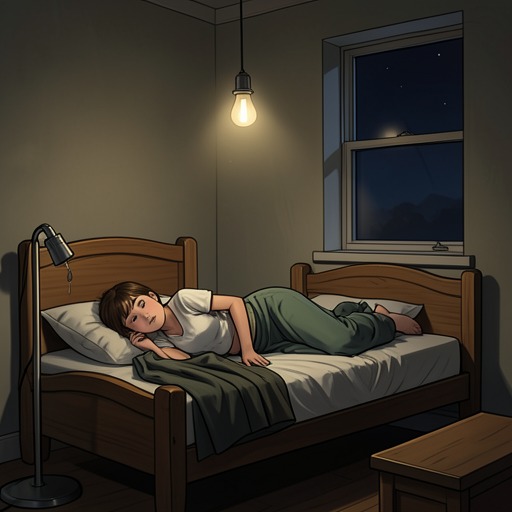
Thirteen-year-old Tabitha lies motionless inside the device as backup power returns. She has only just begun recovering from the head trauma associated with the previous crisis, and her perception still carries the image of blood falling onto the floor of the Williams family lake house. When she looks at her hands, she recognizes the small, overly plump body of her earlier life. The narrative marks the recognition with a blunt temporal verdict: she is back at the beginning again.
Mr. Moore’s arrival repeats the emotional choreography of the previous timeline. A technician enters through the copper-lined shielding, followed by an angry Alan Moore, who demands that Tabitha be removed from the machine. The repeated words and repeated rescue make the reset feel less like a new event than a forced reenactment. Yet the repetition is not identical in its meaning. The first awakening offered Tabitha the shock of discovering the past; the second awakening confronts her with the possibility that no achievement within that past can remain secure.
Her body provides the most immediate proof of what has been lost. The blue orthopedic cast decorated with Alicia’s artwork and signed by her close friends has vanished. The wrist and hand beneath it are unbroken. The lean muscles produced by Tabitha’s summer training and weight-loss transformation have also disappeared, replaced by the soft, doughy body she had previously despised. Although the physical reversal is described as the least important of her losses, it becomes a visible symbol of the restart’s totality: the machine has not simply moved her through time; it has restored an earlier version of her circumstances.
Loss, Repetition, and Psychological Consequences
Tabitha’s reaction is an acute breakdown rather than a moment of strategic adaptation. She sobs inside the hospital gown, struggles to accept that her experiences have been taken from her, and cannot bear the thought of rebuilding them. During the ride home, the six months lost in the restart weigh more heavily than the forty-seven years lost during her original displacement. The shorter interval is more devastating because she now knows exactly what those months contained and how unlikely their precise combination of accidents and encounters is to occur again.
Alan Moore’s concern cannot penetrate her shock during the journey home. At Sunset Estates, he embraces her beside the family mobile home, and she continues crying against his shoulder until sunset. The gesture offers immediate physical comfort, but it cannot restore the erased timeline. The restart thus exposes a limit to familial rescue: Alan can receive her grief, but he cannot make the lost relationships and events happen again in their original form.
The next morning, Tabitha goes to school rather than avoiding it, but the decision reflects exhaustion and resignation more than recovery. She eats stale generic-brand Apple Jacks without milk because the Moore family does not appear to keep milk in the refrigerator, then boards the bus in her restored body, unnoticed by the other middle-school students. The ordinary details of breakfast, transport, and social invisibility intensify the temporal horror. The world proceeds as if nothing has happened, while Tabitha alone remembers a future that has been annulled.
On the bus, she compares the two losses. At sixty, she had left behind acquaintances rather than deeply rooted friendships, and she had not been separated from a beloved pet or significant other. This time, she has lost the friendships she built with Alicia Brooks and Elena Seelbaugh, the difficult progress made with Shannon Moore, and the circumstances through which those connections became possible. Her foreknowledge now appears less like protection than an unbearable burden. She fears that repeated resets will produce a time loop and drive her into severe clinical depression, because knowledge cannot preserve people when the causal path that brought them together has been erased.
Responsibility and Retrospective Disclosure
The second restart changes the meaning of Tabitha’s earlier actions by placing them inside a cycle of attempted correction and unintended consequence. She feels responsible for Jeremy Redford’s death after her intervention causes his white Lincoln Continental to be identified and pursued by the Springton Police Department. The police chase ends when a cruiser T-bones the car, and Redford is killed after emerging and firing at officers. Tabitha’s guilt comes partly from recognizing that she had treated the shooter as a plot device in her previous life rather than as a person, only to discover that altering events has made his death more immediate and morally troubling.
The same burden appears in her failure to anticipate Danny Moore’s arrest. Although she remembers that Uncle Danny would be arrested for stealing roughly thirty thousand dollars’ worth of IBM, Compaq, and Toshiba computers from behind the Sandboro Mall’s Service Merchandise department store, she misses the opportunity to prepare for the news because her parents do not tell her. The recurrence of events is therefore uneven: some remembered facts remain inaccessible until they happen, while others change in their consequences because Tabitha intervenes. The restart turns this imperfect knowledge into another source of helplessness.
It also forces Tabitha toward disclosure about Ashlee Taylor. When Pamela Cribb investigates why the girls bullying her displayed such intense hostility, Tabitha confronts the guilt of having abandoned a childhood friend forty-seven years earlier. She remembers seeing fresh bruises over older ones, recognizing that Ashlee was being beaten and feared Erica Taylor and Brittney Taylor, and recalling the trampoline incident in which Erica and Brittney shoved her. They threatened to make Ashlee’s life unbearable if Tabitha spoke, and the thirteen-year-old Tabitha remained silent because she believed adults would give the Taylor sisters’ words more weight than hers. The second restart does not erase that moral injury; it makes the old silence newly actionable.
Narrative Significance and Uncertain Afterlife
The Second Timeline Restart converts the premise of a second chance into a structure of repetition compulsion. Tabitha initially returns to 1998 with the hope that future knowledge will allow her to repair family damage, prevent violence, and escape the identity she associates with poverty and self-hatred. After the restart, the same knowledge becomes evidence that repair is provisional. Friendships with Alicia Brooks and Elena Seelbaugh, reconciliation with Shannon Moore, physical training, and the trust of people who had witnessed Tabitha’s courage all prove vulnerable to a machine whose operation she cannot control.
The event also destabilizes the hierarchy between fact, memory, and dream. Tabitha’s account includes concrete medical symptoms and the MRI’s physical failure, but it also includes an aneurysm, a reality that seems to turn into a film-making-of sequence, a nightmare pursuit, and a fighter jet in an impossible void. Earlier, a small hand catches her as she falls while the dreamlike F-22 disappears beneath her, leaving the boundary between death, temporal displacement, and hallucination unresolved. The restart is consequently not a puzzle with every mechanism clarified; it is a narrative condition that demands acceptance of recurrence, partial memory, and contradictory levels of reality.
Its deepest significance lies in the difference between chronological reversal and lived loss. Tabitha is returned to the body and circumstances of a thirteen-year-old, but she is not returned to innocence. She carries the emotional knowledge of friendships that no longer exist, harms she failed to prevent, and choices whose consequences have become morally complicated. The reset grants her another beginning while denying the possibility of beginning unchanged. That contradiction defines the event’s lasting force: the past can be revisited, but the person who revisits it has already been formed by everything the reset removes.