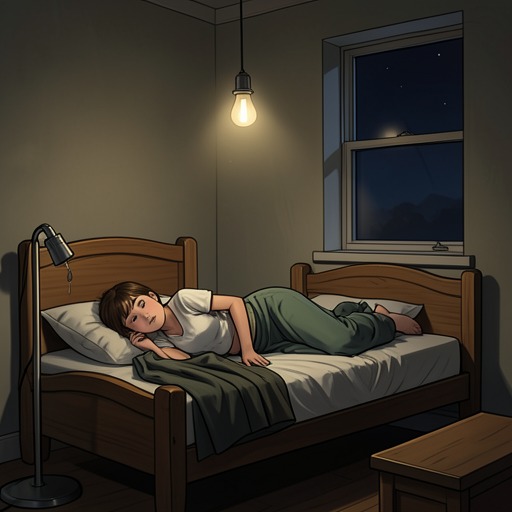
Tabitha awakens from brain death
RETabitha Moore awakens after being declared brain dead, reversing a death sentence that her family and doctors had accepted as final. The event is not a simple recovery: it begins with Hannah MacIntire recognizing that Tabitha is still reacting, moves through a frantic bedside attempt to keep contact with her, and ends with Tabitha conscious but weak, in severe pain, confused by memories of violence and temporal dislocation. Her return transforms death from an ending into an unstable threshold and establishes the long, difficult convalescence that follows.
The Medical Verdict and Hannah’s Doubt
Tabitha’s awakening occurs after doctors have declared her brain dead and placed her in a permanent vegetative state. She has already been removed from life support, and the Moore family has been spending what they believe are her final days at the hospital, waiting for her to die quietly. Her outward condition appears to support that conclusion: for several days she has lain peacefully, with only head bandages suggesting the severity of her injuries.
Hannah MacIntire is the first person to challenge the accepted explanation. When she sees Tabitha’s face become troubled, Hannah calls for her mother and insists that Tabitha is having a nightmare. Sandra MacIntire initially reassures her that Tabitha cannot dream because she has no brain activity and will never wake again. She presents the girl’s stillness as peaceful rest, comparing it to Sleeping Beauty, but Hannah notices what the adults have discounted: Tabitha reaches for her hand. Hannah’s insistence is therefore not abstract hope. It is a response to physical contact and visible distress that the medical interpretation has failed to explain.
The Moment of Return
Sandra freezes when she looks more closely. Tabitha is no longer serene. Her body jerks, her brow furrows, her eyes squeeze shut as if she is in pain, her breathing accelerates, and her trembling lips form a plea for help. The change turns the room’s emotional logic inside out. What had been treated as the calm prelude to death now resembles an active struggle to return.
Hannah keeps hold of Tabitha’s hand while Sandra runs into the hallway to find assistance. She urges Tabitha to wake and gently shakes her, repeating the request as Tabitha’s eyelids flutter and her body stirs on the hospital bed. Hannah’s hand becomes the immediate bridge between the supposedly absent consciousness and the people waiting beside the bed. The scene makes recognition reciprocal: Hannah identifies the signs of life, and Tabitha’s movement answers her before Tabitha can speak.
The actual reawakening is harsh rather than miraculous in any comfortable sense. Tabitha is roused with smelling salts and jolts into awareness with her sinuses burning. Bright light, blurred faces, exhaustion, stiffness, and a terrible pain radiating from her temple make consciousness itself feel like an ordeal. Three people crowd around her, while the emotional voice of an unfamiliar woman competes with Hannah’s smaller, recognizable voice. Tabitha can barely organize what she sees, much less sit up or speak.
Recognition, Pain, and Medical Confirmation
Hannah’s voice gives Tabitha the first stable point in the returning world. Tabitha recognizes her and internally understands that she has come back to the life she wanted, the life connected with the people she knew in only one lifetime. That recognition carries emotional force, but her body can express almost none of it. When she says Hannah’s name, the word emerges as a breathless sigh, and speaking requires so much effort that she feels close to blacking out again.
The adults and the doctor treat the utterance as decisive evidence that Tabitha’s faculties are returning. The woman with Hannah reacts that Tabitha has recognized her daughter, while the male voice insists that the girl not be overwhelmed. Tabitha’s parents have been contacted and are on their way, but the immediate medical priority is pain control and assessment. Tabitha reports that it hurts, then rates the pain as six and says it is moving toward seven. The escalating number gives measurable form to a consciousness that is otherwise fragmented and barely audible.
The doctor confirms the extraordinary stakes of the reversal: Tabitha has been legally dead for two days. He tells her that she is lucky and notes that she will possess an unusual death certificate, while asking whether she knows where she is and what she remembers. Tabitha identifies Springton General Hospital, demonstrating enough orientation to answer the place question. The doctor’s confirmation makes the event more than a mistaken observation by a child; it establishes that Tabitha has crossed back from an officially recorded condition of death.
Fragmented Memory and the Cost of Survival
Tabitha’s memory of the preceding experience is not orderly. Asked for the last thing she remembers, she gives the restrained answer that it involved violence and pain, choosing not to disclose everything. Internally, however, her recollections include smashing her head against the prototype MRI machine at University of Louisville Hospital in 2045, escaping memories or nightmares through the dream of an F-22 fighter jet, being pursued by the Taylor girls through an endless parking lot, and speaking with Julia. She also senses that another timeline had begun and suspects that brain bleeding or related damage disconnected her from it.
This withheld answer creates a sharp division between what Tabitha knows and what she can safely tell the people around her. Her spoken account is minimal, while her consciousness remains crowded with possible timelines, dreams, injuries, and uncertain memories. The event thus presents awakening as a return burdened by knowledge rather than a clean restoration. Tabitha has recovered the ability to recognize Hannah and locate herself in the hospital, but she has not recovered a coherent explanation of what happened to her.
When her pain reaches seven and threatens to become eight, the doctor stops the questioning and administers morphine. The drug quickly suppresses the sharp agony beneath overwhelming drowsiness. Tabitha’s thoughts slow, the conversations around her become distant and fragmented, and the clarity she associates with the preceding dreams gives way to a heavily sedated half-awareness. Survival therefore produces an immediate medical aftermath: she is alive, but consciousness remains intermittent, painful, and dependent on care.
Narrative Significance
The awakening is a reversal of both medical certainty and narrative finality. Tabitha has been treated as someone who can no longer feel, dream, or return, yet Hannah’s attentive witnessing exposes the limits of that judgment. The child’s insistence functions as the scene’s first act of interpretation, while Sandra’s shock and the doctor’s examination convert that intuition into public confirmation.
The event also gives physical form to the story’s recurring conflict between death and renewed life. Tabitha’s legal death is not erased by her recovery; it remains part of her history, represented by the death certificate and by the family’s experience of mourning her while she still possessed an inaccessible inner life. Her return consequently carries the structure of a second chance without the promise of immediate wholeness. The hospital bed becomes a threshold between the life others had declared over and the long convalescence in which Tabitha must learn what her survival means.
As a scene of value reversal, the movement is stark: accepted death becomes uncertain distress, distress becomes contact, contact becomes recognition, and recognition becomes verified consciousness. Yet the final value is deliberately mixed. Tabitha regains life, but she does so with head trauma, extreme weakness, severe pain, fragmented memories, and an unresolved account of temporal experience. The event’s decisive significance lies precisely in that contradiction: awakening defeats death, while opening a new phase defined by bodily damage, medical dependence, and the difficult work of returning to the living world.