Konradin’s Refusal to Acknowledge Hans at the Fidelio Opera
ReunionKonradin’s Refusal to Acknowledge Hans at the Fidelio Opera turns an apparently small social gesture into a decisive exposure of the prejudice governing the boys’ friendship. Before an audience that grants the Hohenfels family instant deference, Konradin sees Hans and chooses not to recognize him. The public slight is followed by a private confrontation in which Konradin explains why Hans has never been welcomed into his home: his mother hates Jews and treats her son’s friendship with one as a stain on the family’s standing.
The Opera and the Entrance
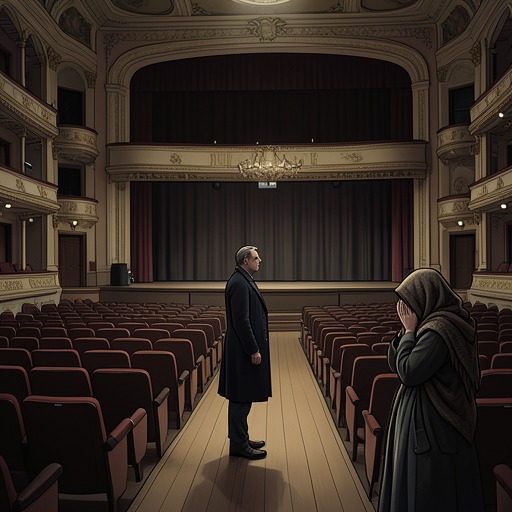
Hans’s mother has obtained a ticket for Fidelio, conducted by Furtwängler. He is seated in the stalls as the violins tune and the audience gathers in one of Europe’s most beautiful opera houses. The president of the Republic is present, yet the crowd’s attention shifts to the entrance of the Hohenfels family. Their arrival makes social rank visible before a word is spoken: the Countess wears black, a diamond tiara, necklace, and earrings, while the grey-haired Count has a diamond-studded star on his heart. Hans recognizes his friend in dinner clothes, now appearing to him as part of this ceremonious family tableau.
The family moves through the theatre as if entitled to command attention. The Countess nods or waves her jewelled hand; the Count inclines his head to acquaintances and to the president, who answers with a deep bow. The crowd makes way. Hans describes the procession as both splendid and ominous: aristocratic authority appears not merely as inherited prestige but as a force that can determine who is seen and who is passed over.
When Konradin looks around before taking his seat, Hans is certain that their eyes meet and that Konradin registers him. Konradin nevertheless gives no sign of recognition. The curtain rises, leaving Hans among the audience in darkness with the distinction between the Hohenfels family and the lesser people around them sharpened rather than resolved. The setting makes the refusal especially public: Hans is not excluded from the opera house, but he is denied acknowledgment within a room where status and visibility are on display.
The Foyer and the Snub
At the first interval, Hans goes to the foyer, a grand room with Corinthian marble columns, crystal candelabra, gold-framed mirrors, cyclamen-red carpets, and honey-coloured wallpaper. He leans against a column and tries to look disdainful while waiting for the Hohenfels family. Yet he also anticipates the encounter as a likely injury and considers escaping before it can happen. His resolve to stay arises from a need to know whether his suspicion is true, even though the answer may cost him his closest friendship.
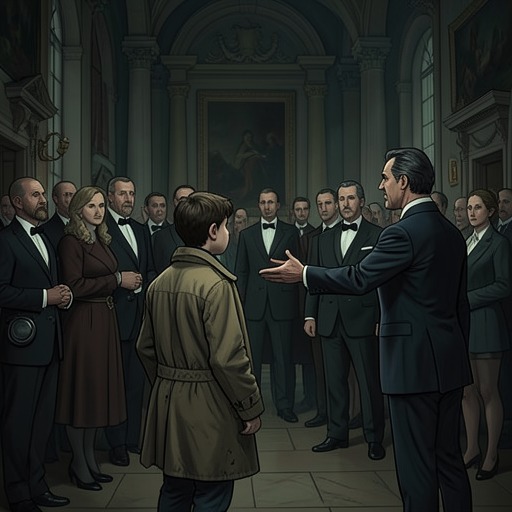
The family approaches abreast, with the Countess in the middle. Hans watches their advance by the dwindling distance between them: ten yards, then five, then four. At the last moment Konradin sees him, smiles, and raises his right hand to his lapel as if brushing away a speck of dust. The small, controlled gesture accompanies the family’s passage without greeting Hans. Its ambiguity does not soften its effect: in the midst of a graceful public procession, Konradin gives his friend only a movement that can pass as nothing at all.
The Count and Countess later return to the foyer without Konradin and continue receiving the spectators’ homage. When the bell rings for the second act, Hans leaves and goes home, slipping straight to bed without being seen by his parents. That night he dreams of two lions and a lioness attacking him and wakes after screaming. The next morning he feels weak, though he goes to school as usual. The dream and his physical depletion register the cost of the encounter without turning it into a public quarrel: the hurt has been carried home and into the next day.
The Question and the Explanation
At school, the two boys initially act as if nothing has happened. Hans keeps his eyes down when Konradin arrives; Konradin arranges his books and pencils without looking at Hans. After the lesson, however, Konradin puts his hands on Hans’s shoulders, a gesture he has not made before, and asks him questions while avoiding the obvious subject of the opera. They walk home together, maintaining their usual appearance for half an hour. Hans understands the silence about the previous evening as evidence that Konradin knows the encounter matters to them both.
As they are about to part at the swinging iron gates, Hans asks why Konradin cut him. Konradin blushes, then goes pale, and first denies the slight, suggesting that Hans imagined it or was oversensitive and saying he could not leave his parents alone. Hans refuses that explanation. He links the opera to a pattern: Konradin has invited him to the Hohenfels home only when his parents were away, and has never introduced him to them. Hans says he wants no social intimacy with them beyond a brief meeting that would let him feel he is not an intruder; he would rather be alone than humiliated. His insistence makes the conflict about dignity as well as loneliness.
Konradin answers that Hans is his only friend and that he has been lonely too. He denies being ashamed of Hans and points to their shared travels and to the fact that their school knows of their friendship. Hans accepts this reassurance but presses the unresolved point: if Konradin is not ashamed, why does he change when his parents are present, and why has Hans been kept from meeting them? The distinction between private affection and public acknowledgment becomes the question the event leaves open until Konradin tells the truth.
Antisemitism Behind the Family Boundary
Konradin explains that he did not dare introduce Hans because his mother comes from a distinguished, once royal Polish family and hates Jews. In the history she inherits, Konradin says, Jews had been treated as lower than serfs and as untouchable. She has never met a Jew, yet fears them; she regards her son’s friendship with Hans as a blot on the Hohenfels escutcheon and believes Hans has undermined Konradin’s religious faith. She also imagines that Hans serves world Jewry, which she equates with Bolshevism, and is plotting to ensnare her son. Konradin says that he has argued with her and had to fight for every hour spent with Hans.
This disclosure changes the meaning of the opera scene without undoing its injury. Konradin says he avoided speaking to Hans because he did not want to hurt him, but his effort to spare Hans has instead left him to interpret a conspicuous rejection alone. His explanation separates personal affection from the mother’s antisemitism while showing how family authority limits the friendship in practice: at home, Konradin cannot or will not make Hans’s place in his life visible.
Konradin describes his father differently. The Count, he says, scarcely cares whom his son meets; as a Hohenfels, Konradin remains a Hohenfels wherever he goes and whoever his companions are. The father’s indifference is qualified by conventional class and marital calculations: Konradin suggests that a Jewish woman might be treated differently as a possible match, especially if very rich, but that his father would still hesitate to hurt his wife’s feelings. The contrast places the mother’s explicit hatred beside a paternal loyalty to aristocratic identity and marriage. The event thus ends not with a reconciliation at the opera but with the source of the division named: Hans’s exclusion is rooted in antisemitism, reinforced by the family’s rank, and negotiated by a friend who privately values him but has failed to acknowledge him when it mattered.