The Schwarz Couple’s Suicide
ReunionThe Schwarz Couple’s Suicide is the fatal event Hans recalls after describing his father’s public defiance of Nazi antisemitism. Its account links an act of resistance outside the family surgery with the parents’ deaths a few days later, while stopping short of explaining the father’s motive. For Hans, the loss becomes inseparable from the effort to avoid Germany and to forget.
Public Defiance
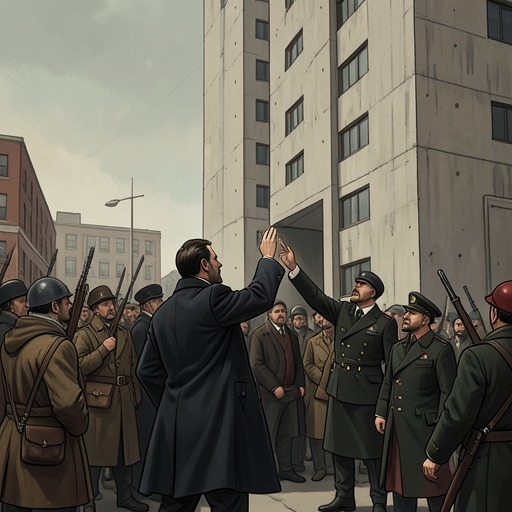
A Nazi was posted outside Hans’s father’s surgery carrying a notice warning Germans to avoid Jews and declaring anyone who associated with them defiled. In answer, Hans’s father put on his officer’s uniform and decorations, including the Iron Cross, First Class, and took his stand beside the Nazi. His response was public and conspicuous: rather than withdraw from the street or conceal his Jewish identity, he placed his decorated service uniform alongside the message of exclusion.
At first, the gathering crowd remained silent. As more people assembled, muttering grew into aggressive jeers. The hostility, Hans makes clear, was directed at the Nazi, not at his father. The Nazi eventually packed up and left; he did not return, and no replacement was sent. The episode therefore records a visible reversal of the intimidation the notice was meant to impose, though it offers no assurance that this moment of resistance could protect the family from the wider persecution around them.
The Parents’ Deaths
A few days later, while Hans’s mother was asleep, his father turned on the gas, and both parents died. The account gives these circumstances plainly but does not state why his father acted or describe any conversation or agreement between the couple. Its sequence places the deaths close after the confrontation, leaving that proximity significant without establishing a motive the narrative does not supply.
Hans is glad that his parents did not end in Belsen. That contrast situates their deaths against the fate he feared for them, without making their actual ending less devastating: they died at home, by his father’s action. The stark movement from the crowd’s jeers driving the Nazi away to the father turning on the gas refuses a consoling resolution to the earlier act of defiance.
Aftermath and Memory
Hans says that after his parents’ deaths he avoided meeting Germans as far as possible and did not open a single German book, not even Hölderlin. He says he tried to forget. In the account, the family loss thus continues beyond the deaths themselves: it shapes his encounters with Germans and his relationship to the language and literature of Germany.
That avoidance is not presented as an inability to speak German. Hans later explains that he can still speak it perfectly well, allowing for his American accent, but dislikes using it; speaking to a German calls up a protective façade, and the wounds have not healed. The remembered event therefore remains active in the present of the narration. Its public scene of exclusion and resistance is followed by a private family catastrophe, and the account’s restrained refusal to explain the father’s final act leaves the consequences—death, estrangement, and the attempt to forget—at the center.