Nazi seizure of power in Germany
ReunionNazi seizure of power in Germany reaches Hans Schwarz’s world not as a single decisive scene but as a creeping redefinition of who can belong. In Stuttgart, the political storm initially seems remote, and Hans’s father believes that his German identity and service will outlast it. That confidence fails as hostility becomes public, takes hold at the Karl Alexander Gymnasium, and separates Hans from his friend Konradin von Hohenfels. Hans leaves for America; his parents stay, and later die by suicide. The takeover is thus measured in the distance between a familiar homeland and a country increasingly organized against its Jewish citizens.
A Distant Storm Enters Daily Life
In the early months, political unrest appears centered in Berlin, where clashes between the Nazi Party and Communists are reported. Stuttgart still seems quiet and reasonable to Hans. Swastikas appear on walls, a Jewish citizen is molested, and Communists are beaten, but these incidents coexist with crowded restaurants, the Opera, and open-air cafés. Grapes ripen in the vineyards; families discuss summer holidays. Hans and Konradin treat politics as an adult concern, while they grapple with questions about life’s purpose and the human condition. The contrast is crucial: public warning signs accumulate beside routines that make catastrophe seem unlikely.
That calm does not last. After the summer, Hans returns from Switzerland to a school in which political exclusion has become difficult to ignore. Before the new history master arrives, the school has seemed like a sanctuary of classical learning, concerned with Greeks, Romans, and inherited ideals rather than recent events. Outside it, blood-red posters denounce Versailles and Jews, swastikas and the hammer and sickle mark the walls, and unemployed people march through the streets. The school’s apparent insulation from politics proves fragile: its curriculum’s silence about events after 1870 has left the boys poorly equipped to understand the upheaval surrounding them.
National Belonging and False Security
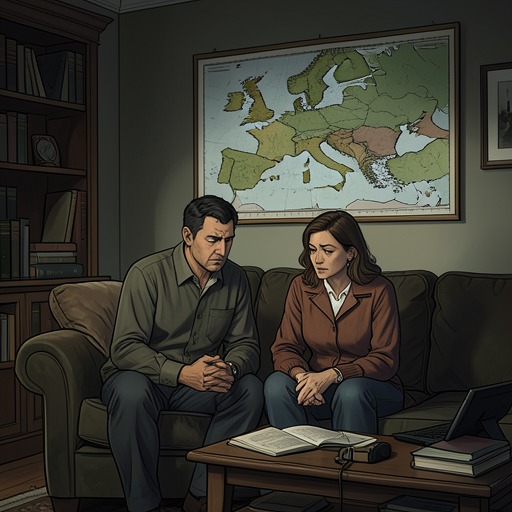
Hans’s father embodies a deeply rooted German patriotism. The family has lived in Stuttgart for at least two hundred years, and Hans understands himself first as Swabian, then German, and then Jewish. His father rejects Zionism and expects the Nazi movement to pass like a temporary illness when economic conditions improve. He invokes the German cultural inheritance and the twelve thousand Jews who died for their country in the First World War as reasons to trust that Germany will not turn against them.
This faith is reinforced by the father’s place in civic life. He is a popular doctor respected by Jews and Gentiles, has been honored by prominent citizens and the mayor, and keeps the Iron Cross, First Class, above his bed beside his officer’s sword. To him, these honors are evidence of a reciprocal bond: he has served Germany, and Germany should recognize him as one of its own. The political change exposes the weakness in that expectation. His record of service and his attachment to the country do not prevent public anti-Jewish agitation from recasting Jewish neighbors as outsiders.
The School Becomes a Political Front
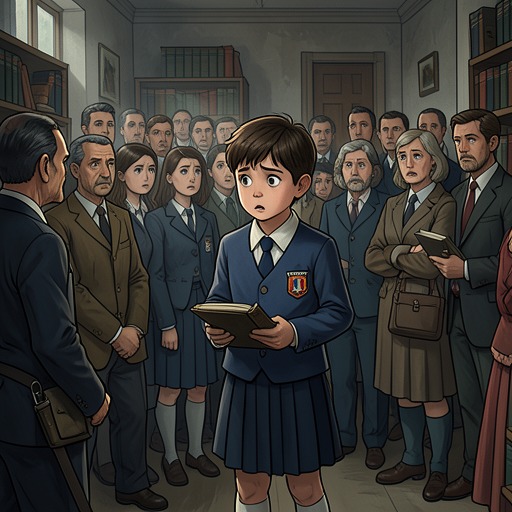
Herr Pompetzki’s arrival in September changes the atmosphere at the Karl Alexander Gymnasium. In his first lecture, he describes hidden forces undermining national heritage without naming the people he means. The boys understand the insinuation. Some reject his account, while others accept parts of it; the episode brings political propaganda into a school that had treated classical tradition as its central concern.
The change becomes personal when Hans hears repeated talk about Jews behind his classroom door. Bollacher and Schulz confront him with contempt, while other boys withdraw to their seats. Hans considers whether he could overpower Schulz but decides that a fight would do little against the poison already spreading through the school. When Bollacher later tells him to return to Palestine, Pompetzki dismisses the insult as friendly advice and turns back to the lesson. His response gives the prejudice institutional cover rather than protection. At the end of the day, Hans waits in the hope that Konradin will be there to comfort him, but leaves to find an empty street. He then avoids his friend, expects that the separation will spare Konradin embarrassment, and finds himself increasingly isolated.
Departure, Allegiance, and Aftermath
At the beginning of December, Hans’s father tells him that his parents have decided to send him to America for the time being. Relations in New York will look after him and arrange for him to attend university. His parents intend to remain in Germany: they still regard it as their Fatherland and home, and believe the crisis will pass. Hans leaves school at Christmas and departs on January 19, his birthday, nearly a year after Konradin entered his life. The decision turns political pressure into a family separation, even while his parents insist that their own place is in Germany.
Two days before Hans leaves, Konradin writes that he supports Adolf Hitler. He presents the choice as one between Hitler and Stalin and believes Hitler can restore Germany’s moral standing. His mother, after meeting Hitler in Munich, has also become convinced that he was sent to save the country. Konradin regrets that there will be no place for Hans in the Germany to come, but imagines that Hans might return later and that Jewish people deemed desirable could be accepted. His letter therefore reveals how their friendship has been overtaken by a political allegiance that makes Hans’s exclusion seem temporary and conditional rather than unjust. Konradin also credits Hans with teaching him to think and doubt, and says that doubt led him toward Christian belief; affection and ideological support now coexist in the same farewell.
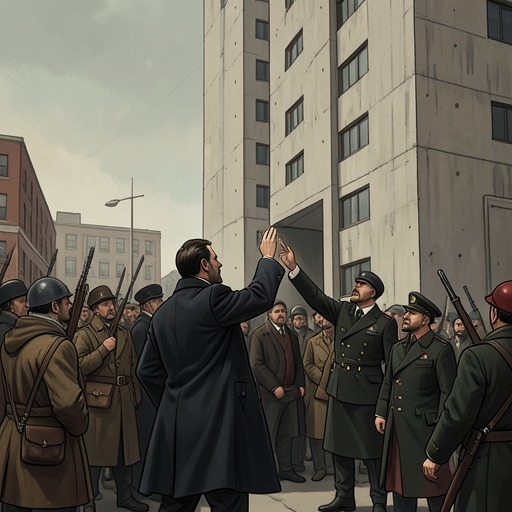
The consequences extend beyond Hans’s departure. His parents remain in Germany, but his father eventually stands beside a Nazi Party notice warning Germans to avoid Jews, wearing his officer’s uniform and decorations, including the Iron Cross, First Class. The Nazi officer leaves after the crowd turns hostile toward him. A few days later, while Hans’s mother sleeps, his father turns on the gas, and both parents die. Their fate completes the reversal of the father’s earlier confidence: the country he considered home has become a place from which his son had to escape and in which the parents could no longer live.
The remembered political turn also opens onto destruction on a much larger scale. About twelve years after the storm reaches Swabia, three-quarters of Stuttgart is gutted, medieval Ulm lies in ruins, and twelve thousand people have died in Heilbronn. For Hans, who survives in America, the takeover is not merely a change in leadership. It is the beginning of an unbroken sequence of exclusion, separation, bereavement, and national ruin.