Second World War
ReunionThe Second World War reaches Hans Schwarz less as a narrated military campaign than as the destruction of a city and the return of names he had tried not to remember. Stuttgart is reported three-quarters destroyed, his former school reduced to rubble, and a memorial appeal reveals that twenty-six of the forty-six boys in his class died for the Nazi regime. The war’s most decisive action in his account is therefore also an act of belated recognition: the dead are no longer an abstract group, but the people among whom he once lived.
From Political Unease to War
Before the war’s devastation, political unrest had seemed remote from Hans and Konradin’s friendship. Clashes between the Nazi Party and Communists were reported in Berlin, while Stuttgart appeared quiet and ordinary. There were swastikas on walls, a Jewish citizen had been molested, and Communists had been beaten, but the city’s cafés and Opera remained busy and residents made holiday plans. The contrast matters: public life continued amid signs of danger, and the boys treated politics as an adult concern while dwelling on questions about how to live and what life meant.
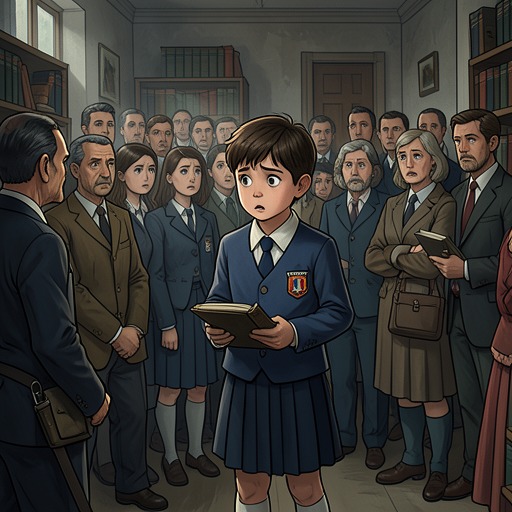
That apparent separation did not last. After Hans returned from a summer holiday in Switzerland, political conflict entered the Karl Alexander Gymnasium, an institution he had understood as a refuge of classical learning. Its teaching had long centered on ancient literature and inherited tradition; the school’s memory of more than a hundred boys killed in the First World War had been framed through classical models of patriotic sacrifice. Contemporary political history, by contrast, had scarcely been taught. Outside, posters denounced Versailles and Jews, swastikas and the hammer and sickle marked walls, and unemployed people marched through the streets. The school’s customary refuge from current events could not keep them out indefinitely.
A new history master, Herr Pompetzki, helped alter the atmosphere. His account of concealed forces and national heritage implied an antisemitic explanation without naming its target. Some pupils challenged his claims, but the next change was personal and unmistakable to Hans: he heard a heated classroom discussion repeating references to Jews. When he entered, the talk stopped; two classmates stared at him with hostility. The war’s later devastation thus follows a period in which political exclusion had already broken into ordinary school life. The narrative does not present the destruction as an isolated catastrophe detached from the public prejudice that preceded it.
A Landscape of Ruin
The scale of the destruction is conveyed through a brief report made years later. A man from Württemberg tells Hans that Stuttgart was three-quarters destroyed. Asked about the Karl Alexander Gymnasium, he answers that it is rubble. Hans then asks about Palais Hohenfels, which is also rubble. The sequence moves from city to school to a place connected with his earlier life, making the damage personal without describing a battle or inventing what happened at any particular site.
The account also places Stuttgart’s fate within a wider regional disaster. The eastward gale that had reached Swabia is described as growing to tornado force; some twelve years later, Stuttgart was three-quarters gutted, medieval Ulm lay in ruins, and twelve thousand people had perished in Heilbronn. These compressed comparisons measure the aftermath through places and losses rather than military detail. The familiar city and its historic surroundings have become evidence of a conflict whose force extends far beyond Hans’s own former neighborhood.
The Memorial Appeal
The war returns to Hans in the form of an unexpected request from the Karl Alexander Gymnasium. An appeal for a memorial to boys who had fallen in the Second World War arrives with a small book of names. Hans does not know how the school found his address or learned that he had once belonged to its community. His first response is to reject the appeal: he has spent seventeen years asking nothing of those people and has treated that part of his life as something that never existed.
He eventually reads the request. It reports that four hundred boys had been killed or were missing, then presents their names in alphabetical order. Hans proceeds cautiously, avoiding the letter H. The first names he examines bring only partial recognition. Fritz Adalbert, killed in Russia in 1942, had been in his class, yet Hans cannot remember him. Karl Behrens, missing in Russia and presumed dead, is similarly beyond recall. The list makes the distance between a recorded fate and a recovered personal memory plain: the boys may once have been familiar, but their names do not reliably restore their faces or shared history.
The appeal changes the meaning of that distance. The boys on the page had been alive and hopeful, as Hans had been; their deaths cannot be made less real by his inability to remember each one. Their alphabetical arrangement is at once impersonal and intimate, turning a school’s memorial effort into a demand that he confront the people contained within a collective count. What began as a request for money becomes an encounter with a past he had deliberately refused to claim.
Counting the Classmates
Hans reads through the list except for the names beginning with H. At the end, he discovers that twenty-six of the forty-six boys in his class had died for the Nazi regime. The number gives the war’s cost a precise scale within the smallest community he once shared with those who remained behind: more than half of his class. The memorial appeal’s four hundred dead or missing are no longer its only measure; the figure that alters Hans’s understanding is the count of his own classmates.
He puts down the list and waits, looking at the printed matter from a past he had tried to forget. The pause does not resolve his estrangement or restore the lost friendship and childhood associated with that period. Instead, it shows the appeal’s effect: the names have disturbed the peace of mind built through separation, and the arithmetic has made that disturbance concrete. In this recollection, the Second World War is registered through ruined places, missing and dead pupils, and the survivor’s belated encounter with the school community he had believed himself to have left behind.