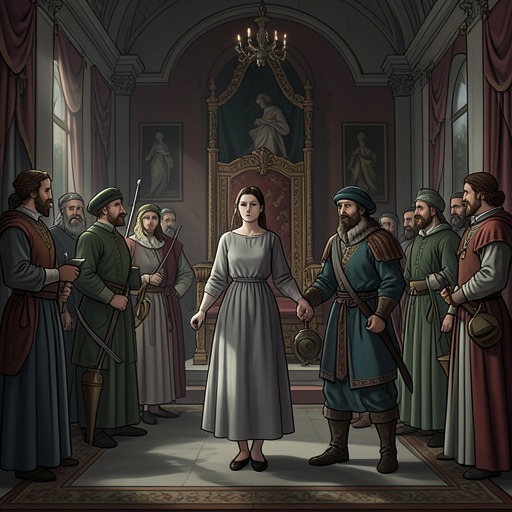
King and the miller’s daughter
RumplestiltskinThe relationship between the King and the miller’s daughter is formed under coercion and transformed by a bargain: the King first confines her and demands that she spin straw into gold, then makes her his queen after she meets the escalating tasks. Her change in rank is decisive, but the marriage grows out of an arrangement in which royal power sets the terms and the daughter bears the danger. The later claim on her first child shows how little security the change of status itself provides.
From the Miller’s Household to the King’s Attention
The daughter begins as the miller’s child, living near his mill and described as both beautiful and shrewd. Her father’s pride becomes the route by which the King notices her: he boasts that she can spin gold from straw. The claim is not hers, and she protests that it is only her father’s foolish boast and that she cannot perform the task. Yet the King acts on the boast rather than her denial, turning a father’s display of pride into a royal demand imposed on his daughter.
The King is attracted not by a stated affection but by the prospect of gain. Fond of money, he hears the miller’s claim and has the girl brought before him. He takes her to a chamber in his palace, locks the door, and orders her to turn a great heap of straw into gold by morning, under threat to her life. Their first encounter is therefore a relation between ruler and captive: he controls her surroundings, the deadline, and the consequences of failure, while she has no demonstrated ability to satisfy the demand.
Royal Demands and the Making of a Marriage
The first night establishes the pattern that governs their dealings. The daughter weeps alone until a strange little man offers to do the work in return for her necklace. By morning the straw has become gold. When the King sees the result, he is astonished and pleased, but satisfaction does not end the trial. His appetite for gain grows; he shuts her up again with another task. Her success benefits him, while the danger and the need to secure help fall on her.
For the second heap, the price of the helper’s labor is the ring on her finger. Once again, the work is completed before morning, and once again the King responds to the gold by demanding more. He takes her to a still larger heap and promises that, if she spins it that night, she will become his queen. The promise attaches marriage and rank to the outcome of a test that he has imposed on a confined woman. It is a conditional reward, not a courtship described through mutual choice.
By the third trial the daughter has nothing left to give the helper among her possessions. He asks instead for the first child she may have as queen. She accepts because she sees no other way to complete the task, thinking the child may never come. The helper spins the final heap, and the King, finding all he wants, is forced to keep his word: he marries the daughter, and she becomes queen. Thus the marriage follows both the successful production of gold and the King’s promised reward; the tale does not describe a separate wooing or a negotiated partnership.
Queenship and the First Child
The marriage changes the daughter’s public status, but the story’s account of her first child makes that new position vulnerable. When the child is born, the Queen is glad and forgets the agreement made during the third spinning trial. Later, while she is sitting with the baby, the helper enters her room and reminds her of the promise. The threat to the child arises from a bargain made before the marriage, when she was under pressure to meet the King’s last demand and had no payment left to offer.
The Queen tries to undo the agreement by offering all the wealth of the kingdom in exchange for being released from it. The offer reveals the scale of what she is willing to surrender to protect her child, but it does not immediately settle the claim. Her tears finally soften the helper, who grants her three days to discover his name; if she succeeds, she may keep the child. The King is not presented as intervening in this crisis. The narrative instead places the Queen herself at its center, facing the consequence of the bargain that enabled her passage from the miller’s household to the throne.
Power, Obligation, and the Relationship’s Meaning
The relationship is marked by sharply different kinds of obligation. The King’s commands are backed by confinement and a threat to the daughter’s life; his promise of queenship becomes binding only after she produces the gold he wants. Her agreement with the helper is also made under duress, but it reaches beyond jewels to a future child and returns as a claim after she has become Queen. Across these transactions, the daughter’s status rises while the demands placed upon her change in kind rather than disappear.
The tale does not show the King and Queen’s married life beyond the birth of their first child, nor does it say how the King responds to the danger. Its account of their bond remains concentrated on its beginning and its consequences: a boast leads to a royal test, the tests lead to marriage, and the last test leaves the Queen with a promise that threatens her child. Queenship is therefore both the outcome of the King’s bargain and a new setting for an older vulnerability. The decisive change is her elevation to the throne; the unresolved contrast is that royal rank does not itself release her from the cost of the bargain that preceded it.