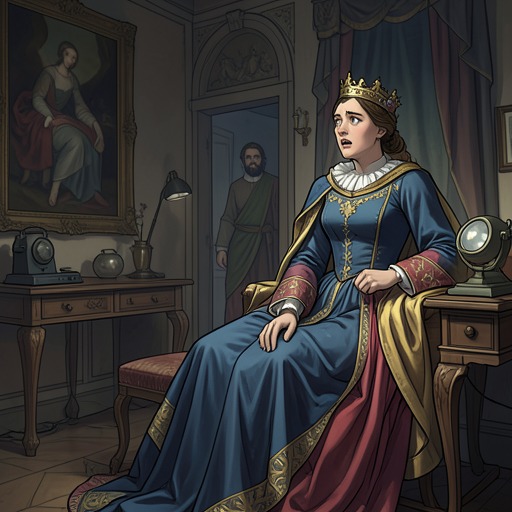
Queen and Rumplestiltskin
RumplestiltskinThe relationship between the queen and Rumpelstiltskin is shaped by bargains made under pressure: he repeatedly rescues her from the king’s impossible demands, but ultimately claims the child she promised him. What begins as an exchange of jewelry for magical labor becomes a contest over her firstborn, resolved when she learns his name and exposes his confidence before the court.
From Forced Task to Unequal Exchange
Before she becomes queen, the miller’s daughter is described as beautiful, shrewd, and clever. Her father boasts to the king that she can spin gold from straw, and the king’s appetite for money turns that boast into a threat: he confines her in a chamber with straw and a spinning wheel and demands that the work be completed before morning. She protests that her father’s claim was foolish and that she cannot do what has been demanded, but the locked room leaves her without a way out.
Rumpelstiltskin enters when she sits weeping. He offers to perform the work in return for her necklace, and she accepts. The relationship is therefore not introduced as a friendship between equals: she is trapped by the king’s command, while Rumpelstiltskin can choose whether to help and sets the price. His intervention saves her from that night’s danger, but it also establishes an exchange in which her need gives him leverage. His magical labor turns the straw into gold, and the necklace becomes payment for a service she could not provide herself.
The king’s reaction makes the first rescue only a temporary reprieve. Seeing the gold, he is pleased, but his greed grows rather than being satisfied; he shuts the miller’s daughter up again with a fresh task. When Rumpelstiltskin returns, she gives him the ring on her finger for completing it. The repeated pattern matters: each time the king’s demand renews the peril, Rumpelstiltskin supplies the labor and receives another possession. The necklace and ring are finite payments, but the queen’s dependence on his help is not yet finished.
The Child Bargain and the Change in Stakes
For the third task, the king takes her to a still larger heap of straw and promises that, if it is spun that night, she will become his queen. When Rumpelstiltskin asks what she will give him, she has nothing left. He proposes a different price: her first child, once she is queen. She thinks that the event may never happen, but, seeing no other way to complete the task, agrees to do what he asks. The bargain is made while she is still facing the king’s immediate threat; its future cost is accepted in order to survive the present one.
Rumpelstiltskin spins the heap into gold, and the king keeps his word by marrying her. She really does become queen, and the seemingly remote condition of the bargain becomes a claim on her actual child. When her first baby is born, she is glad and forgets both Rumpelstiltskin and what she said. He later comes into her room while she is sitting and playing with the baby, reminding her of the promise. The contrast between the earlier exchange of objects and this demand is stark: a necklace and a ring could be handed over, but the promised payment is now the child in her arms.
The queen grieves and offers all the wealth of the kingdom if Rumpelstiltskin will release her from the bargain. He refuses at first. Her offer reveals how completely the terms have shifted: she is prepared to surrender the kingdom’s riches, yet wealth cannot simply cancel the claim he asserts. The story does not present a formal legal process or an agreed remedy. Instead, the conflict turns on his willingness to alter the deadline and on her ability to meet the new condition he sets.
The Three-Day Condition
Rumpelstiltskin is softened by the queen’s tears and gives her three days’ grace. She may keep the child if she tells him his name within that time. The reprieve changes the relationship from a direct demand for the baby into a contest of information: his claim remains in force, but now she has a specific route to defeat it. He gives her time, not certainty, and the burden of finding the answer falls on her.
The queen stays awake thinking of unusual names and sends messengers throughout the land to discover more. On the first day, she tries names including Timothy, Ichabod, Benjamin, and Jeremiah; Rumpelstiltskin rejects each one. The next day she tests comic names such as Bandy-legs, Hunchback, and Crook-shanks, but these guesses fail too. The repeated refusals make his advantage visible: a long list of names is useless unless it contains the one he has withheld.
On the third day, a messenger returns with information gathered during his travels. In the forest, on a high hill among the trees, he saw a little hut and a fire. Beside it, a dwarf danced on one leg and sang about making a feast, brewing and baking, and the fact that his lady did not know his name. The report gives the queen more than another guess. It connects Rumpelstiltskin’s concealed identity to a scene outside the court, where he has himself declared the answer. The name she needs comes not from the court’s store of familiar or comic names but from the messenger’s account of what Rumpelstiltskin revealed while alone in the woods.
Naming and the Public Reversal
When Rumpelstiltskin comes to the queen, she sits on her throne and summons her court to watch. The nurse stands beside her holding the baby, as though the child were ready to be surrendered. Rumpelstiltskin chuckles at the thought of taking the baby home to his hut in the woods and asks the queen for his name. Her preparation turns a private threat into a public test, with the court and nurse present as witnesses to the outcome.
She first offers John, then Tom, then Jemmy. He rejects each one. Only after these false guesses does she slyly say Rumpelstiltskin. He exclaims that a witch must have told her. His response confirms that she has reached the hidden answer and that his former control depended on her ignorance of it. In a fit of rage, he drives his right foot so deep into the floor that he must seize it with both hands to pull it free.
Rumpelstiltskin makes off without the child. The nurse laughs, the baby crows, and the court jeers at him, greeting him by name and wishing him a merry feast. The relationship ends not with a negotiated payment or a transfer of wealth, but with the queen keeping her child and Rumpelstiltskin losing the claim he had pressed. His earlier help had bound the queen to a promise; her discovery of his name finally gives her a way to escape it.
Meaning of the Relationship
The sequence of bargains measures the changing stakes between the two characters. First Rumpelstiltskin takes the queen’s necklace, then her ring, and finally obtains a promise concerning her future firstborn. In parallel, the king’s greed drives each new crisis: the gold that saves the miller’s daughter once only leads him to demand more. Rumpelstiltskin’s assistance is real, but it is never free; each rescue deepens the obligation until the price is no longer a possession but a child.
The last contest reverses the earlier pattern of unequal knowledge. At first, Rumpelstiltskin knows how to spin straw into gold while the queen cannot; later, he knows that his name is the condition of her reprieve while she must search for it. The messenger’s report gives her the missing fact, and speaking it breaks his hold. The tale thus makes naming the counterweight to the bargain: where gold-making created the debt, knowledge of the name lets the queen retain her child and sends Rumpelstiltskin away empty-handed.