Miller and his daughter
RumplestiltskinThe miller and his daughter are linked by the miller’s pride in her beauty and cleverness, but that pride becomes the source of her peril. His boast that she can spin gold from straw reaches the King, who treats it as a promise he can enforce; the daughter must then survive the impossible demand and the bargains that follow without the miller’s help appearing again in the story.
Family Bond and the Boast
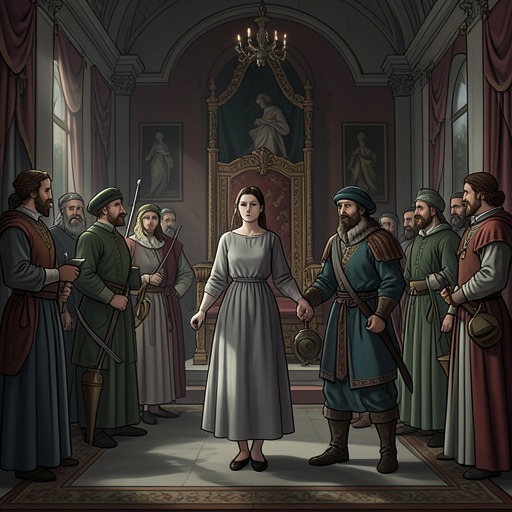
The miller lives beside a mill near a stream, and his daughter is described as very beautiful, shrewd, and clever. He is so proud of her that he tells the King she can spin gold out of straw. The tale does not show the daughter making this claim or consenting to it: the ability is attributed to her by her father, whose boast turns a private family relationship into a matter of royal attention.
The boast has consequences because the King is fond of money. Hearing it, he summons the daughter and leads her to a chamber in his palace, where a great heap of straw and a spinning wheel await. He orders her to turn the straw into gold before morning, under threat to her life. When she explains that her father’s statement was only a foolish boast and that she cannot do what he claimed, the door is locked and she is left alone. Her correction cannot undo the danger created by his words.
The Daughter Bears the Consequences
In the first chamber, the daughter weeps over the fate her father’s claim has brought upon her. A little man appears and offers to perform the spinning in exchange for her necklace. The task is completed, but the King’s response makes the danger greater: seeing the gold, he grows more greedy and shuts her away again with another heap of straw. The miller’s boast has thus initiated a sequence in which the daughter, not the father, must meet the escalating demands.
When the King later sets a larger task and promises to make her queen if she succeeds, the daughter has no possession left to offer her supernatural helper. She agrees to give him her first child if she becomes queen. The miller is absent from this bargain too; his earlier claim has helped move his daughter from the miller’s household toward royal status, while leaving her to bear the personal cost of securing that change. After the spinning is completed, the King keeps his word and marries her.
From Daughter to Queen and Mother
The daughter’s marriage changes her position, but it does not erase the consequences of the original boast. When her first child is born, she is glad and forgets the bargain. The little man later comes to her room while she is playing with the baby and reminds her of the promise. She grieves and offers him all the wealth of the kingdom to spare the child, but he refuses that substitute before granting her three days to discover his name.
The story does not describe a reconciliation between father and daughter, nor does it show the miller taking part in the later struggle. Instead, the daughter’s relationship to him remains most consequential at the beginning: his pride speaks for her, while the dangers and decisions that follow are hers to manage. Her effort to protect her child culminates in the naming challenge; once she says Rumpelstiltskin’s name, the little man departs, and the child remains with her.
Narrative Significance
The father-daughter bond is established through pride, but the tale gives that pride an ironic consequence. The miller’s praise is not harmless: because it presents an impossible skill as fact to a powerful, acquisitive King, it exposes his daughter to confinement and mortal threat. Her own intelligence is acknowledged in the opening description, yet she cannot simply refute the claim once royal power has taken hold.
The relationship also frames the daughter’s change in status without suggesting that the miller directs or shares in it. His boast brings her before the King; the King’s promise makes her a queen; and her own desperate agreements and later resourcefulness determine whether she can keep her child. In this sequence, the father’s pride is the initiating cause, but the daughter’s endurance and actions carry the story to its resolution.