The First Spinning Test
RumplestiltskinThe First Spinning Test begins when the king turns the miller’s boast that his daughter can spin gold from straw into a deadly command. Shut in a locked chamber with a heap of straw and a spinning wheel, she cannot fulfill the impossible task; a strange little man does it for the price of her necklace. The gold saves her for the moment, but its success feeds the king’s appetite and sets the pattern for the trials and bargains that follow.
Boast, command, and confinement
The test is set in motion by the miller’s pride in his beautiful, clever daughter. He tells the king that she can spin gold out of straw, and the king, already fond of money, responds not by questioning the boast but by summoning her. The first trial therefore rests on a claim made by her father and enforced by royal power: she must prove a skill she does not possess.
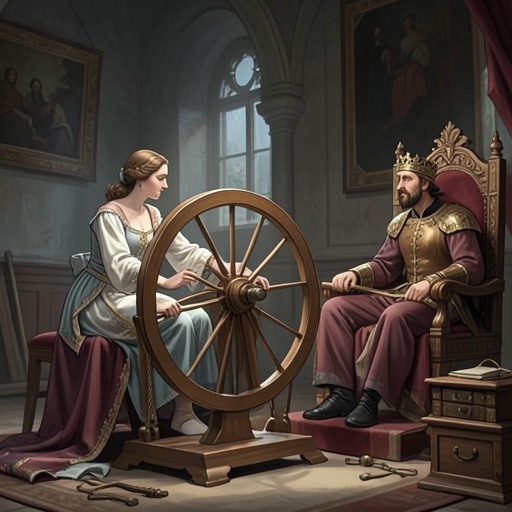
The king leads her into a chamber in his palace, where a great heap of straw and a spinning wheel await. He requires the entire pile to be spun into gold before morning, threatening her life if she fails. She protests that her father’s statement was only a foolish boast and that she cannot perform the task. Her explanation changes nothing: the door is locked, and she is left alone. The chamber turns the king’s greed into an immediate trap, with the daughter bearing the danger created by someone else’s words.
The necklace bargain
Alone in the room, the miller’s daughter sits in a corner and bewails her fate. A door suddenly opens, and a little man hobbles in. He asks why she is weeping, then offers to do the work in return for something from her. With no way to meet the king’s deadline herself, she promises him her necklace.
The necklace is the first price attached to the magic. The exchange is made under pressure: the king has placed her life at stake, while the stranger supplies the means to escape that immediate danger. The text presents her agreement as the practical response available to a captive, rather than as a bargain made from a position of ease or power. The object she gives is personal adornment; what she receives is the completion of the task on which her survival depends.
Spinning straw into gold
The little man takes her at her word, sits at the spinning wheel, and whistles and sings as he works. The wheel goes round merrily, and the straw is quickly spun into gold. The song’s repeated circling motion accompanies a startling conversion: the heap that made the room a threat becomes glittering treasure before morning.
The scene establishes the little man as the source of a power the miller’s daughter has been falsely said to possess. She has neither produced the gold nor learned how to make it; the helper performs the work, while the necklace changes hands as payment. The distinction matters to the sequence of events: the king sees the result, not the coercion and exchange that brought it about, and treats the successful transformation as proof that his demand can be repeated.
Success becomes a greater threat
When the king comes to inspect the result, he is astonished and pleased. Yet the gold does not satisfy him. His heart grows still more greedy for gain, and he shuts the miller’s daughter up again with a fresh task. The first test thus ends in a reversal: the completed work saves her from the immediate deadline, but it also persuades the king to increase his demands.
The first payment establishes the pattern that will govern the later trials. The next time she is shut in with straw, she again needs the little man’s help and gives him her ring. Later, when she has nothing left to offer, his price rises to the first child she may have as queen. The first spinning test is consequently the opening transaction in an escalating chain: a necklace buys one night’s work, but the king’s satisfaction makes the extraordinary service more valuable to him and the helper’s eventual claim more dangerous to her.
Place in the tale’s sequence
This test connects the miller’s boast to the larger conflict without making the daughter’s supposed talent real. The king’s command creates the crisis; the little man’s intervention resolves that crisis through a supernatural transformation; and the king’s response converts the apparent success into another threat. Each step follows from the previous one, even though the daughter has no control over the king’s appetite or the helper’s terms.
The first heap also introduces the tale’s shifting measures of value. Straw becomes gold, the necklace is surrendered for labor, and the king regards the result as an invitation to demand more. At this stage the price remains a possession, but the pattern points toward the later promise of a child. The wheel’s cheerful turning therefore accompanies an outcome that is not simply fortunate: its gold brings relief for the night and, at the same time, deepens the danger that the miller’s boast began.