The Queen Names Rumpelstiltskin
RumplestiltskinThe Queen Names Rumpelstiltskin is the climax of the queen’s struggle to keep her first child from the dwarf to whom she had promised it. Armed with a report from a messenger, she turns his demand into a staged guessing contest before her court; when she speaks his name, his claim collapses and he departs without the baby.
The Name as a Condition
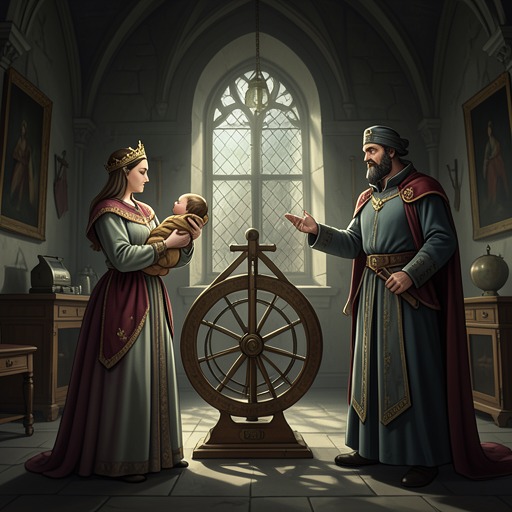
The confrontation follows the queen’s agreement with Rumpelstiltskin. When he reminded her of her promise, she offered him all the wealth of the kingdom to release her from it, but he refused. Her tears softened him enough to grant three days’ grace: if she could tell him his name during that time, she could keep her child. The resolution therefore depends not on payment or force, but on satisfying the condition he himself has set.
The queen uses the interval to gather names. After two days of guesses fail, a messenger returns with a report from a forest hill: beside a hut, a dwarf danced on one leg around a fire and sang a rhyme that disclosed his name. The information comes indirectly, through a witness who has travelled for two days, rather than from the queen’s own encounter with the dwarf. That report transforms an impossible guessing task into a test she can control.
The Courtroom Performance
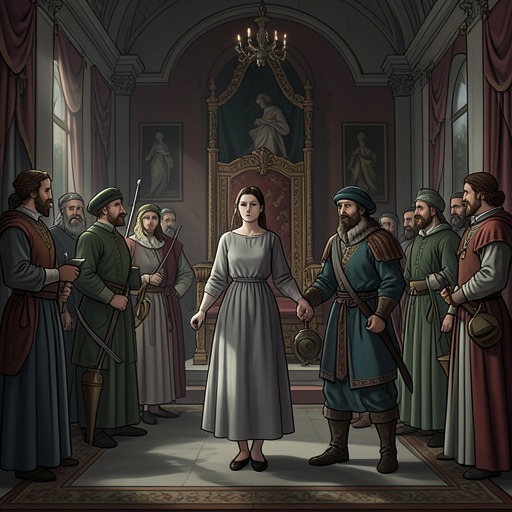
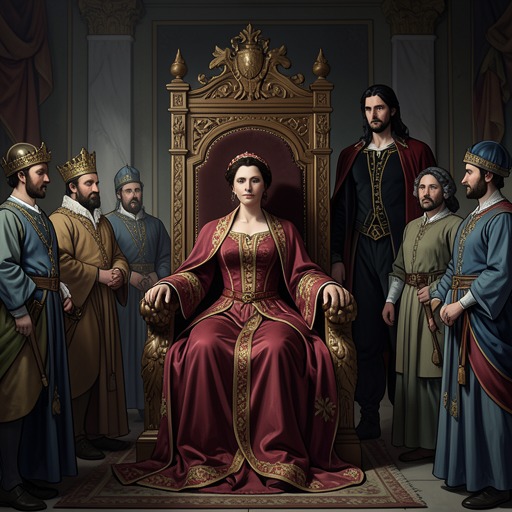
When Rumpelstiltskin arrives, the queen sits on her throne and calls the court together to enjoy the spectacle. The nurse stands beside her holding the baby, as though the child were ready to be surrendered. The arrangement makes the stakes visible: the threatened loss is present in the room, while the queen’s new knowledge gives her the means to resist it.
Rumpelstiltskin chuckles at the prospect of taking the child home to his hut in the woods and asks the queen to name him. She offers JOHN, then TOM, then JEMMY; each guess is rejected. Only after these failures does she slyly say RUMPELSTILTSKIN. His furious response confirms that she has hit the truth: he cries that a witch must have told her. The contrast between his confidence and her controlled sequence of guesses turns the naming into a small performance of suspense, with the answer withheld until the final attempt.
Defeat and Release
Once named, Rumpelstiltskin stamps his right foot so deeply into the floor that he has to seize it with both hands to pull it free. The outburst replaces the delighted expectation with helpless rage, and he makes his way off without the child. The nurse laughs, the baby crows, and the assembled court jeers at the dwarf, wishing him a good morning and a merry feast. His claim ends not through a negotiated payment, but through the knowledge that defeats the condition on which it depended.
Place in the Tale
The scene reverses the direction of the earlier bargains. At first, the miller’s daughter paid her necklace and then her ring to have the dwarf spin straw into gold; when she had nothing left, she promised her first child in exchange for the final spinning. Her marriage to the king made her queen, but the promise followed her into motherhood. Now a messenger’s discovery supplies the answer that possessions and royal wealth could not buy, and the queen keeps the child by naming the claimant.
The court’s presence gives the private threat a public ending. The dwarf had imagined taking the baby away to his hut; instead, the nurse remains beside the queen and the court witnesses his departure. The tale closes the conflict with a reversal in power: Rumpelstiltskin, who once controlled the outcome of the queen’s impossible tasks, is himself exposed and driven off by the name he had kept secret.