The Second Spinning Test
RumplestiltskinThe Second Spinning Test is the second of the miller’s daughter’s forced trials in the King’s palace. After the King sees the first heap of straw transformed into gold, his astonishment does not satisfy him: it sharpens his appetite for more. He confines her again with a fresh task, and the dwarf returns to spin for payment. This time the price is the ring on her finger. The successful work brings another heap of glittering treasure, but no release; instead, the King takes her to a larger heap and sets the next demand. The episode turns a single miraculous rescue into a cycle of extraction, while making the daughter’s dwindling possessions a measure of the mounting cost.
From the First Trial to the Second
The trial begins in the aftermath of the first night. The miller’s boast that his daughter could spin gold from straw had brought her before a King who prized money, and he had locked her in a chamber with a heap of straw and a spinning wheel, requiring the impossible work before morning on pain of death. Alone and unable to perform the task, she had accepted the little man’s offer of help in exchange for her necklace. When the King entered and found the straw spun into gold, he was astonished and pleased—but his response was to shut her up again, not to recognize that the first task had been met at extraordinary cost.
The repetition changes the meaning of the first rescue. The daughter had been left alive because another person performed the work, yet the King treats the result as grounds for demanding more. The gold becomes less a completed achievement than an invitation to renewed confinement: the first heap proves, in his eyes, that the production can continue. His delight is therefore inseparable from his greed. The episode presents the palace’s glittering treasure as the product of coercion, not as an end that brings security to the woman compelled to produce it.
The Ring Bargain
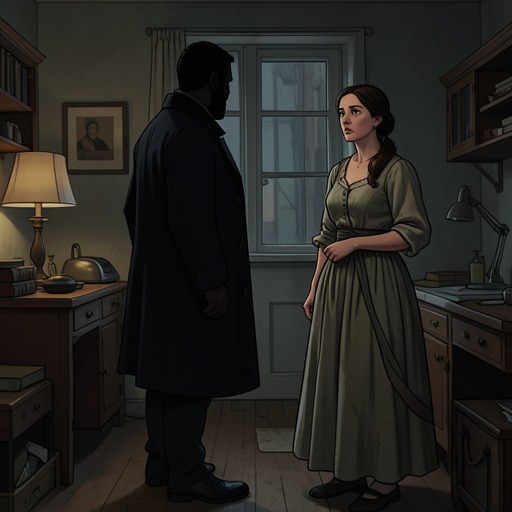
Once again, the daughter sits down to weep, without knowing how she can complete the task. The dwarf opens the door and asks what she will give him to do it. Unlike the first exchange, when she could surrender her necklace, she now offers the ring on her finger. The object is small beside the heap of straw and the quantity of gold expected, but its importance lies in the dwindling sequence: the helper’s labor is paid for first with one personal possession and now with another. Each reprieve consumes something she owns.
The second bargain also follows the same basic terms as the first. The dwarf supplies the labor that she cannot, and she transfers an adornment in return. Her choice is made under pressure, with the locked chamber and the King’s threat still shaping the circumstances; it is an exchange, but not one made from freedom or abundance. The ring secures the immediate completion of the task, while the King—who captures the value of the resulting gold—does not pay either the daughter or her helper. The story makes the parties’ unequal positions visible through the flow of work and reward: the King demands and receives treasure, the dwarf performs the magic for a personal payment, and the daughter bears the danger and the loss.
Repeated Song, Repeated Transformation
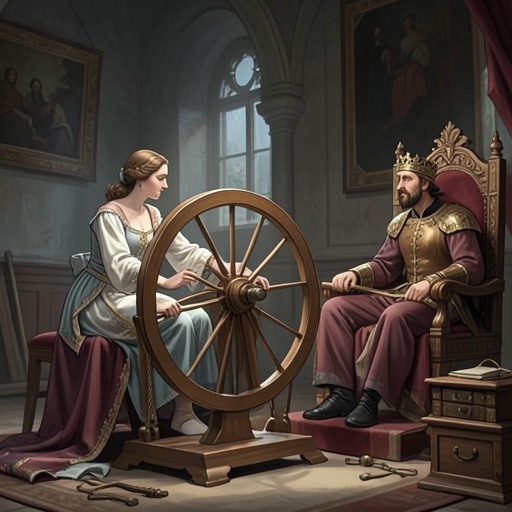
The dwarf sits at the wheel and whistles and sings the refrain used in the first spinning. Its returning rhythm marks the second transformation as a recurrence rather than a new kind of feat: the wheel turns, the straw becomes gold, and the work is finished long before morning. The song gives the labor a brisk, almost effortless surface, in sharp contrast to the daughter’s tears and uncertainty before the helper arrives. The magical production appears easy in performance; the human cost accumulates around it.
The refrain also links the two tasks while the payment changes. In the first trial, the necklace purchases the dwarf’s intervention; in this one, the ring does. The repeated method creates an expectation that the problem can again be solved, but the pattern does not restore what the daughter has given away or end the King’s demands. The wheel’s successful turning is thus both a momentary reversal—from helplessness to completion—and a mechanism that carries the story into a more dangerous bargain.
A Larger Heap and a Higher Price
By morning, the second heap has been spun into gold, and the King is greatly delighted by the glittering treasure. Yet his satisfaction again proves temporary: he takes the daughter to a still larger heap and says that all of it must be spun that night. This time he adds a reward, promising that if she succeeds, she will become his queen. The offer changes the stakes without changing the coercive structure. She is still assigned an impossible task, while the King controls both the demand and the status he holds out as its prize.
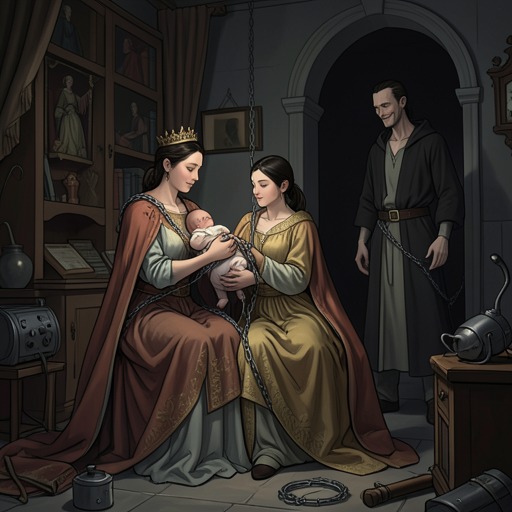
The second test is therefore a hinge between the two payments in jewelry and the later promise involving a child. When the daughter says she has nothing left to give, the dwarf names a far more consequential price: the first little child she may have as queen. She agrees because she knows no other way to get the work done, imagining that the possibility may never come to pass. The second bargain matters not only because it costs her the ring, but because the repeated cycle has brought her to the edge of giving away something beyond property. The King’s appetite for gold drives the escalation; the dwarf’s continued help makes survival possible in the moment; and the daughter’s constrained consent carries the consequence forward into her later life as queen.