The Miller's Boast
RumplestiltskinThe Miller's Boast is the initiating action of the tale: the miller’s pride turns his daughter’s beauty and cleverness into a fantastical claim, and the King’s greed turns that claim into a lethal demand. Although the miller speaks, his daughter bears the consequences, setting in motion the bargains that later reach from her jewelry to her first child.
The Claim and Its Audience
The miller lives beside the mill with his very beautiful daughter, who is also described as shrewd and clever. Proud of her, he tells the King that she can spin gold out of straw. The boast is not presented as a skill she has demonstrated; it is her father’s assertion, made to a ruler who comes to hunt in the nearby wood.
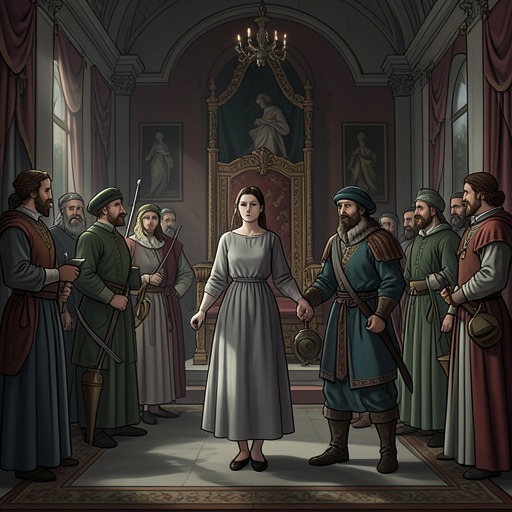
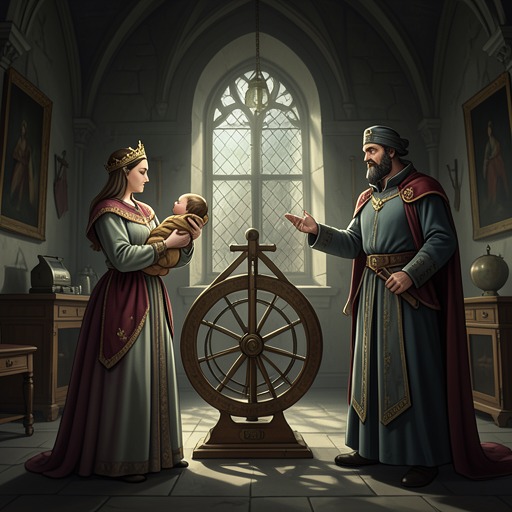
The King’s response converts the boast into an order. Fond of money, he hears the claim with greed rather than skepticism and summons the girl. He leads her to a chamber in his palace, where a great heap of straw and a spinning wheel await her, and requires that she turn it all to gold before morning under threat to her life. She explains that the claim was only her father’s foolish boast and that she cannot perform the feat, but the door is locked and she is left alone.
From Boast to Bargain
The first impossible task exposes the distance between the miller’s words and his daughter’s actual power. Alone in the locked chamber, she weeps; a strange little man enters and offers to do the work in exchange for her necklace. She accepts, and he spins the straw into gold. The King is astonished and pleased, but the success does not release her: it feeds his desire for more treasure, and he confines her again with a fresh task.
On the next night, the daughter pays the same helper with the ring on her finger. The King sees the completed gold and remains unsatisfied. He takes her to a still larger heap and promises that if she spins it that night, she will become his queen. With her necklace and ring already surrendered, she has nothing left to offer the helper. He demands instead the first child she may have as queen. She agrees because she sees no other way to finish the task; the wheel turns again, and the straw becomes gold.
Consequences of the Miller's Words
The King keeps his promise and marries the miller’s daughter, who becomes queen. The original boast has thus produced a change in rank as well as a sequence of transactions: the King gains the gold he covets, the daughter gains queenship, and the helper receives her promise of a future child. The miller’s claim does not merely expose his daughter to one peril; it supplies the premise through which royal power and supernatural assistance repeatedly place her under pressure.
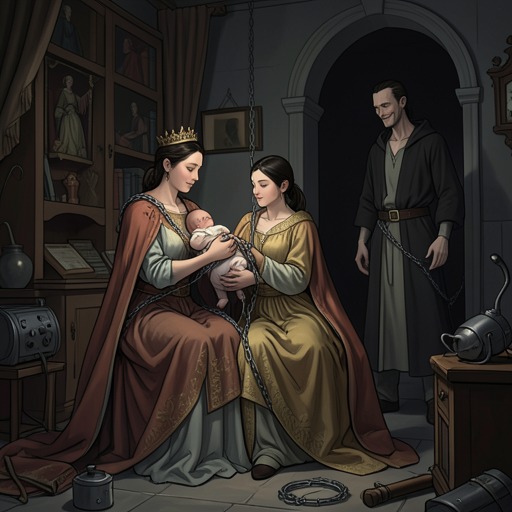
At the birth of her first child, the Queen is happy and has forgotten the agreement. The little man later comes into her room while she sits with the baby and reminds her of it. She offers all the wealth of the kingdom to be released from the promise, but he refuses. Her tears eventually move him to grant three days in which she may guess his name; if she succeeds, she can keep the child. The danger set in motion by the boast is therefore not ended by marriage or wealth: the Queen’s child becomes the final stake, and escape depends on knowledge rather than another payment.
The Boast's Narrative Function
The opening claim drives a compressed chain of escalating demands. A father’s proud words give the King an occasion to test the daughter; each successful transformation increases his appetite, while each crisis pushes her into a more costly exchange. The progression from necklace to ring to first child marks a sharp change in what can be demanded, as the story moves from possessions she wears to a bond she cannot treat as ordinary payment.
The boast also establishes the tale’s central imbalance of agency and consequence. The miller makes the claim, the King imposes the tasks, and the daughter must answer for both, first through desperate bargains and later through the threat to her child. Its importance lies not in proving that she can spin gold, but in the false assertion’s power to set the plot in motion and make other characters’ demands govern her fate.