Little Belle
SanctuaryLittle Belle, Horace Benbow’s stepdaughter, is an offstage presence with unusually powerful narrative force. She is remembered through the grape arbor at Kinston, glimpsed in a photograph, invoked during the courtroom crisis, and finally heard over the telephone. Although the story gives her relatively little direct access to events, her body, voice, and secrecy organize Horace’s fear that the girl he believes he knows has become inaccessible to him. Her decisive significance lies in this gap between paternal devotion and incomplete knowledge: Little Belle is at once the beloved child Horace wants to protect and the young woman whose private life exposes the limits of his authority.
Identity and Introduction
Little Belle is presented as Horace’s stepdaughter, and Horace’s attachment to her is framed through the intimacy of domestic memory rather than through a sustained account of her public life. In his recollection of Kinston, he watches the grape arbor conceal and reveal the hammock as the seasons change. By late May, in the twilight, he can hear Little Belle’s voice in the arbor. Her greeting is not a formal introduction of the men around her but the deliberately minimizing phrase, “It’s just Horace.” The wording makes Horace both familiar and excluded: he is close enough to be named without explanation, yet the secrecy of the encounter implies that the relationship belongs to a private world he cannot enter.
Horace remembers Little Belle in a white dress, demure but alert and impatient. The description joins apparent innocence to watchfulness. She is not simply an unaware child waiting to be supervised; she understands the social situation around her and manages what Horace is permitted to see. His own response is equally revealing. He feels foreign to her flesh, as though her physical and emotional life belonged to a realm unrelated to him. That estrangement is especially painful because he is her stepfather: his protective relation gives him emotional investment but not biological certainty, and it cannot convert her inward life into something transparent.
Memories, Desire, and Secrecy
Little Belle’s remembered encounters become the center of Horace’s extended story about the conflict between nature and Progress. He recalls trying to reason with her after she had apparently brought a young man found on a train into her private sphere. Horace insists that the circumstances matter: if the man had entered her hotel room, he says, he would have killed him, but because the discovery occurred on a train, he feels disgusted and wants the man sent away so that everything can begin again. His distinction between the hotel and the train reveals an attempt to impose legal and moral categories on a situation he cannot emotionally control.
Little Belle rejects his authority with a direct insult, calling him “Shrimp!” The outburst punctures Horace’s self-image as the experienced adult who can interpret danger for her. She recognizes that his warning about men is compromised by his own history of finding or pursuing women in questionable circumstances, and her accusation turns his protective speech back upon him. The scene therefore does not leave her as a passive object of male judgment. Even in recollection, her voice interrupts Horace’s explanation and exposes the hypocrisy beneath it.
Horace then remembers a more intimate and disturbing confrontation. Little Belle says no while he holds her, then clings to him and apologizes. He smells slain flowers and sees her reflected in a mirror behind him. In the reflection, she appears to be watching the back of his head while concealing what she is doing from the face he can see. Horace interprets the scene through his recurring formulation that nature is female and Progress is male: nature made the grape arbor, while Progress invented the mirror. The image makes Little Belle’s secrecy inseparable from the mechanisms of observation. She is both the person being watched and the person who understands how watching works, turning the mirror into an instrument of concealment rather than revelation.
Horace’s Protective Imagination
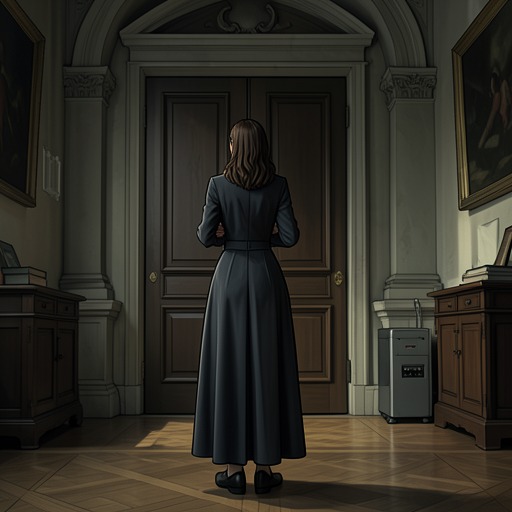
Little Belle’s importance is intensified by her absence from the scenes in which Horace worries about her. Alone in a room, he studies a photograph of her stepdaughter, shifting it until her face becomes clear. The image looks beyond his shoulder, as if its attention were directed toward a life outside the frame. Horace thinks again of the grape arbor, the twilight voices, and the white dress; he associates her with the delicate, urgent life of the blossoming grape, yet he also recognizes that he did not create the flesh whose meaning he is trying to understand.
The photograph changes from a cherished likeness into an object of horror. Its face blurs in the reflected highlight, becoming older in sin than Horace believes he will ever be and more secret than sweet. He knocks the photograph flat, but even then the face seems to contemplate something beyond him. This physical disturbance does not establish a supernatural transformation; it materializes Horace’s altered perception. The familiar portrait has become a thing that refuses his reassuring interpretation. His response is quiet horror and despair, followed by a sleepless wait until three o’clock and a departure from the house. Little Belle’s image thus converts paternal memory into an experience of helplessness.
Horace’s protectiveness also appears in the contrast between Little Belle and Temple Drake. When Temple, frightened and intoxicated, holds the sleeping baby at Lee Goodwin’s house, she invokes her father’s judgeship and her family’s connection with the governor as if status could summon protection. Her situation recalls the world that surrounds Little Belle: respectable family authority promises safety, but young women’s movements and desires repeatedly escape the structures meant to contain them. The story does not make Little Belle and Temple identical. Rather, Temple’s crisis helps clarify the danger Horace imagines whenever he thinks of his stepdaughter’s private encounters and the men who might reach her beyond his sight.
Family, Courtroom, and Telephone
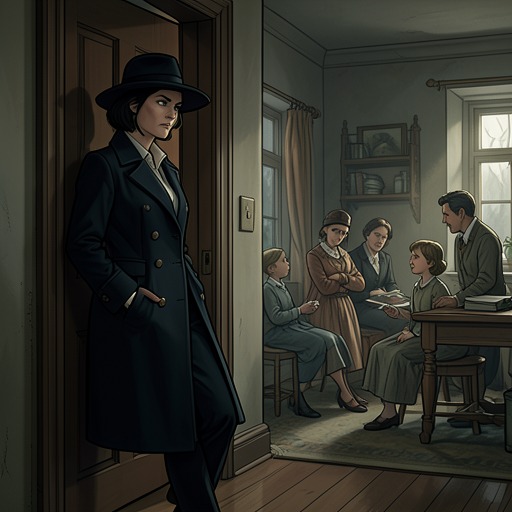
The public crisis surrounding Lee Goodwin brings Little Belle into Horace’s practical thoughts even though she remains physically absent. When Horace asks whether she has been telephoned, the response is that she is at a house party and should not be expected to disrupt her plans or refuse an invitation. The exchange sets her social life against the emergency unfolding in court. Her absence is not caused by exclusion from the family so much as by the continued normality of her own plans, which proceed while adults confront violence, accusation, and legal danger.
The contrast becomes sharper because the courtroom contains a woman holding a child, a prisoner, Horace, the District Attorney, and a Memphis lawyer, while Little Belle is elsewhere. Horace’s concern travels toward her across this crowded public scene, suggesting that the most private source of his anxiety is also the least available to him. The woman carrying the child represents immediate dependence and visible vulnerability; Little Belle represents a more elusive threat, one attached to secrecy, sexuality, and the inability of family protection to remain effective once a daughter moves beyond the household.
Little Belle finally speaks through a telephone connection. Horace hears scuffling and her breathing before a male voice attempts to introduce someone to him. She stops the introduction, identifies Horace as the man she lives with, and then asks whether her mother is all right. Her voice is described as breathless but controlled, cool, discreet, and detached. These qualities complicate the image of the frightened or corrupted girl that Horace has constructed. She is capable of managing the conversation, defining the relationship between herself and Horace, and redirecting attention to her mother’s condition. Yet the scuffling and the presence of the unnamed male voice preserve the secrecy that has troubled Horace from the beginning.
Narrative Role and Significance
Little Belle functions less as an independently narrated protagonist than as the hidden center of Horace’s consciousness. The grape arbor, hammock, mirror, photograph, and telephone all mediate access to her. Each medium offers partial knowledge while withholding the whole: the arbor conceals bodies, the mirror divides perspectives, the photograph fixes an expression that Horace cannot interpret, and the telephone transmits voice without presence. Her characterization is therefore built from gaps, repetitions, and indirect contact rather than from a continuous account of action.
Her relation to Horace also exposes the gendered limits of protection. He can imagine himself as guardian, judge, interpreter, or avenger, but Little Belle repeatedly appears where his categories fail: in a twilight encounter, in an accusation that recalls his own conduct, in a reflection that defeats his gaze, and in a telephone conversation she controls more effectively than he does. The language of purity, danger, and paternal responsibility belongs largely to the adults who watch her. Her own speech, when it breaks through, is sharper and more self-possessed than their explanations.
The story’s recurring opposition between nature and Progress gives Little Belle a symbolic position, but it never fully reduces her to a symbol. Horace associates her with spring, grape leaves, white clothing, and the living secrecy of the arbor; he associates modern progress with mirrors, trains, photographs, telephones, and the technologies that make observation possible without producing understanding. Little Belle moves through both worlds. She is embedded in the seasonal, bodily imagery through which Horace remembers her, yet she also commands the modern channels through which she eludes him. Her final telephone exchange leaves that tension unresolved: she is still loved, still watched, and still fundamentally beyond Horace’s possession or complete knowledge.