Popeye
SanctuaryPopeye is the novel’s decisive criminal agent and one of its most disturbing figures. He first appears as a nearly mechanical presence hidden beside a spring, watching a stranger drink, and he remains associated with sudden violence, evasive movement, and an insistence on controlling appearances. His actions set in motion the catastrophe involving Temple Drake, yet the narrative later reveals that his criminal life is not confined to the Jefferson episode: while traveling to Pensacola to visit his mother, he is arrested for murdering a policeman in Alabama. His final composure beneath the scaffold, where he asks the sheriff to fix his hair before the trap is sprung, condenses his defining contradiction: extreme violence alongside meticulous attention to presentation.
Identity and Introduction
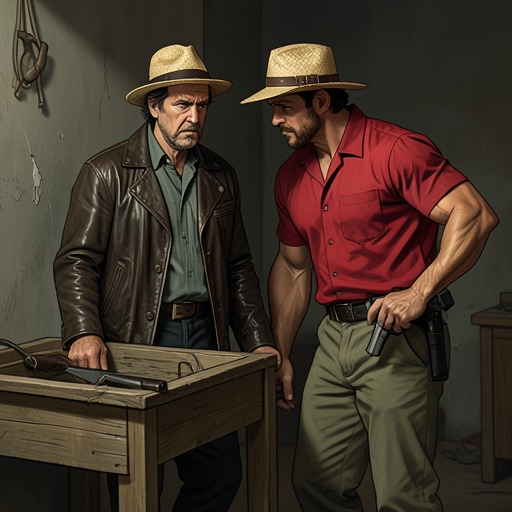
Popeye is introduced indirectly, first as a watcher concealed beyond the bushes surrounding a spring. He observes a tall, thin, hatless man in worn gray flannel trousers kneel to drink, remaining unseen until the man notices the shattered reflection of Popeye’s straw hat in the water. The spring’s secluded setting gives the encounter an almost suspended quality, but Popeye’s appearance breaks that stillness with menace. Facing the drinker across the water, he is undersized, dressed in a black suit with a tight, high-waisted coat, mud-caked rolled trousers, and mud-caked shoes. His bloodless face and the impression of stamped tin make him seem less warmly human than manufactured, sealed, and resistant to ordinary emotional reading.
The details of his posture establish a pattern that recurs throughout his appearances. His hands remain in his coat pockets, a cigarette slants from his chin, and his straw hat frames a figure whose smallness does not diminish his threat. The scene with the spring turns concealment into power: Popeye sees the other man before revealing himself, while the surrounding birdcall, vegetation, and fading automobile noise isolate the meeting from ordinary social life. When the drinking man asks whether a pistol is in Popeye’s pocket, the weapon is already present as an implied fact, making Popeye’s silence and stillness forms of intimidation before any overt attack occurs.
Criminal Conduct and Control
Popeye’s violence is characterized by abruptness rather than spectacle. In the scene witnessed by Temple Drake, the sound of the gunshot is no louder to her than a struck match, but its effect is final: it shuts down the scene and isolates it. Popeye leans from the door with the pistol along his flank, then turns, briefly displays the weapon, returns it to his coat, and walks toward Temple without making a sound. The inversion of sound and silence makes his approach more terrifying than a noisy assault would be. His violence does not merely injure bodies; it reorganizes the victim’s perception of the world, so that movement, silence, and ordinary objects become instruments of dread.
His conduct at the spring after the events at the house shows another aspect of his criminal presence: irritation expressed through trivial, almost bureaucratic complaint. He emerges from the bushes in muddy shoes, twists a cigarette, and blames the men at the house for sitting up all night drinking, adding that there ought to be a law. He calls the house foolish and recalls encountering a man who asked whether he read books, imagining that books might be used as weapons against him. The remarks are not a confession, but they expose Popeye’s detached way of processing the scene. He converts catastrophe into annoyance, reduces other people to nuisances, and announces that he is going to town and clearing out because he has had enough.
That departure is part of his method. Popeye is mobile, evasive, and difficult to place within a stable community. His movements connect isolated locations and criminal episodes without giving him the settled identity of a local outlaw. Even his apparent exit from the Jefferson-area crisis does not represent moral retreat. It is simply a change of location, allowing the consequences of his violence to remain behind while he continues through a wider criminal world.
Relation to Temple Drake and the Novel’s Violence
Popeye’s encounter with Temple Drake is defined by an extreme asymmetry of power. Temple is trapped in a space where the ordinary protections of speech, witnesses, and social order have failed; Popeye controls the door, the pistol, the pace of his movement, and the silence surrounding him. Her repeated realization that something is happening to her registers the collapse of her ability to treat danger as hypothetical. The scene gives Popeye no explanatory interior monologue and no mitigating history at the moment of violence. Instead, his body, weapon, and controlled approach become the available evidence of intention.
The contrast between Popeye’s small physical frame and the scale of his effect is central to his construction. He is not presented as a conventionally imposing brute. His threat comes from precision, concealment, and the absence of visible hesitation. The stamped-tin quality of his face suggests a person reduced to a hard external surface, while his cigarette, coat, hat, and pocketed pistol form a compact vocabulary of criminal authority. Against Temple’s terror, he offers neither emotional recognition nor meaningful dialogue. His power lies in making another person’s fear the only fully legible human response in the scene.
Arrest and Criminal History
The later account of Popeye’s arrest broadens the meaning of the earlier episode. While traveling to Pensacola to visit his mother, he is arrested in Birmingham for the murder of a policeman in a small Alabama town committed on June 17. The arrest occurs in August, and the narrative connects that date to the night Temple had passed Popeye sitting in a parked car beside the road house where Red was later killed. This chronology places Popeye within a chain of violence larger than the immediate Jefferson events and confirms that his criminal identity extends beyond the crimes directly witnessed by the central characters.
His annual journey to visit his mother introduces an unsettling domestic contrast. Each summer Popeye goes to see her, while she believes he works as a night clerk in a Memphis hotel. The respectable occupation she imagines and the murderer known to the reader occupy the same name and body, but not the same social reality. His concealment therefore depends not only on physical flight but also on the ordinary assumptions of family life. His mother’s background is itself described through a history of precarious labor: she is the daughter of a boarding-house keeper, and Popeye’s father was a professional strike-breaker hired by a street railway company during a strike in 1900. The family history does not excuse Popeye’s crimes, but it places his violence against an inherited background in which coercion, hired force, and social respectability already coexist.
Execution and Final Image
Popeye’s career ends under the authority of the law he once treated with cynical distance. At six, officials come for him, accompanied by a minister who supports him by the elbow. Beneath the scaffold, the minister prays while the rope is adjusted over Popeye’s sleek, oiled head, loosening his hair. Even with his hands tied, Popeye begins jerking his head to flip the hair back whenever it falls forward. The gesture is small and strangely fastidious, but it preserves his control over the visible image of himself at the moment when every larger form of control has been removed.
His final request is directed not toward mercy or explanation but toward appearance. Interrupting the minister’s prayer with a sharp whisper, Popeye asks the sheriff to fix his hair. The sheriff agrees and springs the trap. The ending therefore does not redeem or psychologically explain him. It completes the pattern established at the spring and in the house: Popeye remains focused on surfaces, gestures, and command even when confronted by death. His execution supplies legal closure, but the image of him adjusting his appearance under the rope leaves a residue of artificiality and defiance.
Narrative and Thematic Significance
Popeye functions as a concentrated figure of violence that travels through spaces where social institutions are weak, compromised, or absent. He is introduced through surveillance, associated with a pistol before the weapon is openly displayed, and repeatedly defined by the ability to move away from the immediate scene. The novel’s episodic structure lets his presence widen retrospectively: the man at the spring becomes the agent of Temple’s ordeal, the figure connected to Red’s killing, the fugitive arrested for a separate murder, and finally the condemned prisoner beneath the scaffold.
His characterization is deliberately narrow but not simple. He is recognizable through a fixed cluster of traits—smallness, bloodless appearance, cigarette, hat, tailored coat, pocketed weapon, and obsessive control of his hair—yet those traits produce changing effects in different settings. In the wilderness he is an ambush; in the house he is silent physical threat; on the road he is a fugitive; before the scaffold he is a prisoner still attempting to govern his image. The result is a villain whose mystery comes less from hidden goodness than from the gap between his banal surfaces and the catastrophic consequences of his actions.
Popeye’s final defeat also exposes the limits of the apparent autonomy that defines him. He can leave a house, travel toward Pensacola, and pass as a hotel night clerk to his mother, but he cannot remain outside the reach of institutional pursuit forever. The law eventually captures him, and execution reverses his habitual relation to space: the mobile man is fixed in place, the armed man is bound, and the watcher becomes the watched. Yet even then, his last gesture insists on the same cold self-stylization that marked his first appearance, making Popeye’s significance lie not only in what he does but in the unnerving form through which the novel makes violence visible.