Miss Jenny
SanctuaryMiss Jenny, a ninety-year-old woman known for her wheelchair and her place within Horace Benbow’s extended family, is one of the novel’s clearest voices of unsparing practical judgment. Her authority does not come from movement through the world but from her ability to see through Horace’s explanations: she identifies his repeated flight from responsibility, challenges his romantic self-deceptions, and presses him toward a decision he has postponed for ten years. In a narrative crowded with violence, concealment, and moral evasion, Miss Jenny’s quiet questions give domestic judgment the force of an ethical reckoning.
Identity and Family Position
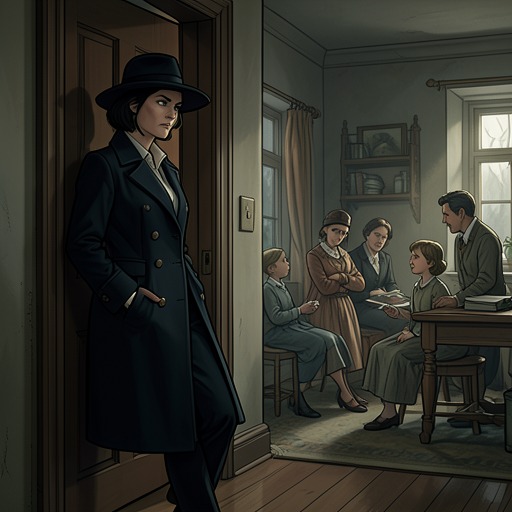
Miss Jenny lives in the country four miles from Jefferson, in the large house belonging to her late nephew-in-law’s family. She shares the household with Horace’s widowed sister and the sister’s ten-year-old son. Her sister-in-law has been a widow for ten years, while Miss Jenny, the great-aunt of the dead husband, remains a visible elder within the family structure. The narrative introduces her beside Horace at a window, watching the widow and Gowan Stevens walk in the garden. Her physical confinement is immediately established by the wheelchair, but the scene gives her no corresponding intellectual limitation: she observes, remembers, names, and judges.
Her position combines age, kinship, and domestic permanence. She belongs to a household organized around widowhood and inherited family space, while Horace arrives as a restless outsider who has left his own domestic obligations behind. The contrast makes Miss Jenny’s stillness significant. She does not need to travel to understand the patterns of men and women who do; the repeated garden scene, seen from the same window in different seasons, becomes evidence that the people moving through it are trapped in recurring behavior.
The Watcher Who Remembers
When Horace asks why his sister has never married again, Miss Jenny answers with the blunt assertion that a young woman needs a man. The statement is conventional, but her role in the conversation is not merely to repeat a social rule. She knows the history beneath the apparently innocent question and recognizes that Horace is observing his sister’s life while avoiding an examination of his own. She also identifies Gowan Stevens for him when he fails to remember the young man, recalling that Stevens has been visiting since returning from Virginia and distinguishing him from the earlier suitor, Herschell Jones.
The repeated observation of the garden gives Miss Jenny a form of narrative memory. Horace remembers seeing the same two figures the previous October, when Stevens was new to him and wore brown rather than the blue coat he wears now. Miss Jenny’s knowledge is more continuous than Horace’s: she has remained in the household while successive young men have appeared beside the widow. Her perspective converts romantic novelty into recurrence. What Horace experiences as a new visit is, to her, another variation in a pattern already observed.
Interrogating Horace’s Evasions
Miss Jenny’s most important relationship is with Horace, whom she addresses without the deference he might expect from an elderly relative. After he has become entangled in the consequences surrounding Lee Goodwin, she reads the Memphis paper with the family and later speaks to Horace privately in her room. Her question about whether his departure from Belle Benbow was motivated by disgust with domestic life cuts through his claim that he was not running from one woman to another. When Horace insists that he has not left one woman merely to seek another, Miss Jenny answers that he has been doing exactly that for ten years.
Her criticism is concrete rather than abstract. She connects Horace’s wandering with his earlier marriage and mocks the belatedness of his self-knowledge, remarking that it took him a long time to learn that a woman who does not make a good wife for one man is unlikely to make one for another. The remark exposes his habit of treating successive relationships as separate problems while refusing to recognize the constant element: himself. Miss Jenny refuses to let him turn dissatisfaction into destiny.
The family’s other judgments are harsher in a different way. Horace’s sister condemns his association with moonshiners and street-walkers, while Miss Jenny notes that he has already abandoned the street-walker as well. Her intervention does not defend his conduct; instead, it identifies the pattern beneath the scandal. She sees that Horace’s movement from respectable marriage into forbidden or socially marginal relationships has not made him freer. It has allowed him to keep changing settings while carrying the same evasion with him.
Counsel, Return, and Domestic Obligation
When Horace asks about the alternative to returning home, Miss Jenny reduces the choice to a test of character. She tells him that the other way is available if he lacks backbone, then names the course directly: he should go back to Belle, and he should go back home. Her advice is not sentimental reconciliation or a promise that domestic life will become easy. It is a demand that Horace stop treating departure as proof of independence.
The force of this counsel lies in its timing. Horace is surrounded by public crisis, legal danger, and the spectacle of Goodwin’s imprisonment, yet Miss Jenny returns the question to the private structure Horace has neglected. The novel places her domestic conversation beside the courthouse, jail, and public crowd, suggesting that responsibility is not exhausted by legal defense or dramatic loyalty. Horace may act as a lawyer for another man, but Miss Jenny asks whether he can assume responsibility for the life he himself abandoned.
Her advice also carries the authority of duration. She has watched Horace leave, return, and rationalize; she knows that his present crisis cannot be understood apart from the decade-long history of his choices. By telling him to return to Belle, she opposes the romance of permanent flight with the harder ethics of repetition, consequence, and repair.
Final Presence and Narrative Significance
Miss Jenny remains present after the trial and its public violence have reached their climax. Horace returns to the family house, eats supper, and speaks with his sister about his room. He says that he intends to stop there, then walks away across the porch and down the road. His movement initially appears to repeat his old pattern of departure, but the narrative brings him back toward Jefferson, where he hears the crowd and discovers the fire near the jail. Miss Jenny is not physically present at that scene, yet the moral pressure of her earlier command frames Horace’s movement: the question is no longer whether he can escape, but whether he can stop escaping.
At the house, she also participates in the understated tenderness of Horace’s return. When he says that his sister has been kind, Miss Jenny challenges his repeated phrase about her kindness, asking since when he has stopped smoking his pipe indoors. The exchange is small, but it restores the ordinary texture of family life against the sensational events surrounding Goodwin. Her humor does not erase the crisis; it makes clear what kind of world Horace has risked losing.
Miss Jenny’s characterization is therefore built from contrast. She is physically restricted but interpretively mobile; elderly but more perceptive than the adults who claim freedom; confined to a family house yet capable of diagnosing the roads by which Horace avoids it. The novel does not make her a sentimental emblem of wisdom. Her judgments can reproduce the gendered assumptions of her society, as in her insistence that a young woman needs a man, but she also turns those assumptions back upon Horace, forcing him to confront the obligations his own masculine freedom has displaced. Her narrative function is to make evasion legible: whenever Horace tries to explain himself as a traveler, lover, or principled lawyer, Miss Jenny recalls the husband, brother, and returning member of a household who must answer for the consequences of his choices.