Narcissa Sartoris
SanctuaryNarcissa Sartoris occupies the moral and domestic center of Horace Benbow’s family world, but that center is not stable. A widow for ten years, she lives in the country four miles from Jefferson with her ten-year-old son, Benbow Sartoris, in the large house belonging to her husband’s family, alongside Miss Jenny, the ninety-year-old great-aunt who is confined to a wheelchair. Narcissa’s importance lies less in public action than in the authority of this household: she represents continuity, propriety, family reputation, and the expectation that Horace will remain intelligible within those boundaries. When his legal and personal commitments carry him toward Lee Goodwin, Ruby Lamar, and the child, her domestic serenity hardens into open resistance.
Identity and Household Authority
Narcissa is first presented through the country house and its carefully enclosed social world. Horace watches her walking in the garden with a young man while Miss Jenny comments on the fact that Narcissa has never remarried. The question exposes the pressure placed upon a widowed woman: Miss Jenny insists that a young woman needs a man, while Narcissa’s decade of widowhood has become an established condition rather than a temporary absence. Narcissa is therefore both an individual woman and the custodian of a family structure in which marriage, gender, and reputation are constantly interpreted by others.
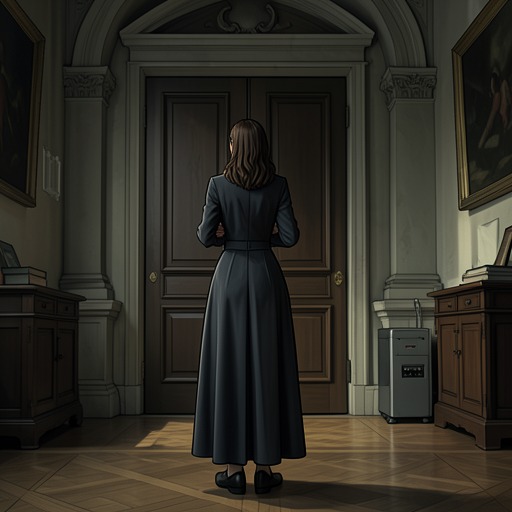
Her physical description reinforces the contrast between personal solidity and intellectual or emotional opacity. She is a large woman with dark hair and a broad, stupid, serene face, customarily dressed in white. The calm appearance is not simple passivity. It gives her a composed surface from which she can observe, judge, and regulate the conduct of others. When Gowan Stevens is introduced to Horace as Narcissa’s brother, the family’s internal relationships immediately become part of the scene: Narcissa notices Horace’s concern for Belle Benbow and Little Belle, nearly says something more, then stops and fixes him with a grave, intent look.
That look carries the force of an unspoken accusation or warning. Miss Jenny openly predicts that Gowan may eventually leave Belle, while also remarking that Narcissa would not be satisfied even if he did. Narcissa’s brief commands to silence do not resolve the issue; they show her attempting to preserve decorum while the household’s judgments circulate around her. Her authority depends on maintaining the appearance of order even when desire, infidelity, and resentment threaten it from within.
Conflict with Horace Benbow
Narcissa’s conflict with Horace becomes direct when he involves himself in Lee Goodwin’s case and takes responsibility for Ruby Lamar and her child. Her anger is cumulative. She recalls that Horace had taken another man’s wife and child away from him, then walked out of the house, opened a separate house in town, scrubbed it himself while the town watched, and lived there like a tramp rather than remaining where respectable people expected him to stay. His refusal to behave according to family expectations is, to Narcissa, not a sequence of independent choices but a sustained assault on the family’s dignity.
Her strongest condemnation comes when Horace decides to help Ruby, whom he himself has described as a street-walker and a murderer’s woman. Narcissa calls this deliberate involvement meddling. The word reduces Horace’s ethical commitment to an intrusive personal whim, because acknowledging Ruby’s vulnerability would require Narcissa to recognize a responsibility outside the boundaries of respectable kinship. Her fury is directed not only at Ruby’s social position but at Horace’s willingness to let that position redefine his own.
Horace answers that Ruby has nothing and no one. He describes her made-over dress as neatly maintained but about five years out of fashion, and the child as never having been more than half alive, wrapped in a blanket scrubbed almost white. His attention to these material details opposes Narcissa’s abstract language of propriety. He sees poverty, care, and abandonment; she sees contamination of the family’s social identity. Their disagreement is thus ethical as well as domestic: Horace treats another person’s need as an obligation, while Narcissa treats the same need as a danger to the household’s order.
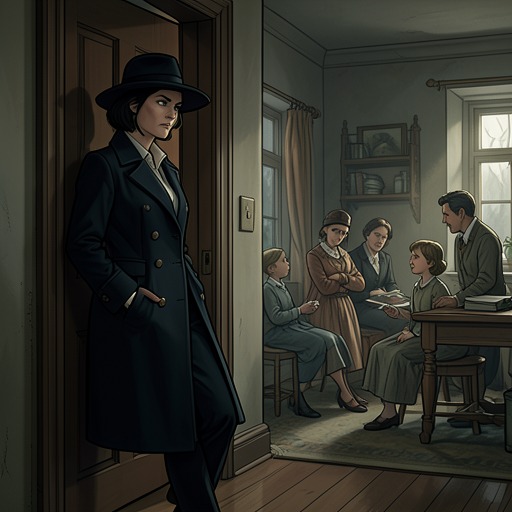
Narcissa also challenges the practical basis of Horace’s defense of Lee. Miss Jenny asks whether a moonshiner lacks the money to hire the best lawyer in the country, and the question exposes the family’s suspicion that Horace’s legal work is not required by necessity. Horace’s reply, that he cannot help himself because Ruby has no one, confirms that he is acting from a responsibility that family common sense cannot contain. Narcissa’s opposition helps define the moral pressure of the plot: Horace’s choice is not merely professional, because it costs him his place within the respectable household.
Refusal, Confrontation, and Forced Recognition
After events in town, Horace returns to his sister and tells her that he must take Ruby home. Narcissa’s response is immediate and categorical: she will not allow Ruby into her house. Horace looks at her and fills his pipe slowly and carefully before explaining that the matter is not a choice. The pause records the transformation of their disagreement into a confrontation over principle. Narcissa speaks as the owner or guardian of a domestic boundary; Horace answers as someone who has accepted a duty that overrides permission.
Her refusal is particularly consequential because Horace’s actions have already made the family’s private standards visible in public. He has abandoned the expected arrangement of his life, lived separately, and taken up the burdens of people whom the town excludes. Narcissa’s resistance attempts to restore a distinction between the family home and the social consequences of Lee’s alleged crime. Horace’s insistence prevents that distinction from holding, even though the evidence does not show him persuading her emotionally.
The contrast between Narcissa and Ruby is sharpened by the novel’s recurring attention to bodies, clothing, and dependence. Ruby carries the sleeping child while Horace carries milk and groceries; the child remains in a near-drugged immobility. In the jail, Goodwin places his hand on Ruby’s head and asks Horace to secure the child a newspaper-selling job when he is old enough to make change. Narcissa does not share this scene, but her opposition gives it a larger social meaning: the people she would exclude are precisely those whose survival depends on improvised forms of care rather than institutional protection.
The Courthouse and the Limits of Domestic Repair
At the courthouse, Narcissa waits in the car after the jury has been out for eight minutes. Horace emerges at dusk among the departing wagons, stiff and drawn like an old man, and she asks whether he wants to go home. Her wording immediately divides home into two possibilities: the house or the country home. The question acknowledges that Horace’s return is not self-evident. He may return to the domestic property associated with her, or he may return to the separate house whose existence marked his break with the family arrangement.
This exchange is restrained, but it carries the pressure of their entire conflict. Narcissa does not openly repeat her earlier accusations, nor does she offer a reconciliation. Instead, she frames Horace’s destination, making him choose what kind of belonging remains available. Her role has shifted from angry guardian of the household to the person who can still offer, or withhold, a path back into it.
Horace finally leaves the car with the suitcase that had remained in the closet at Narcissa’s home for ten years and that he brought into town on the morning she asked the name of the District Attorney. The suitcase materializes the duration of his suspended life and the delayed movement away from the family home. When he reaches his own new house, he sees the rose-colored shade at his wife’s windows, enters through the back, and finds her reading in bed beside chocolates. He tells her, “I came back.” Narcissa is absent from this final domestic scene, but her presence remains in the suitcase and in the question of where “home” is.
Narrative Significance
Narcissa is not simply a conventional opponent whose judgments the novel asks the reader to dismiss. Her household embodies a genuine system of attachments: a widowed woman, a child, an elderly dependent, inherited property, and the habits of a family that has survived by preserving recognizable forms. Yet the same system turns social respectability into a mechanism of exclusion. Narcissa can respond to Horace’s disruption only by naming it meddling, impropriety, and betrayal of the home.
Her serene face and furious voice expose the gap between appearance and ethical consequence. The calm white-dressed woman in the garden belongs to a world that prizes composure, while the events outside that world bring poverty, violence, criminal accusation, pregnancy, and abandoned children directly against its walls. Horace’s decision to protect Ruby and the child forces Narcissa to confront an other whom the family’s categories would rather leave unseen. She resists that summons, but her resistance makes the summons legible.
Narcissa’s final significance is therefore structural as much as personal. She marks the domestic order Horace leaves, the social judgment that follows him, and the possibility of return that remains morally compromised. The novel does not give her a dramatic conversion. Instead, it preserves her as a steady pressure against Horace’s altered commitments, showing how family loyalty can function simultaneously as care, possession, reputation, and refusal of responsibility toward outsiders.