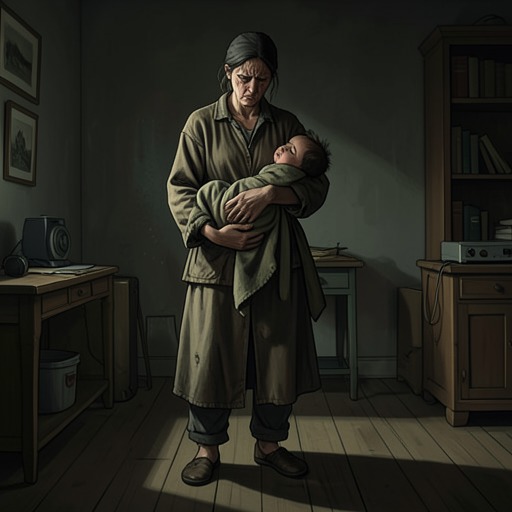
Ruby Lamar
SanctuaryRuby Lamar, known in the courtroom as Mrs. Goodwin, is Lee Goodwin’s wife and the mother of a child not yet a year old. Her decisive significance lies in the way she connects several otherwise separate worlds: Memphis prostitution, the rural household at the Old Frenchman place, the domestic labor of survival, and the public machinery of law. She is at once a hidden woman being threatened with exposure, a caretaker protecting an infant from rats, a reluctant witness, and a person whose limited choices help determine Lee Goodwin’s fate.
Identity and Introduction
Ruby first appears not as a socially secure wife but as a woman concealed in the country. Popeye threatens to return her to Memphis and to expose that she has left hustling on Manuel Street. He mocks her for living at the Old Frenchman place, wearing Lee Goodwin’s discarded shoes, and chopping her own firewood, while implying that her absence from prostitution is temporary and precarious. Her immediate response is fury: she calls him a bastard, but the exchange also reveals how completely Popeye understands the material vulnerability from which she cannot easily escape.
The Old Frenchman place intensifies that vulnerability. The house is a gutted plantation ruin built before the Civil War, standing amid land that has reverted to jungle and that local people have dismantled piecemeal for firewood while searching for reputed buried gold. Ruby’s presence there is therefore not an image of settled domesticity. She occupies a decaying remnant of an older social order, cooking for men in a house whose history, isolation, and physical disrepair make privacy and protection uncertain.
Her appearance reinforces this condition. She cooks in a faded calico dress and wears an old pair of men’s brogans, unlaced around her bare ankles. Later, in Jefferson, she wears a neatly brushed gray crepe dress with hand-darned seams, a cheap purple shoulder ornament, and a gray hat with a carefully mended veil. The contrast is not a transformation into security; it shows the labor of preserving respectability with worn materials. Her clothing records both poverty and an effort to maintain a recognizable social identity while the people around her attempt to define her through prostitution, marriage, and scandal.
Domestic Labor and Maternal Responsibility
Ruby’s life at the Old Frenchman place is organized by work. When Popeye tells her to cook because the visiting professor will want food, she answers that she cooks for men whom she describes in contemptuous, degraded terms. The repetition of cooking in her reply makes domestic labor sound less like a chosen household role than an imposed routine extending across a population of male dependents. She is expected to feed the men, wash, and keep the household functioning while receiving little protection in return.
Her most concrete act of care concerns her child. She keeps the sleeping infant in a box behind the stove because rats might get to him. Horace Benbow discovers the child there and initially mistakes the box for something else before recognizing the pinched sleeping face. The scene makes Ruby’s motherhood inseparable from the brutal conditions in which she must practice it: she protects the child with the only enclosure available, while the kitchen, the stove, and the surrounding house remain exposed to vermin and disorder.
Ruby’s guardedness does not cancel her attachment to the child. When Benbow offers to send something from Jefferson, she does not ask for an abstract rescue or a change of life; she asks for an orange-stick, naming a small, concrete object that belongs to the daily burden of dishwater and washing. Later, Lee Goodwin asks Benbow to secure the boy a newspaper job when he is old enough to make change and assures Ruby that she will be all right. The child thus becomes the point at which both adults imagine a future, even though the future remains dependent on charity, work, and the uncertain protection of men.
Encounter with Temple Drake
Ruby’s interaction with Temple Drake exposes the gulf between their social positions while also creating a temporary alliance between two endangered women. Temple arrives frightened and asks Ruby to persuade Lee Goodwin to obtain a car and take her somewhere. While holding the infant, Temple insists that people at the house are ordinary and tries to invoke her father’s judgeship and the governor’s visits to her family home as guarantees of protection. Ruby rejects that appeal to class privilege, attacking Temple’s assumption that women like her can retreat to respectable families whenever danger becomes real.
Ruby’s anger is sharpened by what she recounts about Lee. She tells Temple that he killed a fellow soldier over a woman in the Philippines, was sent to Leavenworth, was released for wartime service, won two medals, and was returned to Leavenworth afterward until a lawyer and a congressman secured his release. This history turns the Old Frenchman place into more than a rough refuge. Ruby knows that the man from whom Temple seeks help has a record of lethal violence and institutional confinement, and her knowledge makes her warning both personal and immediate.
Temple’s own story of Frank’s death further complicates Ruby’s hostility. Temple describes how her father took a shotgun and killed Frank after Temple tried to stand between them. Ruby hears this confession while turning meat in the skillet and responds by placing Temple among the privileged women who claim purity yet seek help from women considered beneath them. The exchange is not simple solidarity, but neither is it mere rejection: Ruby’s contempt and Temple’s fear meet inside the same household, where both are forced to depend on a man whose violence exceeds their control.
When Ruby finally helps Temple leave, she does not become gentle or reconciled. They cross the porch barefoot like ghosts, and about fifty yards from the house Ruby stops, grips Temple by the shoulders, curses her in a whisper, and flings her away before continuing toward the barn. In the dark hallway, a rat rushes nearby; Temple panics and clings to Ruby, while Ruby identifies the danger as merely a rat. The scene binds their escape to the material conditions Ruby has already been managing: the vermin threatening the child also become part of Temple’s terror.
From Hidden Wife to Public Witness
Ruby is the person who takes Temple to Tull’s house, two miles away, so that she can use the telephone. With Tull’s family still eating Sunday dinner around the table, Ruby patiently reaches the sheriff and identifies the location as the Old Frenchman place. She gives the essential information in the name of Mrs. Goodwin, making her marriage both a source of authority and a dangerous public exposure. Her movement from the isolated ruin to the telephone and then toward official intervention marks the first major shift in her position: she becomes the channel through which the crime enters the legal world.
After Lee Goodwin is taken to town, Ruby remains connected to him through the child and through the case. In Jefferson, she tells Benbow that they have no money and begins to explain that the last batch Popeye handled did not bring payment. Benbow interrupts her and postpones the disclosure until morning, but the unfinished statement reveals a financial crisis behind the family’s apparent domestic arrangement. Ruby is not merely a witness to violence; she is also economically exposed, dependent on transactions controlled by men and vulnerable to Popeye’s failure or betrayal.
Benbow takes Ruby and the child to his house, carrying milk and canned groceries while she carries the sleeping infant. He suggests finding a nurse, an offer that acknowledges both the child’s frailty and Ruby’s inability to provide secure care alone. Their relationship is practical rather than sentimental: she accepts assistance, but her clothes, her guarded manner, and her continued responsibility for the child keep the imbalance visible. Her survival depends on a sequence of male interventions, yet those interventions never erase the conditions that made them necessary.
Testimony and Ending
At the trial, the District Attorney offers the bullet from Tommy’s skull and a stoneware jug containing corn whiskey as evidence. Benbow calls Mrs. Goodwin to the stand and helps Ruby into the chair while Lee’s eyes remain on him. Ruby repeats the account she had given Benbow after the child became ill. Lee tries twice to interrupt and is silenced by the Court, while Benbow refuses to look back at him. Ruby’s testimony therefore converts private knowledge into public evidence, but it also places her between the legal system and the husband whose rage she must endure.
The courtroom preserves her as an image of exhausted maternal performance. She sits erect in the worn gray dress and hat with the darned veil, the purple ornament still on her shoulder, while the child lies on her lap in drugged immobility. Her hand hovers over the child’s face, performing needless maternal gestures almost without awareness. The gesture suggests both genuine care and the mechanical repetition of a role demanded of her: motherhood is her visible defense, her burden, and the social form through which the court reads her.
After the proceedings, Ruby remains in the courtroom with the child while Temple leaves surrounded by her family’s men. Temple’s exit is marked by repeated stops, shrinking movements, and the protective wall formed by the older man and four younger men. Ruby’s position is the opposite: she is not carried away by a family network but left at the counsel table beside the prisoner, Benbow, and the prosecutors. The contrast makes class protection visible without requiring Ruby to explain it. Temple can be physically enclosed by respectable male relatives; Ruby must remain exposed as the wife whose testimony has helped condemn her husband.
When the courtroom’s attention breaks and the child whimpers, Ruby tells him to hush. Her final recorded action is quiet and functional rather than triumphant. The narrative does not give her a secure home, financial independence, or a resolved future. Instead, it leaves her with the infant, the worn signs of respectability, and the consequences of having spoken. Ruby’s ending is consequently defined by survival under pressure: she has moved from concealment at the Old Frenchman place to public testimony, but the structures that made her vulnerable remain around her.