Tommy
SanctuaryTommy is the barefoot, overalled countryman whose grotesque humor and alert, secretive manner briefly animate the rural world around Popeye, Lee Goodwin, and Temple Drake. He is more than comic relief: his unease around violence, his recognition of danger, and his death expose how people who live at the margins of social identity can be indispensable witnesses yet remain almost literally nameless within the community and its institutions.
Identity and Introduction
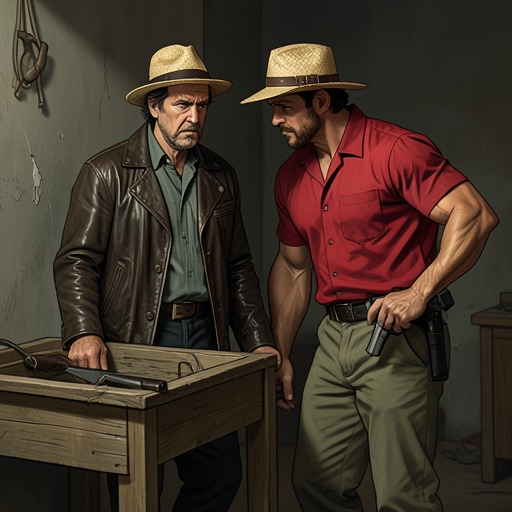
Tommy first appears as a man stooped in overalls, barefoot, with a sunburned, matted thatch of hair, pale furious eyes, and a short soft beard the color of dirty gold. His physical appearance places him within the hard, impoverished landscape of the countryside, but his behavior complicates any simple image of a dull laborer. He enters the kitchen with a shuffling sound, crosses the room in a shambling, bear-like gait, and carries an air of alert and gleeful secrecy, as though he is perpetually waiting for a joke whose proper moment has not arrived.
That secrecy is attached to practical knowledge. In plain sight of Popeye and the woman, Tommy removes a loose board in the floor and takes out a gallon jug, concealing it clumsily below his flank as he leaves. The hidden jug connects him to the illicit rural economy surrounding Lee Goodwin’s operation, while his furtive glance at Popeye suggests that he understands the danger of the stranger before he openly confronts it. His apparent foolishness therefore coexists with observation and instinct.
Tommy’s speech establishes his distinctive social presence. He calls himself “Tawmmy,” using a rural pronunciation that becomes part of his identity, and he responds with baffled amusement when another man calls him Jack. His correction is not merely a joke about names. It shows that even within the loose, familiar community of the countryside, Tommy’s identity is unstable in the eyes of others, while his own insistence on the name he knows remains one of the few forms of self-definition available to him.
Conduct and Relations
Tommy’s encounter with Popeye reveals both his comic temperament and his vulnerability. He watches Popeye’s face as the latter lights a cigarette, notices the match flare between his hands, and follows the small burning object into the weeds. Tommy’s reaction is bodily and repetitious: he writhes slowly, calls Temple a poor little creature, and considers going down to the barn to remain there. His response conveys fear without the vocabulary of formal moral judgment. He recognizes that Temple is in danger and that Popeye is dangerous, yet he can express the recognition only through country idiom, nervous movement, and avoidance.
The encounter with Popeye also gives Tommy a peculiar position between witness and participant. He does not challenge Popeye directly, but he watches him, understands enough to retreat, and remains near the house. His alert diffidence makes him seem ready to laugh even while he is frightened. This combination of mirth and apprehension is central to his characterization: humor is not evidence that he fails to perceive violence; it is the form in which his perception emerges.
Tommy later recounts Popeye’s killing of a dog. He says that the animal came from under the house, sniffed Popeye’s heels while Popeye was barefoot, and caused Popeye to flinch as though confronted by a moccasin. Popeye then drew a small automatic pistol and shot the dog dead. Tommy stresses the absurd disproportion between the harmless animal and the armed man, identifying the dog as his own and adding that it would not hurt a flea. The story turns a seemingly minor incident into a demonstration of Popeye’s reflexive violence and Tommy’s capacity to preserve the scene’s telling details.
His farewell to Horace Benbow further defines his social position. When Benbow extends his hand and asks for his name, Tommy solemnly pumps the lawyer’s hand once with his limp, calloused one and answers that his name is “Tawmmy.” He is described as a squat, shapeless figure against the faint glare of the road, while Benbow stumbles into the truck and is warned to watch himself. The contrast is telling: Benbow belongs to the world of professional identity and legal speech, but Tommy’s handshake and name are more materially grounded, marked by labor, bodily awkwardness, and the uncertainty of how others record him.
Witness to Danger
Tommy’s watchfulness becomes especially significant when he observes Temple in the isolated room. After Popeye comes outside, Tommy goes around the house and looks through a window partly blocked by a sheet of rusted tin nailed across a missing pane. Inside, Temple sits on a bed with her legs tucked beneath her, her hands in her lap, and a chair wedged against the door. The room contains almost nothing beyond the bed, faded quilt, chair, raincoat, and khaki-covered canteen; its cracked plaster and exposed lathing intensify the sense of confinement.
From outside, Tommy sees Temple’s head turn slowly and unnaturally, as if she is following someone beyond the wall. She eventually takes a tiny watch from the top of her stocking, studies it with calm, empty eyes, and returns it to its place. Tommy does not enter or rescue her, but his observation preserves the details of her suspended terror. His presence outside the window creates a morally charged gap between seeing and acting: he is close enough to register what is happening, yet the violence around him has made intervention nearly impossible.
That gap helps explain the later importance of Tommy’s final testimony. In questioning, a witness identifies Tommy as being outside the crib by the door and watching. He reportedly said that he would not let someone proceed, though the surviving evidence does not supply the complete sentence or establish precisely what he intended to prevent. The fragment nevertheless changes his status in retrospect. Tommy was not simply a bystander wandering through the scene; he was positioned at its threshold, observing and apparently attempting, in some limited way, to restrain what was occurring.
Death and Loss of Name
Tommy’s death is presented through the public aftermath in Jefferson. On the Monday after the rural events, townspeople gather around the courthouse and square, while others visit the undertaker’s parlor. Boys and youths press their faces against the glass, and younger men enter in pairs and threes to look at the body of the man called Tommy. The phrase emphasizes that the community possesses a nickname but not a full legal identity.
His body lies barefoot on a wooden table in overalls. The sunbleached curls at the back of his head are matted with dried blood and singed with powder. These details materially register the violence that has killed him, but they also return him to the appearance by which he was known in life: barefoot, dressed for labor, and detached from the markers of respectable citizenship. The coroner attempts to determine his last name, yet nobody can provide it—not the people who have known him around the countryside for fifteen years, nor the merchants who have occasionally seen him in town.
The failure to recover Tommy’s surname is more than an administrative inconvenience. It reveals a community that can recognize a body socially while failing to recognize the person legally. He has been visible for years, remembered as a barefoot man with an empty gaze and a peppermint jawbreaker bulging in his cheek, but that familiarity never becomes documented identity. Death makes the contradiction impossible to ignore: the town gathers to look at him, yet its institutions cannot say who he was.
Narrative Role and Significance
Tommy occupies the novel’s unstable border between comic grotesque and tragic witness. His dialect, laugh, shambling gait, hidden jug, and stories about the dog invite readers to see him as an eccentric rural figure. At the same time, his physical fear, his attention to Temple, and his observation of Popeye’s violence make him a sensitive register of danger. The apparent foolishness of his manner does not cancel his perception; it protects and disguises it.
His death converts that disguised perception into evidence while exposing the limits of evidence itself. Tommy can report what he sees, and others can later repeat that he was watching outside the door, but the legal and social order still cannot restore his complete name. He is therefore both necessary to the reconstruction of the crime and excluded from full recognition by the world reconstructing it.
Tommy’s trajectory moves from furtive rural presence to public corpse, with no corresponding movement toward social dignity. His final significance lies in that cruel imbalance. He sees more than the people who dismiss him may understand, but he lacks the power to make his understanding count while alive; after death, his observations matter, while his identity disappears. The character embodies a central contradiction of the narrative’s violence: the powerless may bear witness to the truth, yet the structures that need their testimony may still treat them as expendable and unknowable.