La grande déesse Télé
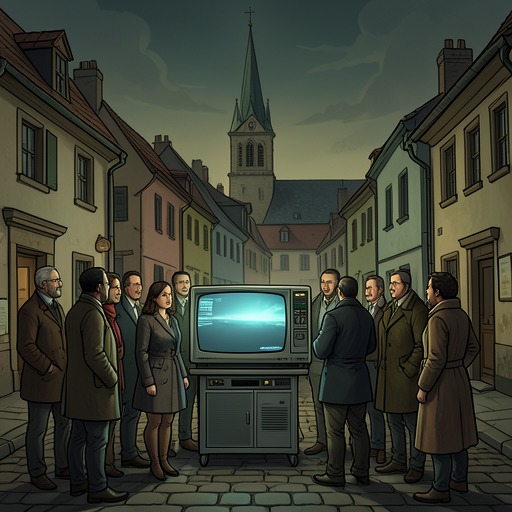
SatanLa grande déesse Télé is the novel’s personification of television as a force that reshapes life in Touladi. Its blinking eye becomes a rival to the eye of God: a modern altar promising democratic instruction and entertainment, yet carrying an unsettling power to reorganize attention, community, and belief.
The Apparatus as a Presence
When La Grébiche came to inspect the television a few days after its arrival, she regarded it with a mixture of amusement and suspicion, repeatedly muttering that the devil was inside it. Annette, too, kept a respectful distance, apparently sensing something uncanny in the device. Yet she became one of the household’s most faithful viewers, waiting eagerly for the daily programs while never daring to switch the set on herself. The contrast gives the new medium its peculiar charge: it is both an object of fear and a source of fascination, powerful enough to attract its most apprehensive observer.
A New Domestic and Communal Rhythm
In the autumn of 1954, television carried Touladi into the “global village.” The novel presents that arrival as a sudden breach of distance: people accustomed to hearing faraway voices on the radio now saw a speaker from Montreal, hundreds of kilometres away, appear in their living rooms face to face. The immediacy could leave the more impressionable viewers stunned, confronted by visible expressions and bodies as well as distant voices.
The new medium soon changed the village’s routines. When popular serials were broadcast, the streets and the spaces around the houses emptied more completely than they did during Sunday mass. Evening gatherings for cards, checkers, or conversation gradually diminished, except among a few persistent older residents. At first, neighbors gathered in one another’s homes to watch; later, as families acquired their own sets, viewing became a more private habit. Television thus offered shared entertainment even as it weakened the need to assemble in person.
The New Goddess and the Old Faith
The expression’s religious language sharpens the contrast between technological modernity and inherited belief. As television’s appeal grew, the priest’s sermons increasingly reached distracted listeners, drawn instead to the medium’s supposedly democratic teachings. The blinking eye of La grande déesse Télé supplanted God’s eye, which the rhetoric of modern progress demoted to an archaic belief. The image does not describe a simple replacement of religion by entertainment: the television is itself cast as a divinity, a new authority before which villagers gather. Its significance lies in that reversal, as a device once suspected of harboring the devil becomes the village’s modern source of instruction, spectacle, and collective attention.