Les petites boîtes
SatanLes petites boîtes is the image that turns an ordinary village into a miniature, precarious world in Loïc’s imagination. Seen from his father’s airplane, Touladi’s houses resemble matchboxes; from within that vision, homes, minds, coffins, and graves fold into one another. The expression recurs as more than a description of scale: it links the smallness of human life to the vulnerability of the places that contain it, and later gives shape to Loïc’s thoughts about his missing biological father.
An Aerial View of Touladi
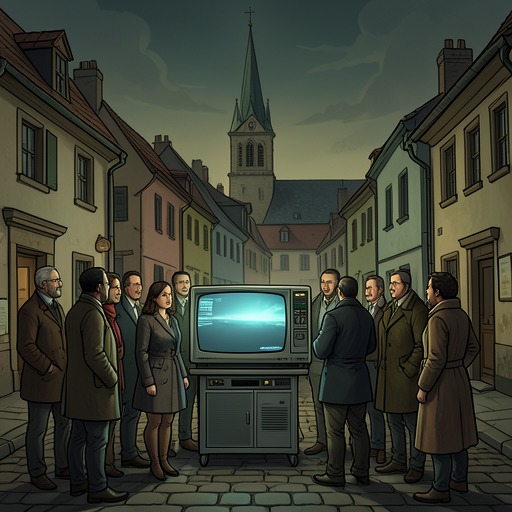
The image takes form during the airplane ride after the earthquake. As the plane climbs over the lake and forest and turns back toward the village, Loïc recognizes its two rows of houses following the bends of a lake and two rivers, then drawing closer around the church. From above, the settlement seems reduced to a line of little boxes. He can pick out the house where he lives, at the bend in the main street near the cemetery road, set among elms and a cherry orchard. The familiar home remains identifiable, but its place in the landscape has changed: it is one small container among many.
That change in scale unsettles the safety usually associated with a home. Loïc imagines that a hand could move the house or a finger crush it. The earthquake has already shaken it, making its apparent solidity newly doubtful. He wonders whether the houses are arranged for God’s amusement, and whether divine or angelic eyes regard people from above, able to see through roofs and walls. The vision makes the aerial perspective at once playful and threatening: the village resembles a toy, but the power that might handle it is beyond human control.
Nested Containers: Home, Mind, and Grave
The houses contain not only their inhabitants but also, in Loïc’s thought, everything those inhabitants carry within themselves. At the eastern edge of Touladi he recognizes his grandfather Bolduc’s house; nearly opposite is the house where people say he was born. He imagines all the villagers enclosed in their homes, with their thoughts, emotions, and memories contained in their skulls. The nesting image thus moves inward: the village holds houses, the houses hold people, and people hold private worlds of memory and feeling. The alias associated with the expression, the world as a series of nested boxes, captures this expansion from visible settlement to inward life.
The same structure turns ominous when Loïc considers death. Another earthquake, stronger than the one that has just shaken the houses, might bring them down like houses of cards. The little boxes would then become coffins. Their inhabitants, including Loïc and his parents, would be shut away in further boxes beneath the earth, in the cemetery. A home and a coffin are not identical, but the image makes one frighteningly convertible into the other: both are bounded spaces that hold a life, and both may become inaccessible from outside.
The Cemetery Beneath the Flight
As the plane passes the village, circles near the mountain hiding Lake Témiscouata, and flies over the church steeple, Loïc’s attention turns to the cemetery above Lake Squatec. Beneath the orderly rows of gravestones he imagines more boxes, with the dead enclosed inside them. The orderly surface does not dispel the fear of what lies below; it gives that fear a visible arrangement, one box after another.
His thought returns to a child found turned over in its grave during the cemetery’s relocation after the 1944 landslide. The child’s jaw had closed on its own forearm. The account Loïc overheard among adults identified the child as a victim of the Spanish flu, buried too quickly amid the epidemic’s many deaths among Touladi’s children. This remembered story makes the box image bodily and specific. A coffin is not merely a figure for death but a confined space in which, in Loïc’s fearful imagining, a child might wake without air and be unable to cry out. The aerial ride therefore moves from the apparent fragility of houses to the still more terrible possibility of consciousness trapped underground.
The Image Returns with Loss
In the winter of 1953, after learning that Alcide has disappeared, Loïc is confined to the house by successive bouts of measles, mumps, and jaundice. His own enclosure by illness coincides with the uncertain fate of his biological father. He imagines Alcide shut inside a flying box, rising, falling, turning, and spinning through snow squalls. The airplane that once gave Loïc a view over the village becomes the imagined container of a man who may never return.
From his feverish place at the frost-covered window, Loïc follows the snow and blizzard in dreams that carry him away from the house, even as his body remains confined within it. The contrast deepens the expression’s meaning: boxes can hold people fast, but they also become images through which the mind pictures departure and disappearance. Earlier, the aerial view made the whole village seem fragile under a power beyond it; now the absent father’s aircraft becomes a small, isolated enclosure inside the vast northern storm. Les petites boîtes binds these episodes through a shared sense of vulnerability, turning familiar houses, the inward lives of their occupants, graves, and a missing pilot’s airplane into variations on the same unsettling question of what a container protects—and what it can imprison.