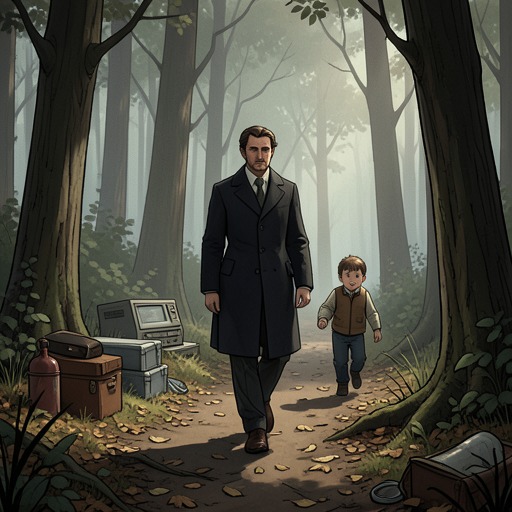
Loïc D’Anjou—Guillaume D’Anjou
SatanGuillaume D’Anjou is both Loïc’s uncle and adoptive father: after Loïc’s mother dies in childbirth, Guillaume and Marie-Louise D’Anjou take in the frail newborn and adopt him with the agreement of his biological father, Alcide Bolduc, and the Bolduc family. Their relationship is formed through urgent care, formally chosen parenthood, and the child’s growing recognition of Guillaume as his father; it is also tested by the possibility that Loïc might be taken back into his birth family.
Adoption in a Moment of Crisis
Loïc’s adoption begins not as an abstract arrangement but as a response to a dangerous first days of life. After Marie-Ange D’Anjou dies, the relatives gathered at her home decide that Guillaume and his daughter Laurette will take the baby to their house, where he can be cared for more closely. The newborn is in such poor condition that the family fears he may not live. When Laurette brings him to the Founder’s House, Guillaume gathers his mother, his wife, and his three daughters and solemnly urges them to look after Marie-Ange’s child. The account emphasizes both the family’s collective responsibility and Guillaume’s personal role in making a place for the infant.
The urgency continues at the church. Because Loïc remains so weak, he is taken promptly to be baptized; Guillaume and Marie-Louise serve as his godparents. They then decide to adopt him. The decision has the agreement of Alcide, who is still not fully sober, and of the Bolduc family, which takes responsibility for the other two children. Loïc’s new household is therefore established through a negotiated division of care between the D’Anjou and Bolduc families, not by the disappearance of his birth father or birth family from the story.
Care, Naming, and Recognition
The adoption places Guillaume in the role of a father while Loïc is still precariously suspended between life and death. The baby is described as bluish and limp, taking in only a little milk and spitting most of it back out; for many days and nights, his survival remains uncertain. The novel’s account of his condition gives the decision to adopt a material weight: Guillaume’s household is taking responsibility for a child who requires sustained attention, not simply granting him a family name.
A later exchange makes the emotional meaning of that responsibility visible. After an earthquake interrupts the household, Loïc is allowed to go by plane. He answers Guillaume by addressing him as his father. Guillaume is deeply moved by the word and turns away so the child will not see his emotion. The moment is brief, but it marks a change from the formal acts of baptism and adoption: Loïc’s address expresses a lived bond, while Guillaume’s restrained response shows how strongly he receives it. The child’s trust appears in an ordinary permission, not in a declaration about family.
Birth Family and Custody Tension
The adoptive relationship exists alongside Loïc’s continuing connection to Alcide. When Loïc is young, a rumor circulates in Touladi that his household may change and that Alcide, described as an aviator, intends to reclaim him. Loïc’s brothers and cousins tell him that they believe the rumor. Meanwhile, Guillaume and Marie-Louise are caught in the growing tension between the Bolducs and the D’Anjous, two powerful families in the village. The prospect of a transfer turns private parentage into a public contest over where the child belongs.
Loïc overhears his parents discussing the rumor while hiding in the washroom. He is intimidated by their conversation, and the surrounding account places his fear within a childhood already shaped by unsettling experiences and a sense of unseen presences. The adults’ custody conflict is thus not merely background: it reaches the child before he can understand or settle it. Guillaume’s fatherhood is emotionally real, but its security is exposed to the claims and expectations of the Bolduc family.
Adoption and Family History
The novel also sets Loïc’s adoption beside a much older secret in the D’Anjou family. Guillaume learns that the Founder was adopted and had concealed both that fact and his uncertain origins. This parallel does not make the two adoptions identical: the Founder’s adoption is bound up with secrecy, a hidden object, and an unknown birth family, whereas Loïc’s is openly agreed to by the Bolducs and enacted within the household that raises him. Still, the revelation makes adoption part of the family’s history rather than an isolated exception.
For Loïc and Guillaume, the distinction between biological descent and social parenthood is concrete. Alcide remains Loïc’s birth father, but Guillaume assumes the daily and publicly recognized role of father; the adoption joins them without erasing the competing family ties. The tenderness of Loïc’s address and Guillaume’s response supplies the relationship’s clearest resolution, even as the earlier custody rumor shows that affection alone cannot prevent kinship from becoming a source of tension.