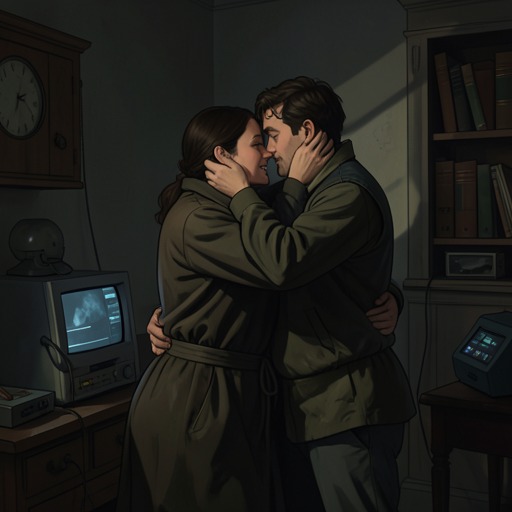
Loïc et Brigitte
SatanLoïc and Brigitte’s relationship is a consuming attachment built around mutual attraction and the desire to see oneself reflected in another. Its movement from exhilaration to violence makes that mirror increasingly damaging: the relationship that seems to promise fusion becomes a struggle between two egos, and an unexpected pregnancy followed by abortion deepens Loïc’s sense of loss.
Meeting and Attraction
The relationship begins unexpectedly at a literary cocktail held alongside the Montréal book fair. Loïc notices Brigitte at the bar, her dark hair catching the light; when she meets his gaze and smiles, he approaches. Their first exchange establishes an immediate familiarity: he asks whether they know each other, and she says that she knows him. The narrative presents the encounter as the beginning of a passion that will leave him profoundly changed.
Brigitte speaks eagerly about books and, especially, poetry. She tells Loïc about two poets she has known and loved. One, a Lebanese man, had been her partner for two years in a relationship she describes as difficult and from which she had not fully recovered. The other published under the name Leroy and, she says, descended from Russian nobility. She carries his poetry with her to reread on buses, in the metro, and in restaurants. As she talks, Loïc becomes increasingly drawn to her. Her animated discussion, the allure he finds in her manner and accent, and her openly expressed admiration for poetry all form part of the attraction as the novel recalls it.
The Mirror They Form
One of Loïc’s lasting images of their first meeting is of the two of them, drinks in hand, reflected in the dark windows, with the illuminated downtown skyscrapers beyond them. In retrospect, the reflected pair anticipates the relationship itself. Loïc sees their bond as a kind of double mirror: each needs the other to produce a flattering image of the self. What begins as mutual reflection gradually becomes more demanding and, eventually, tyrannical.
The narrative presents their attraction as an experience that preceded clear explanation. Loïc later considers whether he was drawn into something like hypnosis, an experience in which Brigitte’s appeal had both a bright and a dark side. He recalls an intense desire for fusion, as if the boundaries between them could disappear. At the time, he does not pause to define the attachment as narcissistic or destructive. In retrospect, he recognizes that each answered a need in the other: Brigitte valued his charisma, while he was captivated by her erotic appeal and the charm of her foreignness.
Their shared interests extend beyond literature. Brigitte is drawn to science fiction, fantasy, occultism, parapsychology, and purported extrasensory phenomena. She brings Loïc into New Age activities, including tai chi, yoga, aikido, strict macrobiotic diets, and personality-development weekends involving rebirthing through hyperventilation. He does not remain committed to those practices for long. He nevertheless gives Brigitte the teasing nickname Brigitte of the spirits, reflecting how closely he associates her with these interests.
From Passion to Conflict
The relationship’s early intensity does not protect it from deterioration. The narrative describes a reversal: passionate closeness is increasingly followed by furious confrontations. Their everyday life becomes saturated with arguments. Brigitte sometimes slaps Loïc and throws whatever is nearby, including plates, glasses, and utensils. The quarrels grow more frequent and more severe, and both suffer as the relationship descends into brutality.
Intimacy and aggression become entangled rather than remaining separate parts of their life together. The novel describes encounters following violent disputes as part of a disturbing confusion between desire, pain, and anger. That pattern gives the relationship its central contradiction: the force that first drew them together appears again in their conflicts, but in a destructive form. Loïc’s later interpretation is that their search for fusion had proved illusory. What had seemed like a momentary unity of feeling became, in his view, either mechanical gratification or a contest between egos for submission and control.
The imagery of fire and ashes marks the cost of this change. The passion that had seemed exhilarating becomes consuming and corrosive; eventually, Loïc recalls, pain and ashes are what remain of the couple. His account does not treat the relationship’s collapse as a simple loss of attraction. It traces how the original promise of self-transcendence was compromised by a dependence on the other person as a mirror.
Pregnancy, Loss, and Aftermath
An unexpected pregnancy becomes another decisive rupture. A double ovulation had escaped the Ogino method, and the decision not to have a baby is made quickly: Brigitte has an abortion. The narrative offers little practical detail about the decision, but gives substantial attention to how Loïc remembers its aftermath. On a cold winter morning, he walks morosely between rows of black trees, imagining them as mourners heading toward the nonexistent grave of the unknown child. He associates the termination with cries rising within him, an image that recurs in his later account of grief.
For a long time, Loïc imagines unborn children crying from a prenatal limbo, their voices unable to reach the world. This is his inner and symbolic response, not a claim that the pregnancy involved multiple children: the narrative identifies a single unexpected pregnancy and describes the double ovulation as its circumstance. In the year that follows, he interprets his distress through images of evil and a world in which the unborn are lost without names. The abortion thus connects the history of his relationship with Brigitte to a broader preoccupation with death, absence, and the power of the never-born.
Retrospective Meaning
Loïc eventually escapes the consuming passion, though he does not specify a precise moment or mechanism of separation. He recalls being relieved to have survived it and compares his recovery to a phoenix rising from ashes. That survival requires him to recognize the mirror itself as a trap. A reflection supplied by another person, or by an imagined version of oneself, can become a substitute for the risk of being oneself without such confirmation.
The relationship also belongs to Loïc’s broader search for fusion, which he believes has disappointed him in other attachments and even in friendship. He tentatively connects that longing to the tragedy of his birth and the suppressed imprint of his stillborn twin sister. The novel presents this as his retrospective interpretation, not as a settled explanation of Brigitte’s actions or of the relationship. Within that account, their romance is both a specific destructive bond and one episode in a larger effort to find a completeness that earthly relationships cannot provide.