The Disputed Kinship Claim between Charles de Castelmont and Mathieu D’Anjou
SatanThe disputed kinship claim between Charles de Castelmont and Mathieu D’Anjou makes family descent a question of evidence, inheritance, and an object whose identity cannot be secured. Mathieu argues that Élie D’Anjou, an American-born child adopted by a French-Canadian couple, was a Castelmont; Charles, whose family history is bound to a long-running inheritance dispute, is forced to consider the claim when the documents arrive in October 2016. The evidence shakes his certainty, but the exchange produces no confirmed kinship: the cameo photographs reveal a counterfeit, and no DNA test is reported.
Family History and the Documentary Trail
The claim rests on a hidden history of adoption. Élie D’Anjou had told Marthe that he himself had been adopted and knew nothing of his original family. He also confided that a valuable stone in his safe troubled him because it came from the United States, his country of origin. Afraid of the object, he had sewn it into his scapular and clothing, intending to be buried with it and to have the matter forgotten. His reticence left later generations with a secret but no clear explanation of how the stone connected to his birth family.
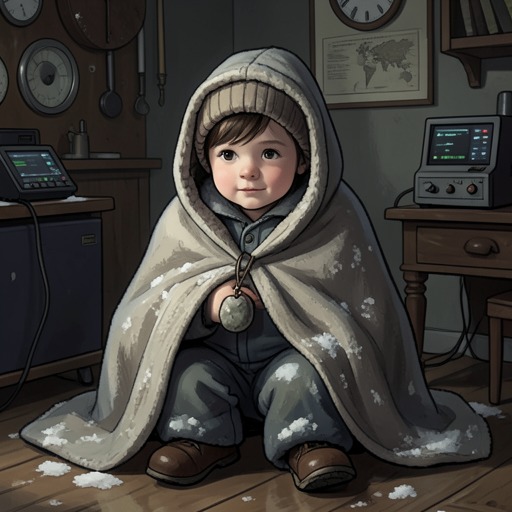
A Jesuit account later found by Régis D’Anjou supplies a more specific origin story. It describes a baby found in the snow with a finely made jewel pinned to the infant’s swaddling clothes, and says the child was to be baptized and adopted. Loïc connects that rescued child to his own ancestor and to the Founder. The baptismal record, dated December 1, names the child Éloi; an unclear handwritten ending could also be read as Élie. A young, childless French-Canadian couple adopted the baby, and the name Élie D’Anjou entered the family’s history through this uncertain reading. Régis photographed the old register, preserving a record that Mathieu would later use in his argument.
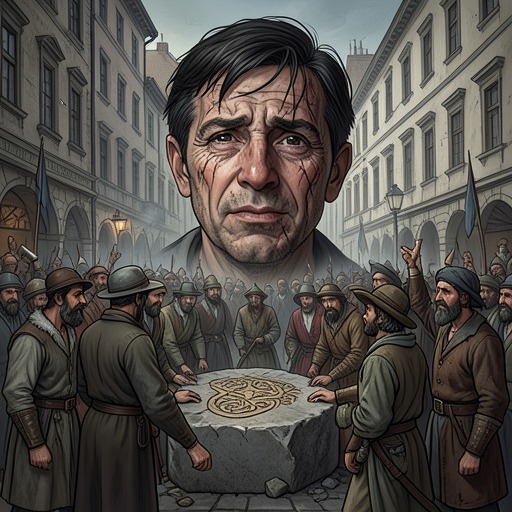
The proposed descent also touches an older Castelmont inheritance conflict. During the Bourbon Restoration, Charles de Castelmont reclaimed the family’s lands while his twin brother Louis was presumed to have left Europe permanently. Louis returned to claim his titles and share of the inheritance, relying in part on his right of primogeniture: he had been born minutes before Charles. Charles denied his brother’s identity and rights and tried to have him killed; Louis eventually returned to America while continuing to pursue his claim. Louis is identified as the Founder’s putative father. This history does not itself prove Mathieu’s descent, but it gives the later dispute a family structure in which bloodline, documentary recognition, and inheritance have long been contested together.
Mathieu’s Proposal
In October 2016, Mathieu sends Charles a registered letter proposing a comparative DNA analysis to test whether his family descends from the Castelmonts. He sets out the principal elements of his case: Élie’s birth in the United States in 1842, his adoption by French Canadians, and the cameo said to have been pinned to his swaddling clothes. Mathieu encloses a copy of the Jesuit account, the baptismal record, and a close-up photograph of the cameo, which he says was recovered from the New York City rubble. A USB drive contains additional recent, high-resolution photographs that can be enlarged for inspection.
Mathieu offers to arrange the DNA analysis in France and says he will pay for it. The offer makes the proposed test concrete, but the letter remains a claim rather than a completed verification. Its force depends not only on the family records but on the credibility of the photographed object: if the cameo really has been recovered, it could connect the account of the rescued infant to a surviving piece of material evidence. If it has not, the proposed relationship remains unproven by the materials Charles can inspect.
Charles’s Doubt and the Counterfeit
Charles reacts with anger and contempt, resisting what he sees as an affront from the D’Anjous. Yet the papers unsettle him. The claim that the cameo was found in New York City seems impossible to reconcile with his understanding of its history, and he first suspects that Mathieu’s photographs are old images altered to look recent. On closer inspection, however, he recognizes the object as the same cameo he received from New York in 2003. He compares the old scratch on the onyx with its appearance in the enlarged images and concludes that the mark is recent and imitated.
That detail changes the dispute without resolving it. Charles determines that the D’Anjous, like him, have received a counterfeit. Their supposed piece of evidence cannot authenticate Élie’s descent merely because it resembles the family relic. Nor can Charles treat the photographs as proof that the item in the D’Anjou account was the authentic original. The possibility that the original was found but replaced with a fake becomes, in his mind, a likely explanation; it is an inference, not a demonstrated chain of custody.
Charles then reasons that New York authorities must have sent out two counterfeit cameos, one to each claimant, and that someone must have stolen the valuable original and substituted reproductions. He takes the dispatch of fakes as evidence that the original itself must have been found, and from there concludes that it was authentic. But the narrative preserves the uncertainty inside his deduction: he briefly considers whether the cameo was actually recovered at all, then dismisses the possibility. His conviction that the D’Anjous might be relatives thus grows from a sequence of suspicions and inferences, not from an independent confirmation of the object’s provenance or a genetic result.
The Unresolved Relationship
The counterfeit resets the argument to its starting point. Charles can no longer dismiss Mathieu’s letter as a simple fabrication, because the shared fake indicates that both families have received the same misleading object. But neither family’s possession of a counterfeit establishes that the genuine cameo belonged to Élie, that it survived, or that Élie descended from Louis de Castelmont. Charles recognizes that the D’Anjous’ claim could be true even as he finds it intolerable; he tries to push the lingering doubt out of mind and considers how to trace the original through influential contacts.
He plans to tell Mathieu that the D’Anjou cameo is a reproduction and to use that fact to discredit the family’s account. The response he contemplates would answer the photograph, not settle the ancestry. The narrative does not report that Charles accepts DNA testing, that either man undergoes it, or that the biological relationship is ultimately confirmed. Their connection remains a disputed genealogical possibility, suspended between an adoption record, a suggestive but ambiguous baptismal entry, a family tradition about a hidden stone, and photographs of two false cameos.