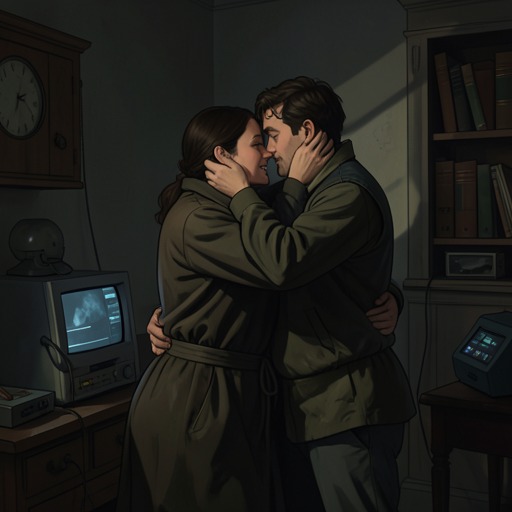
Loïc et Laurence d’Albignac
SatanLoïc and Laurence d’Albignac’s relationship is presented as both a love story and a profound disturbance in Loïc’s established sense of self: their first encounter feels less like an ordinary introduction than the beginning of a new life. What follows is marked by mutual caution, humor, intellectual exchange, and a communion Loïc has never experienced before. Their growing intimacy offers him temporary relief from the family cameo that has occupied his thoughts, while Laurence’s background and their journey together bring the relationship into the orbit of the novel’s historical mystery.
Encounter and Resistance
On a June evening, Loïc attends a book launch at Maison des écrivains on rue Laval, more from social obligation than genuine interest. He notices Laurence among a small group near the bar. Her clear gaze strikes him first; the impression deepens into a feeling of familiarity, as if he has known her for a long time. He is drawn to her appearance, but the encounter’s decisive force lies in his sense that something in him has recognized her before he can explain why.
That attraction is accompanied by fear. Loïc imagines that Laurence could absorb or transform him so completely that his familiar identity would no longer hold. The prospect feels like a second birth, and he is frightened of the upheaval even as he senses that it might lead to a fuller version of himself. The narration casts this response as both a promise and a threat: Laurence seems to him a blessing, but accepting the possibility of change means relinquishing the settled habits that have narrowed his life. The intensity of this first recognition therefore does not immediately produce ease or confidence; it makes the choice to approach her feel consequential.
Loïc’s hesitation is connected to a broader habit of retreat. He is shy, fears confrontation and social rejection, and sometimes relies on humor or bravado to manage that fear. In the days after meeting Laurence, he considers seeing Claudine, an ex-partner with whom he has not entirely severed contact. That possibility represents a return to the known rather than renewed commitment: the relationship offers familiar sensuality, but, in Loïc’s estimation, little prospect of change. He is divided between the safety of repetition and the uncertainty of following the connection he has just encountered.
A Courtship Built on Wit and Care
The exchange of looks at the launch stays with Loïc. After putting his doubts and delays into his journal, he finds Laurence’s address in the Union des écrivains directory and sends her an email whose humor gives the approach a less intimidating form. Her response comes quickly and is warmly playful. Their early correspondence establishes a shared pleasure in language: both enjoy wordplay, and laughter, literary conversation, and enthusiasm become the first ground of their relationship.
They soon tell each other about their lives. Laurence, from an old French aristocratic family, has chosen to live in Québec for several years and writes humorous, imaginative, poetic books for young readers. Her past includes several painful relationships and a difficult separation from her first great love in France. The loss of a young child and a miscarriage had contributed to the end of that relationship. Like Loïc, she is wary of being hurt by a new love, so their attraction does not erase their caution or make trust automatic.
Their physical closeness develops gradually. The account emphasizes a deliberate approach, with both allowing the relationship to grow rather than rushing to resolve its intensity. This mutual reserve matters: the new bond differs from the destructive, self-consuming relationships Loïc has known, which raised romantic hopes only to end in painful disappointment. With Laurence, desire and apprehension coexist, but their shared humor and sincerity give them a way to remain in contact while they approach intimacy at a measured pace.
Communion and Shared Empathy
For the first time in his life, Loïc no longer feels alone. He is so unsettled by the force of this recognition that he wonders whether Laurence might be the reincarnation of the twin sister who died in their mother’s womb. The novel presents this as Loïc’s question, not as an established explanation of their bond. What he can describe is a sense of communion in thought and being: they sometimes find themselves thinking the same thing at the same moment, even arriving at the same phrase or expression.
Their connection is conveyed through small exchanges rather than through a single declaration or decisive act. A smile or glance becomes, in the narration, a spark that intensifies their emotional life; conversation and correspondence seem to pass easily between them. The pattern suggests a relationship in which recognition is continually renewed through shared attention. Loïc does not simply admire Laurence from a distance: he experiences their closeness as a reciprocal exchange, one that makes thought, language, and feeling seem unusually aligned.
He is also struck by the breadth of Laurence’s empathy. He has never known anyone who feels so deeply for living beings, whether people, animals, or plants. The quality he notices is not limited to tenderness toward him; it extends outward to all who live and suffer. That capacity helps distinguish Laurence in Loïc’s eyes from the idealized object of a narrowly romantic attachment. Their love matters to him partly because he sees in her a responsiveness to the wider world, and because the relationship’s promise appears bound up with that generosity of attention.
The Cameo and the Journey to Bas-Saint-Laurent
The new relationship briefly draws Loïc away from the family cameo, which has obsessed him for nearly a year. The relief does not resolve the mystery. Instead, the account makes Laurence’s ancestry one of the ways their private connection meets the novel’s longer historical inquiry: she belongs to an old lineage in southwestern France whose history extends back a thousand years. Loïc does not yet know the scale of the discoveries ahead, but their relationship becomes part of the path leading toward revelations buried across successive centuries and connected to the cameo.
At the end of the summer, Loïc takes Laurence to Bas-Saint-Laurent to show her the region of his childhood. The trip functions as a honeymoon before marriage, deepening and confirming their intimacy. It also gives Loïc the occasion to tell her the story of the cameo. He does so during an evening alone together at their inn in Notre-Dame-du-Lac, on a balcony overlooking Lake Témiscouata under a bright moon. The scene joins two kinds of disclosure: Laurence has become close enough to share Loïc’s formative landscape, and he is ready to bring her into the family history that has occupied him.
Significance and Limits of the Relationship’s Arc
The relationship’s significance lies in the change it makes imaginable for Loïc. At first, the prospect of loving Laurence threatens to undo the identity he has carefully maintained; as they become close, the same upheaval appears capable of opening him to a more complete life. Their story is not framed as a simple cure for his earlier loneliness or for the painful history he carries. Rather, the novel builds their bond through the tension between fear and trust, between retreat into familiar patterns and willingness to enter an uncertain future.
The supplied account leaves the relationship at a moment of deepening intimacy and shared disclosure. It establishes their unusual accord, their gradual approach to closeness, and the way Laurence’s ancestry intersects with Loïc’s search around the cameo. It does not, in these scenes, settle the couple’s eventual future. Instead, their journey to Loïc’s childhood region and his telling of the cameo’s story mark a threshold: the relationship has become both an intimate partnership and a point of entry into histories neither of them has yet fully uncovered.