Santa Theresa
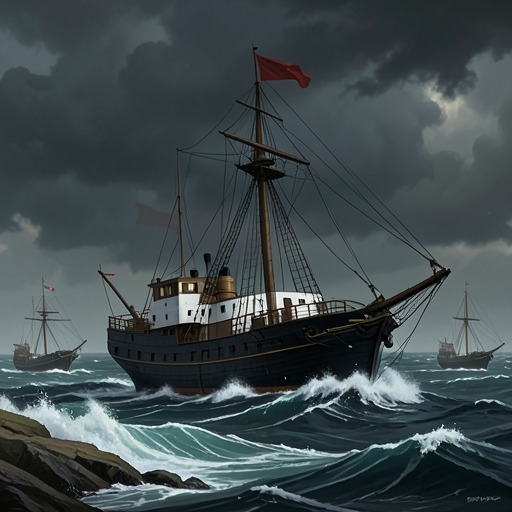
ShōgunThe Santa Theresa is a Portuguese frigate stationed in Osaka harbor, where its guns, trained crew, and freedom to maneuver make it a formidable counterweight to Toranaga’s galley. During the attempt to get that galley out of the harbor, the frigate shifts from a monitored presence at the wharf to an active pursuer; its failure to force the galley’s surrender exposes how local traffic and the harbor’s narrow approaches can limit even a powerful European ship.
Identity and Position in Osaka
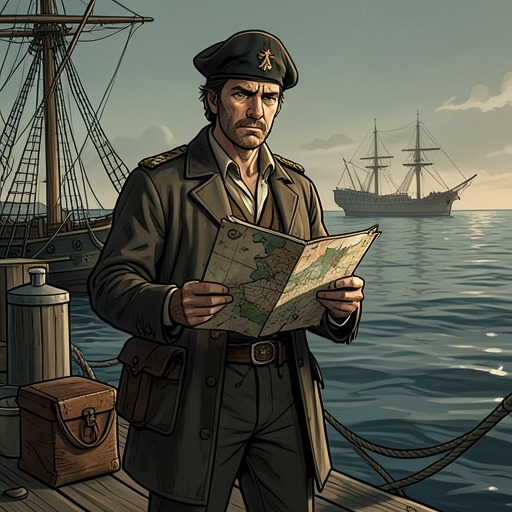
The Santa Theresa lies five hundred paces south of Toranaga’s galley, alongside a stone wharf. Porters load barrels and bales under flares, while Ishido’s Gray Guards gather nearby. The ship is part of the Portuguese presence that Japanese authorities keep under close watch: foreign vessels in port are subject to perpetual surveillance, and Nagasaki is the sole exception where Portuguese shipping may move freely. The frigate is therefore both a trading vessel at a working berth and a military presence within a harbor where its movements are observed.
Its position also places it within the larger political bind Toranaga sees in the Portuguese trade. He considers tighter security against foreign ships, but recognizes that Japan’s dependence on expanding trade with China—and the influence of Christian daimyō in Kyushu—makes simply confining the Portuguese untenable. The Santa Theresa’s wharf-side cargo operation gives this strategic dilemma a material form: the ship brings goods into a system whose commerce Japanese rulers want, even as its armed presence makes it difficult to treat as an ordinary merchant vessel.
Readiness and Naval Power
When the escort of Gray Guards hurries away, the Santa Theresa quietly slips its moorings. Its longboat warps it from the jetty into deep water, where it anchors a few cables offshore, broadside to the shore. Blackthorne recognizes this as a standard precaution for European ships in alien or hostile harbors. Although the deck shows no unusual activity, he understands that the cannon would be primed, muskets distributed, ammunition ready, cutlasses in their racks, and armed men stationed aloft to watch the approaches.
The frigate’s firepower is not merely anticipated. Its two stern chasers, each a thirty-pounder, point toward the galley, and Ferriera gives the order to prepare the cannon and load grape. Blackthorne judges the Portuguese gunners exceptionally capable, second only to the English. The ship’s armament makes the chase a direct threat, while its offshore anchorage and prepared crew mean that the danger begins before Ferriera openly commits to an attack.
Pursuit Through the Harbor
For half an hour, the frigate and galley maneuver against one another. Blackthorne guides the galley toward the windward position, hoping to bottle the frigate against a lee shore; the Santa Theresa seeks room to get out of the harbor. Neither gains a decisive advantage. Their different strengths shape the contest: the frigate is faster under sail, but the galley can maneuver more freely, while the harbor leaves limited space for the frigate to tack safely.
As the Santa Theresa bears down, the galley’s course brings it through a channel near the cliffs, where Blackthorne estimates that only a few yards separate success from disaster. The frigate must tack to reach the harbor mouth, whereas the galley can alter its movement more readily. Yet the frigate’s speed allows it to close the distance, and Rodrigues has already made clear that the galley must stay out of its way when the larger ship needs sea room. Blackthorne takes command of the course, insists that the galley hold its line, and directs its movement while Yabu commands the fighting men.
The Santa Theresa comes to within fifty yards astern, occupying the middle of the channel and making plain that it wants the same passage. Ferriera considers ramming the galley, but Toranaga and Mariko are aboard, making that choice more dangerous. Fishing boats crowding the harbor mouth also affect the encounter: their presence becomes evident to the frigate’s crew during the chase and helps explain why the galley is steering toward them. The waterway is not empty sea room in which the frigate’s speed and guns can decide the result; civilian craft and the confined channel complicate its attack.
The Standoff and Its Significance
Ferriera declares his intention to blow the galley out of the water, while Dell’Aqua opposes him. The disagreement marks a limit on the frigate’s use of force: its captain may want to destroy the vessel, but the decision is not uncontested among those aboard. The pursuit nevertheless remains dangerous until the galley clears the harbor mouth. Once the ships reach Osaka Roads, the galley is a few cables astern of the frigate, and most of its oars have been shipped temporarily so the rowers can recover while the vessel makes way calmly.
The Santa Theresa does not simply represent Portuguese strength in the abstract. Its surveillance, guns, sail speed, and tactical position give that strength an immediate presence in Toranaga’s escape. At the same time, the episode shows that naval power depends on more than weapons: knowledge of wind and course, room to maneuver, and the traffic at a harbor entrance all shape what the ship can accomplish. The frigate remains formidable, but the galley’s passage into Osaka Roads demonstrates that its superiority is not absolute when the contest is fought in constrained waters.