Toranaga’s galley
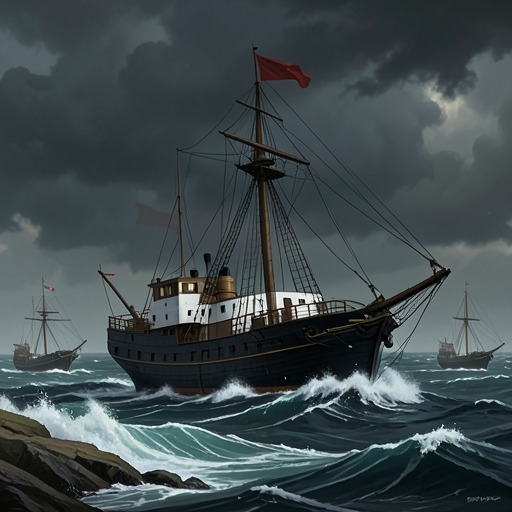
ShōgunToranaga’s galley is both a means of escape and a contested piece of naval power: its route through Osaka’s harbor depends on speed, deception, and the decisions of its pilots and commanders. During Toranaga’s flight, the vessel becomes the destination of a carefully staged diversion, then the focus of a violent attempt to prevent its departure. Once underway, its maneuverability gives it a chance against a faster frigate, and John Blackthorne’s navigation places him in command of the crisis.
Role and Maritime Setting
The galley is assigned to carry Toranaga to Anjiro and back quickly, with Rodrigues serving as pilot. The journey takes it away from the relative safety of the coast: after following the eastern shore of the Izu Peninsula, Rodrigues sets a west-southwesterly course from Cape Ito toward a landfall two hundred miles away. He explains that a coastal route would take too long. The decision puts the galley in open water, where the limits of local seafaring knowledge and the need for a capable pilot matter as much as the vessel itself.
That dependence on navigation is significant in a world where charts are vague and longitude cannot be fixed. A Rutter—a pilot’s record of courses, depths, currents, winds, hazards, and places to find water or shelter—can make unfamiliar waters more navigable, though its accuracy depends on the pilot and the quality of its copying or translation. Rodrigues’s open-water passage embodies the practical stakes of that knowledge: the galley must follow a deliberate course rather than simply keep the shore in sight.
The Galley as an Escape Route
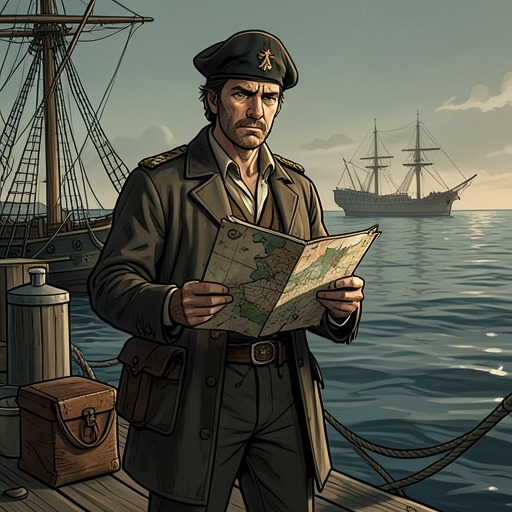
At the Osaka wharf, Toranaga studies the galley’s position from the shadows of a warehouse. It lies alongside a stone wharf extending about a hundred yards into the sea, with its oars shipped and sailors and warriors visible on deck. A detachment of Ishido’s Gray Guard waits by the gangway across open ground, making a surprise approach difficult. The vessel is accessible, but not safely so.
Toranaga’s plan turns the galley into the endpoint of a diversion. Mariko, the pilot, and six samurai are to approach the Gray Guard as if in panic and report a supposed ambush, drawing the guards away. If the ship is safe, Mariko is to return to the gangway and pretend to faint as a signal. Toranaga gives John Blackthorne only part of the plan, keeping the signal secret from him. The stratagem makes access to the vessel depend not on a direct assault alone, but on a credible account of danger elsewhere.
The approach leads to a fight around the ship. While John Blackthorne recovers enough strength to stand, Toranaga’s disguised samurai dispatch the wounded and throw the dead into the sea. The six of Toranaga’s Brown samurai and all the Gray attackers have perished. The crew readies the galley for immediate departure: some men take the oars, others stand by the mooring lines, and the flares are extinguished. Toranaga’s men establish a defensive position against a hundred Gray soldiers coming from the frigate. The escape has secured the vessel, but the shore force still threatens its exit.
Passage Through the Harbor
The galley’s escape becomes a test of seamanship and timing. Fishing boats block the route ahead, leaving a tempting passage between them. At the harbor mouth, the channel narrows to four hundred yards, and the gap between the ambushing boats is only a hundred yards. The approaching frigate has the advantage of speed, but it must tack into the harbor against the wind; the galley can maneuver more freely under oars. The channel offers little room to recover from a wrong judgment.
John Blackthorne takes charge of the course, telling Yabu that he is now the chief captain. The samurai remain crouched below the gunwales until his signal; Yabu is to command the fighting, the oarsmen are to keep time with the drum, and the drum master is to obey John Blackthorne. With the frigate only fifty yards astern and occupying the middle of the channel, the galley holds its course. The tactical arrangement divides responsibility between navigation and combat: Blackthorne guides the ship, while Yabu directs the men who will fight from it.
Beyond the harbor mouth, the galley reaches Osaka Roads. Its oars are mostly shipped so the exhausted rowers can rest, while the remaining oarsmen keep the vessel moving calmly a few cables behind the frigate. The immediate escape has succeeded, but the larger confrontation has not vanished: the galley has carried Toranaga out of the harbor without removing the threat posed by the armed ship and the forces on shore.
Command and Political Significance
The galley’s value lies in the difference between its capabilities and those of its opponents. It cannot match the frigate’s speed under sail, yet its oars allow it to maneuver while the larger vessel must tack. Blackthorne exploits that difference in the confined channel, where the frigate’s speed is dangerous but cannot by itself dictate the route. The vessel is therefore neither simply inferior nor secure; its prospects turn on how its particular means of movement fit the geography and wind.
Its passage also exposes a transfer of practical authority. Rodrigues is the pilot for the journey, but during the escape John Blackthorne directs the galley through the harbor while Yabu coordinates the fighting. Once the ships are clear, Rodrigues observes Toranaga studying the frigate’s guns, ropes, sails, and methods of loading and firing. The galley has brought Toranaga into close contact with European naval practice, making the voyage an occasion not only of escape but of military observation. As it carries him beyond the harbor, the ship links a political contest on land to the knowledge and force that govern movement at sea.