Treaty of Tordesillas
ShōgunThe Treaty of Tordesillas is a Spain–Portugal agreement that John Blackthorne describes as dividing ownership claims to the newly discovered New World. In his explanation to Toranaga, it is more than a distant European settlement: it is evidence of a system that turns papal decisions and legal documents into claims over foreign lands and governments. The treaty’s importance in the story lies in Blackthorne’s use of it to make the danger of Portuguese and Spanish expansion legible to his Japanese listeners.
The Agreement and Its Claimed Division
Blackthorne tells Toranaga that the kings of Spain and Portugal signed the treaty in 1494 to divide the undiscovered world between them. He describes a north–south line bisecting Brazil: lands east of it were claimed by Portugal, and lands west by Spain. In his account, the line gave the two kingdoms a framework for treating overseas discoveries as possessions rather than as territories already inhabited and governed by others.
Blackthorne places the treaty within a sequence of papally sanctioned boundaries. He explains that Pope Alexander VI set an earlier line of demarcation in 1493, that Pope Julius II sanctioned changes in 1506, and that the later Treaty of Saragossa, sanctioned by Pope Clement VII in 1529, drew a second line through the tip of southern Japan. He associates the first division with the competing claims in the Americas and the later agreement with Portugal’s asserted sphere extending through Japan, China, and Africa. These are distinct stages in the account: Tordesillas divides New World claims, while Saragossa supplies the later line Blackthorne says reaches Japan.
The Conquest Blackthorne Associates with It
Blackthorne argues that the agreements granted each king a right to claim lands discovered by his subjects if those lands were non-Catholic, and to replace their existing governments with Catholic rule. He uses Brazil as an example, saying Portugal’s claim was followed by the destruction of native culture and legal authority and the extraction of gold and silver. He also describes Spanish conquest in Mexico and Peru, including the destruction of Inca nations, the enslavement of hundreds of thousands of people, and the wealth Spain gained from plundered metals.
In Blackthorne’s account, conquest works through a combination of military and religious power. He says the conquistadores had modern guns while the native peoples did not; priests followed, some princes converted, and rivalries between princes were used to divide and absorb realms. The treaty therefore enters his argument not as an isolated diplomatic document but as part of a claimed chain linking legal authorization, armed conquest, religious conversion, and imperial wealth.
Blackthorne’s Warning to Toranaga
Blackthorne introduces the treaty while explaining why he had sailed north: he had been the pilot of a ship seeking a northeast passage. He then turns from navigation to the consequences of European mapmaking and law. When Toranaga likens the division of foreign lands to dividing the heavens with the Emperor of China, Blackthorne insists that the comparison is different because, as he understands it, European legal documents authorize claims and replacement of local rule.
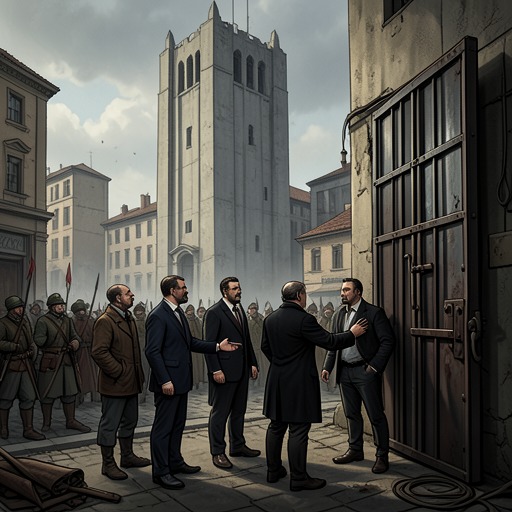
Mariko translates the explanation, and Toranaga recognizes its political significance even as he dismisses the conversation as worthless and questions how Europeans could grant themselves such rights. Mariko, too, is unsettled by what she has heard. The scene makes the treaty’s force depend on explanation and interpretation: Blackthorne supplies the European history, Mariko carries it across a language barrier, and Toranaga tests its claims against his own understanding of sovereignty.
Limits of the Treaty’s Reach in Japan
Blackthorne’s account connects Tordesillas to the later Treaty of Saragossa, but the distinction matters. He attributes the claim that Portugal had exclusive rights to Japan and neighboring regions to the later agreement and its second line, not to the original division of the New World alone. His presentation makes the European claim to Japan a warning about the wider consequences of these agreements, rather than evidence that Toranaga accepts their authority.
That challenge meets a different rule of sovereignty in Japan. Toranaga tells Blackthorne that foreigners are in the country by permission, that public mischief or quarrels are punished by death, and that local law must be obeyed. Later, when Blackthorne considers using foreign forces against enemies on Japanese soil, Toranaga rejects such an attack by one foreign nation against another within Japan, while distinguishing it from action against the Emperor’s enemies at sea. Read alongside Blackthorne’s account, the treaty exposes a conflict between European claims to divide and exploit territory and Toranaga’s insistence that Japanese authority determines what foreigners may do there.