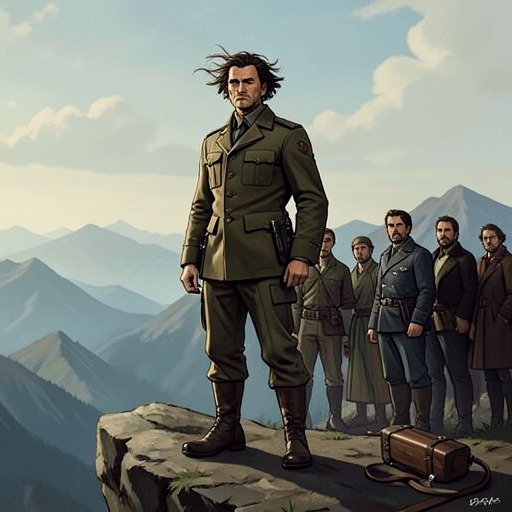
Khader's mujaheddin unit's final escape and battle
ShantaramKhader's mujaheddin unit's final escape and battle is the attempt by Lin and five companions to break out of a mountain compound, an escape that collides with a larger assault and turns into a friendly-fire disaster. The men reach safety only after deaths, serious wounds, and Nazeer’s act of protecting Lin; the battle’s aftermath makes clear that what had seemed to Lin like glory was, in part, the senseless cost of a confused war.
The escape plan
The immediate circumstances are those of exhaustion and hunger. Before dawn, the men force themselves to eat a soup prepared for them, then wait as their bodies recover. After prayers, they assemble near the compound’s south-eastern edge, at the steep slope Habib Abdur Rahman had recommended as their best chance to fight their way to freedom. His advice seemed credible to them because he had planned to join the attack. Their trust in the route rests on the information they have, not on knowledge of the larger movements around the mountain.
There are six men in the group: Lin, Suleiman Shahbadi, Mahmoud Melbaaf, Nazeer, Jalalaad, and the young Ala-ud-Din. The moment of departure sharpens Lin’s awareness of how little he knows Jalalaad, despite having spent months alongside him. The men check their weapons, exchange embraces and handshakes, and look down the slope. That small gathering is both a practical preparation for flight and a farewell whose significance none can avoid.
Suleiman gives the order, and the group crosses the ridge into a clear dawn. The descent begins cautiously over snow, then quickens as the ground becomes less steep. Lin recalls having thought that the Afghan mountains, like prison, offered no true dawn or sunset; now the morning seems unusually beautiful. The contrast between the open landscape and the men’s confinement gives their escape its first promise of freedom, but the sound of mortar explosions soon replaces the quiet of the descent.
The charge and the mistaken attack
At first, the distant explosions do not alarm Lin. As the mortar fire draws closer, however, he sees the other men running harder and struggles to make his numb legs keep pace. Shells burst near him, and the exchange of AK-74 fire shows that the opposing positions are close enough for both sides to inflict casualties. The escaping men cannot see clearly where the enemy is, so they press forward over rough ground while trying to find a path that offers some protection.
Jalalaad is killed by a mortar shell while running near Nazeer. Further ahead, Suleiman is struck and falls; the survivors have to continue over the rocky ground as the attack intensifies. Lin sees flashes from the enemy Kalashnikovs and a tracer round pass close by. At that point, the group appears badly outmatched: the enemy has time to aim at them, while the men are exposed in the open.
The firing then changes abruptly. Explosions hit the enemy positions, and Nazeer and Mahmoud Melbaaf fire as they run; Lin raises his own weapon and joins them. In the moment, Lin reads the blasts as the opposing force accidentally striking itself. The later account reveals a different, larger cause: Ahmed Shah Massoud's forces had been preparing their own attack, and the sentries in the enemy camp, startled by the escape attempt, opened fire. Massoud’s men interpreted that shooting as a pre-emptive attack and began their assault. Their mortar strikes against the Russian positions were real, but other mortar rounds hit the escapees by mistake.
Lin is wounded; Nazeer protects him
A mortar round bursts close enough to knock Lin down and leave him unconscious. He later learns that fragments wounded him in several places, while the blast damaged his left eardrum. The immediate experience is one of being overwhelmed by the explosion and losing consciousness, not a clear view of how the others fare. The violence of the battle is therefore initially registered through a gap in his memory, which the survivors’ later account must fill.
Nazeer, himself wounded in the legs and arm, drags Lin into a shallow depression for shelter. He then covers Lin with his own body while the bombardment continues. A piece of metal strikes Nazeer in the shoulder rather than Lin, and after the firing subsides he pulls Lin to safety. The rescue turns the attempted escape into an act of personal loyalty: Nazeer does not merely survive beside Lin but places himself between his unconscious companion and further danger.
The aftermath and what the survivors learn
Nazeer and Lin remain on the battlefield through the cold day and into evening. The returning survivors find them there; Mahmoud Melbaaf and Ala-ud-Din bring back the bodies of Suleiman and Jalalaad. The group’s losses are thus made present in the aftermath of the escape, when the men who had set out together must account for those who will not continue with them. The surviving Ala-ud-Din is later remembered as having escaped unharmed, while Nazeer’s wounds leave him with a lasting limp.
Only gradually do the survivors piece together the military sequence. The Russian and Afghan force had been searching for Habib Abdur Rahman, whose atrocities had made the pursuit intensely personal for its soldiers. Many of those troops were occupied laying mines and traps on the far side of the mountain. The sentries left in the enemy camp fired wildly when the escapees appeared, and that gunfire precipitated Massoud’s planned attack. The mortars that seemed to Lin to be the enemy’s own shells exploding were, in fact, direct hits by Massoud’s forces; the rounds that tore into the escaping line were accidental friendly fire. After the survivors fell, Massoud’s men pursued the retreating enemy and destroyed the force sent to capture Habib.
Massoud’s forces and independent Achakzai fighters then secured the Chaman highway from the pass toward the Russian defensive perimeter around besieged Kandahar, less than fifty kilometres from the city. The evacuation toward Chaman and through Chaman Pass into Pakistan was rapid. The survivors travelled by truck with their dead companions, covering in hours a route that had taken them a month to cross on Khader’s horses. In the weeks that followed, they moved repeatedly between tents, slum huts, and hidden rooms to avoid attracting the attention of Pakistan’s secret service. Nazeer’s successful recovery was incomplete: the wound in his right thigh impaired his leg, and he continued to walk with a limp.
Courage without glory
During the charge, Lin experiences the men running together as a moment of fierce exaltation and calls it glorious in his mind. The explanation of the battle changes the meaning of that response. What he had perceived as a decisive moment of resistance was partly the result of friendly fire, and the deaths in his own group did not become less real because Massoud’s attack succeeded against the enemy. The later narration rejects glory as an adequate name for the event and concentrates instead on the courage, fear, and love that war destroys one life at a time.
That reversal also shapes the episode’s account of survival. The escape succeeds in the limited sense that Lin and the other survivors reach Pakistan, but it does not restore the group as it was: Suleiman Shahbadi and Jalalaad are dead, Lin is badly shaken and wounded, and Nazeer bears lasting consequences from saving him. The final movement is neither a clean victory nor a return to ordinary safety. It is a passage out of the mountains with the dead carried alongside the living, and with Lin’s understanding of the battle revised by the survivors’ knowledge of how it actually unfolded.