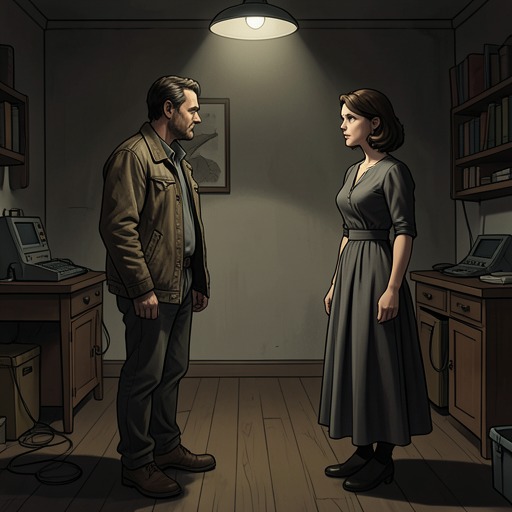
Lin’s prison escape
ShantaramLin’s prison escape is the audacious break from a maximum-security prison that turns confinement into the beginning of his fugitive life. Planned with a fellow prisoner and carried out in broad daylight, it depends on using ordinary prison routines as cover: the two men are maintenance gardeners, the security building is being renovated, and guards accustomed to seeing them eventually look away. The escape is meticulous only up to the point where the plan meets the building’s thick roof; beyond that, improvisation, danger, and nerve determine whether the men can get out.
Identity and Stakes
The escape is recounted by Lin as a defining threshold in his life. He describes the attempt as taking place at one o’clock in the afternoon, over the prison’s front wall and between two gun-towers. Its stakes are immediate: if the plan fails, the guards in the punishment unit may kick the prisoners to death. The danger is not abstract, and neither is the freedom they are pursuing. Lin later frames his escape from prison as a condition that must be renewed day and night: reaching another country does not end the fugitive life, but begins another phase of it.
The escape also marks the first link in a much wider chain of consequences. After getting out, Lin becomes his country’s most wanted man. Nearly two years later, he reaches Bombay using a false New Zealand passport, having crossed another border and entered a new country while still hunted. From there, his life will bring him into the Bombay mafia and into work as a gunrunner, smuggler, and counterfeiter. The prison break does not make him secure or erase his past; it gives him a precarious freedom that has to be protected through continual movement.
Planning and the Opening
Lin and his accomplice are alone in the attempt. The other prisoner is a big-hearted twenty-five-year-old serving a life sentence for murder. They approach eight tough prisoners, all serving long sentences for violent crimes, but each declines. Lin does not condemn them: he recognizes that a plan that looks heroic if successful could seem insane if it fails. The two who proceed are young first offenders without established reputations in the prison system, and their isolation makes the decision more exposed as well as more urgent.
Their opportunity comes from extensive renovations to a two-storey security-force office and interrogation block near the main entrance. The men work there as maintenance gardeners, so the guards on duty see them regularly. On the day of the escape, the guards watch them for a while, as they usually do, then turn away. The building is empty, and the renovation workers are at lunch. The men exploit a brief gap created not by defeating the guards’ surveillance but by becoming familiar enough to escape its attention.
They cut through the chain-link fence around the renovation site, force open a door, and climb through the deserted building. Its unfinished interior exposes uprights and load-bearing beams; dusty bare steps are strewn with brick and plaster fragments. At the top floor, a manhole opens into the roof-space. Lin climbs onto his friend’s shoulders, breaks through the wooden trapdoor, and gets into the ceiling. He has brought an extension cord concealed beneath his coveralls. He fixes it to a roof beam and lowers the other end so his friend can climb up after him.
The Roof and the Race Against Discovery
The roof runs in zigzag waves. The pair crawl toward the narrowing space where it meets the prison’s front wall, choosing a trough whose neighboring peaks may conceal their opening from the gun-towers. In the dark roof-space, Lin uses a cigarette lighter for light. With a long screwdriver, a chisel, and tin snips, the men begin cutting through the hardwood beneath the outer sheet of tin. After fifteen minutes of hacking and scraping, they have made only a small hole, about the size of a man’s eye. The wood is too thick for their hand tools to produce an opening large enough to escape through quickly.
Time, rather than the guards’ immediate presence, becomes the trap. Lin estimates that they have about thirty minutes before a routine check. They still need to cut through the wood and tin, get onto the roof, recover the extension cord, and use it to descend the outer wall. Meanwhile, any guard might find the cut fence, broken door, or smashed manhole. His companion urges retreat, but Lin recognizes that returning would expose their damage and identify them as the only men permitted in the area. The escape has passed a point where simply abandoning it can restore safety.
The solution is the power saw resting near the building’s door, but retrieving it requires Lin to descend and enter the open gate area. He slides down the cord, creeps downstairs, ties the cord to the saw’s handle, and returns to the roof-space. Then he has to go out again to plug in the cord. Armed guards are talking less than twenty metres from the door. Lin waits until their attention is directed elsewhere, steps outside, connects the cord, and slips back in without being seen. His friend hauls up the saw. In the roof’s dark corner, Lin holds the lighter while the other man cuts. Four rapid cuts make a square opening in the hardwood and reveal the tin beneath it.
The saw’s noise brings a fresh moment of suspense: the men hear a telephone ring at the main gate and think they have been discovered. A guard answers and continues talking and laughing; the workers’ renovation noise gives the guards a reason to dismiss the sound. Lin punches through the tin with the screwdriver, widens the hole, and cuts a flap on three sides. Together, they push it outward. The opening leads into a trough of the roof, a blind spot where the men can lie beyond the tower guards’ view. The prison wall is close, but the route out is not complete.
The Threshold and Its Consequences
The extension cord, still plugged in downstairs, is their only rope for climbing down the outside wall. One of them must return through the door in full view of the guards, unplug it, and climb back into the roof. Lin knows the task has fallen to him. At the door, he presses himself against the inside wall, breathing hard and feeling dizzy and nauseous; he tries to summon the strength to move into the open, but cannot make himself do it. The narration’s detailed account pauses at this hesitation, after the men have cut their way into the roof but before the cord has been recovered and the descent made.
The outcome is nevertheless established: Lin escapes over the front wall between the gun-towers. The tension between that completed fact and the scene’s pause at the threshold gives the escape its human scale. Freedom is achieved neither by a flawless plan nor by fear disappearing, but through a sequence of exposed decisions made while fear remains. The later consequences are vast—an ongoing fugitive existence, flight across borders, and Lin’s arrival in Bombay—but the break itself turns on a small, immediate question of movement: whether he can step back into the guards’ sight to retrieve the rope that will carry him out.