Roman Catholic Church
ShrineThe Roman Catholic Church in the novel must decide what can be known about the events at St. Joseph’s Church in Banfield—and who has authority to decide it. It treats a cure that medicine cannot explain as a question for investigation, not automatic proof of divine action. At the same time, church leaders recognize that alleged miracles can draw crowds, revive religious feeling, and affect the institution’s standing. The result is an organization portrayed as wary and procedural, but never untouched by the spiritual and political stakes of its judgments.
Authority and Caution
The first response to Alice Pagett’s recovery is uncertainty. Father Andrew Hagan knows that she can hear and speak again, but the medical history offers no physical explanation for her former deafness and muteness: specialists had regarded the condition as psychological, and later examinations found no corresponding damage to her ears or throat. To the medical profession, the change could therefore be understood as a change of mind. Hagan can accept that a profound emotional or spiritual experience may have prompted it, but he cannot settle whether the cause was self-induced or divine.
That hesitation is not presented as indifference to faith. Hagan reflects on Lourdes, where the Church’s medical scrutiny has recognized only a small number of cures as miraculous despite thousands of recorded recoveries. He also understands spiritual renewal—the restoration or beginning of faith, inner peace, and an ability to endure illness—as a kind of miracle that medical records cannot measure. The institution’s caution thus sits beside a broader religious understanding of what may be meaningful: a cure is not the only possible consequence of a pilgrimage or vision.
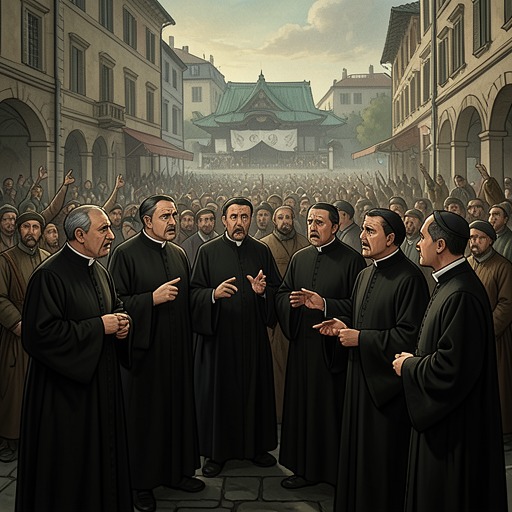
Bishop Caines makes the institutional limit explicit when Hagan asks whether Alice saw the Virgin Mary and whether the other children witnessed something. The bishop answers that there is no evidence to establish those claims and insists that the Church must proceed carefully. He allows for investigation rather than closing the question outright, explaining that the Church’s rules, associated in the novel with Pope Benedict XIV and the eighteenth century, are meant to protect it from proclaiming as miraculous an event that science might later explain. The rules do not eliminate faith, in his account; they are meant to eliminate grounds for doubt.
Investigation and the Limits of Medical Judgment
The novel gives this caution an administrative form. In a press conference, Bishop Caines says that six alleged cures—the five other cases and Alice’s recovery—will be examined by a specially organized medical bureau, with its findings passed to the International Medical Committee. The bureau is to consult each patient’s medical records, general practitioner, and hospital, conduct its own examination, and keep a dossier. Its members are not required to be Roman Catholics: the bureau is described as independent, although the Church will employ its director and some of its members. It is planned to include at least twelve medical professionals.
The division of responsibility is central. The bureau and the International Medical Committee are to assess whether a cure is medically inexplicable, not whether it is a miracle. Their questions concern whether recovery was sudden, complete, and lasting; whether there was a period of convalescence; how serious and objectively documented the illness had been; and whether treatment contributed to recovery. A judgment on permanence may require three or four years. The criteria also exclude a cure attributed to a mental disorder, a particularly consequential limit in Alice’s case, given the established view that her condition had psychological origins.
The church’s spiritual judgment remains distinct from the medical one. The committee can recommend; Bishop Caines, as the bishop of the diocese, retains the final decision on whether a cure is declared miraculous. He and his advisers must consider divine intervention only after the medical question has been examined. When Monsignor Delgard later outlines findings available at that stage, he reports no physical change in Alice’s ears or throat and no evidence of damage that would account for her former condition. The procedure clarifies what the investigation can establish, while leaving the cause of her recovery—and its religious meaning—unresolved.
Managing Public Attention
For church leaders, investigation is also a response to the scale of what may follow. Bishop Caines tells Father Andrew Hagan to watch the situation, keep him informed, avoid contributing to public hysteria, and stay away from the press. He expects to provide a report to the Conference of Bishops within two months, while assuming the incident may have faded from public attention by then. That expectation proves markedly different from his later assessment of the likely crowds.
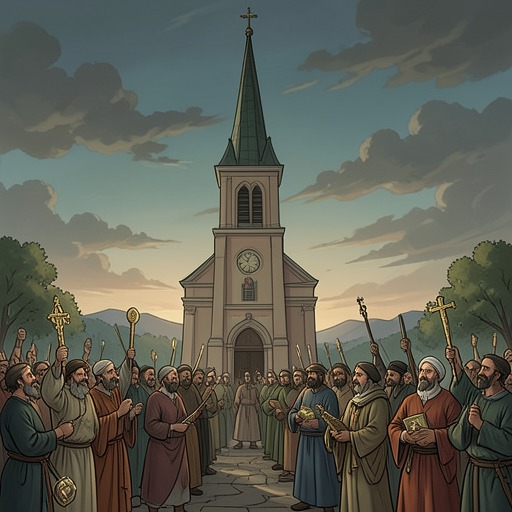
After learning that five people besides Alice have reportedly been cured, the bishop predicts that news will spread and that thousands may visit the site, including people drawn by curiosity as well as religious belief. Whether St. Joseph’s Church is formally declared a shrine, he argues, may not matter to those visitors. The Church must therefore control the situation from the beginning. He also wants to see Alice and her mother, recognizing that an alleged blessing could have consequences for the Church in England and might encourage renewed religious fervor.
That institutional concern overlaps with local interests without being identical to them. George Southworth presents the event as a possible rebirth for Banfield and a chance for its people to regain belief, while acknowledging that the town’s revitalization could benefit him. Rodney Tucker is more openly interested in financial opportunity. Southworth asks Gerry Fenn to write further about what will become known as The Banfield Miracle, because Fenn’s earlier story has already generated interest. The Church’s wish to manage the event thus unfolds alongside publicity and commercial hopes that it does not itself control.
The Church’s practical response includes acquiring the field next to St. Joseph’s Church, where the events took place. Bishop Caines tells reporters that an agreement to purchase the land has been reached and that the documents are expected to be signed within days. The stated proximity allows him to describe the cures as having occurred on church grounds, although the reporter distinguishes the adjacent field from the church itself. The purchase makes the institution a direct participant in the site’s future as public attention gathers around it.
The Church in the Historical Manuscript
The manuscript attributed to Thomas Woolgar gives the Church a darker historical setting, though its account reaches the reader through Woolgar’s troubled testimony rather than an independent record. It describes Sister Einor as a healer whom villagers regarded as pure and saintly. People brought her gifts, and children sought her blessing; offerings of greater value, the manuscript says, were hidden in the crypt of St. Joseph’s Church, while lesser gifts went to the priory. Public devotion and the Church’s local life therefore surround a figure whose private conduct Woolgar later confesses was profoundly different from her reputation.
The manuscript also depicts religious governance entangled with patronage and responsibility. After a novice’s confession raises suspicions, the Prioress confronts Woolgar, who admits a sinful relationship with Einor but attempts to place the blame on her supposed influence. He does not initially disclose everything. The Prioress grants him forgiveness, and the two discuss Einor’s punishment. Woolgar then denounces her as a witch and heretic; the Prioress sends for a Summoner to arrange her confinement and tells him to warn the congregation. Her ties to Woolgar’s influential father, a generous patron of the Church, form part of the political circumstances Woolgar describes.
Woolgar says that he returns to Banfield and spreads what he and the Prioress have concluded about Einor. The congregation’s anger grows as word passes through the village. This account places church authority within a chain of confession, accusation, ecclesiastical procedure, and communal response, but it also makes that chain vulnerable to self-exculpation and local power. Set beside the modern medical inquiry, the manuscript broadens the novel’s portrait of the Roman Catholic Church: institutional procedures can restrain premature claims, yet the people who interpret evidence and wield authority remain implicated in the consequences of their judgments.