Washington Post
ShrineThe Washington Post is among the news organizations covering the alleged cures at St. Joseph’s Church in Banfield. Its questions bring the Church’s standards for assessing a miracle into public view, while the surrounding coverage shows how quickly a local religious event becomes a matter of wider attention and institutional management.
Press Coverage and Public Interest
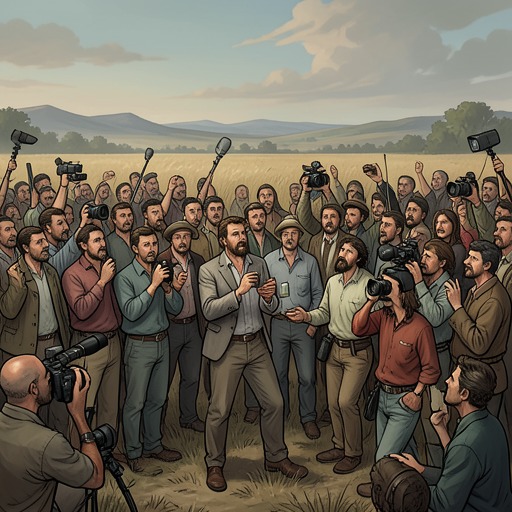
The paper appears during a press conference at which Bishop Caines and Monsignor Delgard address reporters about the Banfield cures. Its questions are part of a wider exchange with national and international news organizations, not a private inquiry: the subject is what the Church can responsibly claim while its investigation is in progress. The conference reflects the scale of interest that has gathered around Alice Pagett’s recovery and the other reported cures.
That attention has practical consequences in the story. Bishop Caines warns Father Hagan that Fenn’s reporting could help draw thousands of curious visitors to the site, whether or not St. Joseph’s is formally declared a shrine. The Washington Post’s presence at the briefing gives the episode a reach beyond Banfield and places the developing story within a public debate about belief, evidence, and authority.
Questions About Miracle Claims
The Washington Post asks what would constitute a miracle in the Church’s view. Bishop Caines answers that the cure must be medically inexplicable in the present state of science. Monsignor Delgard then clarifies the division of responsibility: medical investigators assess whether a cure is inexplicable, but they do not decide whether it has a religious or mystical meaning. That judgment belongs to the bishop and his advisers.
The answer makes the Church’s caution explicit. A finding that medicine cannot currently explain a recovery is not itself a declaration of divine intervention; what appears inexplicable in one period may later prove scientifically understandable. The bureau and the International Medical Committee are therefore to examine such matters as whether a cure was sudden, complete, lasting, objectively established, and independent of medical treatment. A lasting cure may require years of observation before it can be confirmed.
Investigation, Authority, and Limits
In the same press exchange, Bishop Caines says that the six alleged cures will be scrutinized by a specially formed medical bureau, whose findings will go to the International Medical Committee. The bureau is to include at least twelve physicians, not all of them Catholic; investigators will consult each patient’s general practitioner and hospital, conduct examinations, and maintain a dossier. The international body will make a recommendation, while the final decision on whether to declare a cure miraculous rests with the bishop of the diocese.
The paper’s question thus draws out a layered process rather than a single verdict. Medical review is tasked with testing the condition of the body and the course of recovery; ecclesiastical authorities retain responsibility for interpreting any spiritual significance. The Church’s stated guidelines, attributed to Pope Benedict XIV and dating to the eighteenth century, are presented as safeguards against proclaiming a miracle that later scientific explanation could disprove.
The Press Around Banfield
The Washington Post’s appearance belongs to a larger press presence that helps transform the Banfield events into a public story. George Southworth recognizes that Fenn’s reporting has already generated enormous interest and asks him to write more about what will become known as the Banfield Miracle. The request sits uneasily beside Southworth’s admission that Banfield’s revival could benefit him financially, underscoring that the circulation of news is entangled with local hopes and interests.
The novel does not provide a separate account of the Washington Post’s editorial position or of its eventual coverage. Its documented role is narrower and pointed: the paper asks a direct question at the moment when Church officials are defining what can be known, who may judge it, and how long judgment must wait. In that exchange, journalism becomes a public forum for the boundaries between medical evidence and religious interpretation.