St. Joseph's Medical Bureau
ShrineSt. Joseph's Medical Bureau is the investigative body organized after reports of six extraordinary cures at St. Joseph’s Church in Banfield. Its significance lies in the boundary it establishes: medical investigators are to determine whether recoveries can be explained by the available science, not whether they are miracles. The evidence is to be gathered through examinations, consultations, and case records, then reviewed internationally; the spiritual judgment remains with Bishop Caines and his advisers.
Formation and remit
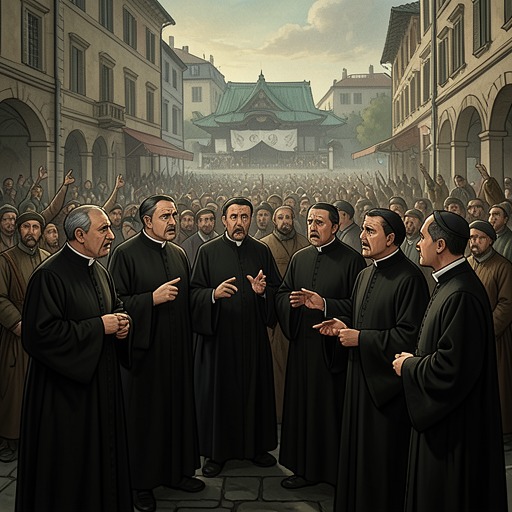
The proposal emerged as crowds gathered at the church and the reported cures attracted attention. Monsignor Delgard urged that each apparently cured person be interviewed and that their doctors be asked for permission to examine their medical records. He proposed an independent medical commission to investigate the histories of all six people, including Alice Pagett. The expectation was that public interest would make it possible to secure cooperation, and that an inquiry might be undertaken even without the Church’s initiative.
Delgard also argued that, if Banfield was to follow the example of Lourdes, it should have a medical bureau at the shrine itself. Bishop Caines agreed that such an organization would be useful, noting that alleged cures had sometimes been dismissed for lack of scientific or medical documentation. The bureau was subsequently described publicly as being organized. These statements establish a planned and active investigation, rather than a completed judgment on the cures.
In a press conference, Bishop Caines said the Church acknowledged a series of extraordinary, or more cautiously, alleged cures at St. Joseph’s. He explained that the six cases would be examined scrupulously by a specially formed bureau and that its findings would go to the International Medical Committee. The announcement did not certify any cure as miraculous. It instead presented investigation as a condition that had to precede any such claim.
Membership and investigative procedure
The bureau was described as an independent body consisting of at least twelve medical professionals. Its director and several members would be employed by the Church; others would be drawn from medical and scientific research organizations with an interest in the cases. The account therefore presents independence not as the absence of Church involvement, but as a procedure incorporating expertise beyond the Church’s own staff.
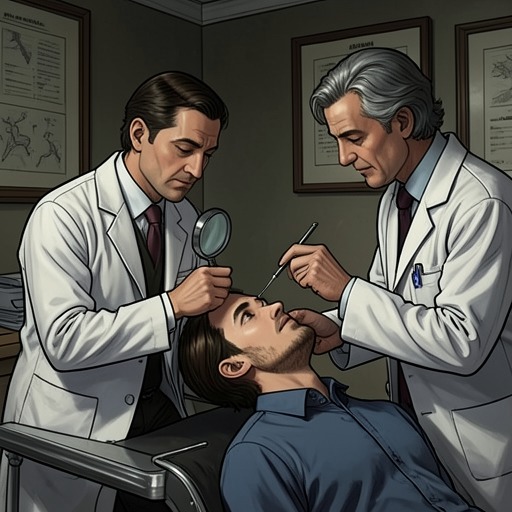
For each person under investigation, the bureau was to examine medical records, consult the individual’s general practitioner and hospital, conduct its own thorough medical examination, and keep a dossier. The cases would not be assessed solely from testimony about an apparent recovery: the stated method combined a person’s medical history, evidence from treating professionals, and a new examination. Findings would then be forwarded to the International Medical Committee, which would make a recommendation.
That division of labor limits what the medical bodies are authorized to conclude. Delgard clarified that the bureau and international committee would decide whether a cure was medically inexplicable in the present state of science, not whether it had a religious or mystical cause. The distinction allows medical uncertainty to be formally recognized without treating it as proof of divine intervention. The bishop, as head of the diocese, retained the final decision on whether a cure should be declared miraculous, after considering its spiritual aspects with his advisers.
Criteria and the Banfield cases
The stated criteria require a cure to be sudden, unexpected, complete, and lasting, with no period of convalescence. The underlying illness must also be sufficiently serious and specifically established. Investigators are to consider whether tests, X-rays, or biopsies objectively demonstrated the condition and whether prior treatment contributed to the recovery, even in part. Because durability cannot be established immediately, Delgard said that three or four years might have to pass before a cure could be confirmed. The bureau’s task was therefore framed as a sustained review, not a verdict prompted by the first public account.
The criteria make Alice Pagett’s medical history especially relevant. She had been unable to hear or speak for seven years, but specialists had found no physical malformation in her ears or throat and believed that her condition had psychological origins. After her sudden return of hearing and speech, Father Hagan took her to Sussex Hospital in Brighton for further tests. The medical findings reported to date identified no physical change in the organs of her ears or throat, no discernible damage to the auditory nerves, and no apparent disorder of the middle- or inner-ear structures or vocal cords. A possible infection associated with her illness had left no signs of persistence; her condition had long been considered psychological in origin.
Those findings did not settle the question of a miracle. They reinforced the view that Alice’s original impairment had not arisen from detectable structural damage, while the bureau’s criteria specified that infirmity due to mental disorder would rule out acceptance of a miraculous cure. The case thus illustrates why the investigation had to distinguish an observable change in ability from a medically unexplained recovery that met the Church’s standards. The available account gives findings to date, not a final bureau determination.
Institutional significance
St. Joseph's Medical Bureau is presented as one stage in a larger process of scrutiny. The bureau collects and assesses clinical evidence; the International Medical Committee reviews its findings and recommends whether a cure is medically inexplicable; Bishop Caines and his advisers retain responsibility for the distinct spiritual judgment. Each stage has a different authority, and none is presented as interchangeable with the others.
The structure also responds to the uncertainty surrounding the events at Banfield. The children’s collapse and other reported experiences prompted competing explanations, while the sudden restoration of Alice’s hearing and speech drew attention to the limits of ordinary diagnosis. The bureau does not, on the evidence available, resolve every such question. Its stated purpose is narrower and more procedural: to test individual cure claims against medical records, examination, duration, and possible treatment effects. By requiring evidence and time before recognition, it makes restraint part of the investigation rather than an afterthought.