Evanston
StrangersEvanston is the setting for the siege of Calvin Sharkle’s home, where mounting fear and an armed police response culminate in an explosion that tears through the house. The episode begins as Father Stefan Wycazik travels to a quiet residential neighborhood to reach one of the Tranquility Motel witnesses; it ends with the crowd outside Sharkle’s home recoiling from a catastrophe it had gathered to watch. Evanston’s ordinary streets become the ground where private terror, public curiosity, and the danger of delayed understanding meet.
Setting and Approach
At seven-thirty on Tuesday, January 14, Father Stefan Wycazik sets out for Evanston after receiving a late-night telephone call from Brendan Cronin. He is going to the last known address of Calvin Sharkle, a trucker who had been at the Tranquility Motel that summer and whose telephone has since been disconnected. In light of the previous evening’s developments in Nevada, the group has agreed to make every possible effort to contact the witnesses they have been unable to reach. Stefan leaves from the warm rectory kitchen in his topcoat and fedora, carrying that urgent purpose into the winter morning.
Father Michael Gerrano has just sat down to oatmeal and toast after celebrating sunrise Mass. He asks to know more about Brendan’s situation, in case something happens to Stefan. Stefan firmly dismisses the possibility that he will be killed, insisting that his decades of experience have prepared him to do his best work for the Church. The exchange gives the journey a pointed contrast: Stefan departs with confidence in the value of acting, while the danger awaiting him is already taking shape beyond his knowledge.
Sharkle lives on O’Bannon Lane, in a pleasant, middle-class neighborhood. Stefan has to stop twice at service stations for directions. Near the corner of O’Bannon Lane and Scott Avenue, only two blocks from Sharkle’s address, police turn him back at an emergency barricade formed by two police cruisers and a paramedic van. Television crews are there with minicams, and the obstruction makes clear that this is no routine visit. Stefan understands at once that the trouble is happening at Sharkle’s house.
Sharkle’s Fear and the Neighborhood Siege
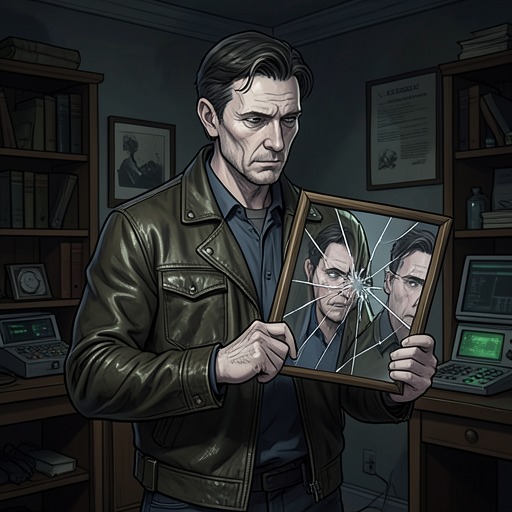
The account Stefan pieces together from people behind the barricade describes a stark change in a man once known as cheerful, pleasant, and well-liked. Living alone, Sharkle had become brooding and grim over the preceding months. He told neighbors he had a bad feeling and expected something terrible, read survivalist books and magazines, talked about Armageddon, and suffered vivid nightmares. His alarm did not fit the familiar catalogue of survivalist fears: he could not identify the cause, and said it was not nuclear war, a Russian invasion, economic collapse, or another danger of that kind.
On December first, Sharkle quit trucking, sold his rig, and told relatives and neighbors that the end was near. He wanted to sell his house, buy remote land in the mountains, and build a retreat like the ones in survivalist magazines. Believing there was no time for that plan, he decided instead to prepare his existing house for a siege. His sister, Nan Gilchrist, took him to a doctor, who found him fit and attributed his condition only to job-related stress. After Christmas, however, Sharkle grew suspicious and withdrawn. In the first week of January he had his telephone disconnected, fearing that whoever was coming might reach people through it; he still could not say who they were.
By the time Stefan arrives, the threat has become a public spectacle. Although it is in the mid-twenties and the wind gusts to thirty miles an hour, about a hundred people have gathered on sidewalks and lawns outside the police line. Traffic on Scott Avenue slows as drivers look toward O’Bannon Lane, and Stefan has to travel almost two blocks at a crawl before finding a place to park. The size and exposure of the crowd contrast with the private, inward fear that has brought Sharkle to barricade himself inside his own home.
The Planned Assault
Stefan tries to understand what is happening by joining people gathered around a metallic-blue Chevrolet recreational van, decorated with a California beach mural. Its large, bearded owner has opened both doors and turned up a police-band radio, making the operation audible to the crowd. Through the relayed voices, Stefan learns that the SWAT team is preparing a two-sided assault. One group is positioned in the first floor of Sharkle’s house; officers plan to use carefully measured plastic charges to blow the steel cellar door off its pins while another group blows the exterior cellar door. Both teams will then enter the basement in a pincer movement.
The plan is dangerous for both officers and hostages, but the authorities believe that delaying action would place them in greater danger. Hearing the plan changes Stefan’s immediate objective: he becomes certain that he must stop the assault and reach Sharkle before it begins. He does not know what words will penetrate Sharkle’s paranoia. He considers telling him that he is not alone, but has no settled strategy beyond getting through the barricade and buying time to speak with him.
The Failed Intervention and Explosion
Stefan races back toward the entrance to O’Bannon Lane. His sudden departure prompts some spectators to run after him, and younger, faster onlookers overtake him, shouting as they plunge from the sidewalk into the street. Scott Avenue’s already sluggish traffic stops completely; brakes bark, horns sound, and one car bumps another. Jostled hard enough to fall onto his hands and knees, Stefan receives no help from the runners. He gets up and continues toward the blockade, appalled by the crowd’s frenzy and determined to reach the police.
At the barricade, the crowd is jammed against sawhorses and cruisers, straining to see into the forbidden block. Stefan pushes forward and identifies himself as a priest, but the officers are trying to force the surging spectators back and threaten arrest. Ready to say whatever might delay the assault, Stefan tries to persuade them that he knows Sharkle and can get him to surrender, though he does not in fact know how to secure that surrender. When words fail, he tears open his topcoat and removes his white scarf to show his Roman collar. The crowd presses him against a sawhorse; the barrier falls, and the officer still does not listen.
Two small explosions follow, one a split second after the other: the charges have blown the cellar doors. Then a much larger blast tears through the scene. The pavement shakes; the force vibrates through bodies, and slabs and splinters from Sharkle’s house shoot into the winter sky. The crowd, which had pressed toward the barricade to watch the operation, scrambles backward when the blast makes clear that death is no longer an abstract spectacle. A police officer realizes that Sharkle had a bomb inside. The paramedics’ van pulls away from the barricade, its red beacons flashing, and speeds toward the middle of the block.
Narrative Significance
Evanston’s significance lies in the gap between what the crowd can see and what it understands. Sharkle’s months of dread have been reduced to a police emergency and a newsworthy gathering; the radio turns a life-threatening operation into a broadcast that spectators can follow from a van. Stefan’s attempt to interrupt that sequence is an act of responsibility, but he reaches the police line without either authority over the crowd or a reliable way to reassure Sharkle. The blast reverses the crowd’s posture in an instant: those who had rushed forward to witness danger flee when it reaches them.
The catastrophe also makes the neighborhood’s domestic setting consequential. Sharkle’s house is not a remote survivalist retreat but the home he tried to prepare because he believed there was no time to build one elsewhere. Its cellar doors become the targets of a tactical plan, and the house itself is broken open by the explosion. The account ends with paramedics moving toward the scene, leaving the immediate human consequences unresolved while marking O’Bannon Lane as a point where the effort to find an unreachable witness has become an emergency in its own right.