Tranquility Motel
StrangersThe Tranquility Motel is a small, isolated Nevada lodging whose everyday role as a roadside way station becomes inseparable from a concealed encounter on July 6. Run by Ernie and Faye Block, it is the place where several travelers were held and subjected to memory alteration, and later the place where their scattered recollections begin to return. Its name promises rest; its distance from other buildings, its rooms, and its old registration book instead make it a landscape of fear, evidence, and collective recovery.
Setting and Physical Layout
The motel stands on a knoll north of Interstate 80, amid sagebrush plains rising toward grassy meadows. It is the only lodging for miles: Elko is more than thirty miles east, Battle Mountain about forty miles west, and although Carlin and Beowawe are closer, neither settlement can be seen from the property. From the parking lot, no other building is visible in any direction. The highway brings travelers within reach, but the surrounding land makes the motel feel cut off from ordinary help and witness.
The complex combines the motel with the Tranquility Grille, a separate diner at its western end. The grille has broad windows, a blue neon sign, and a large parking lot used by long-haul trucks. A single-story white motel stretches beneath an aluminum awning painted forest green. Its west wing contains ten rooms with glossy green doors; the east wing is L-shaped, with six rooms in one section and four in the shorter arm. Between the wings, a two-story section holds the office downstairs and the owners’ apartment above. The arrangement puts the public counter and private living quarters at the center of the property, while the rooms extend outward toward the surrounding dark land.
At night, the building’s lights become a measure of security. On a November evening, Ernie returns from Elko later than planned after a flat tire and a delay getting it repaired. As the sun sinks toward the edge of the Great Basin, the motel’s blue and green neon sign shines against the twilight and offers him a welcome sight. Inside, the office windows give him a view of Faye at the desk. The same building that isolates its occupants from the landscape can, when lit and occupied, provide a brief sense of shelter.
The Blocks’ Motel and Its Ordinary Rhythms
Ernie and Faye operate the property as a family business, with their working lives and home joined in the same building. On the Friday after Thanksgiving, Ernie works alone in the office while Faye is away visiting Lucy, Frank, and their grandchildren in Wisconsin. They plan to close the motel for a week in December and go to Milwaukee together, but this time Faye has made the visit by herself. The motel’s routine is shaped by both customer traffic and family obligations: it must be cleaned, supplied, and ready for travelers, yet it is also the Blocks’ workplace and home.
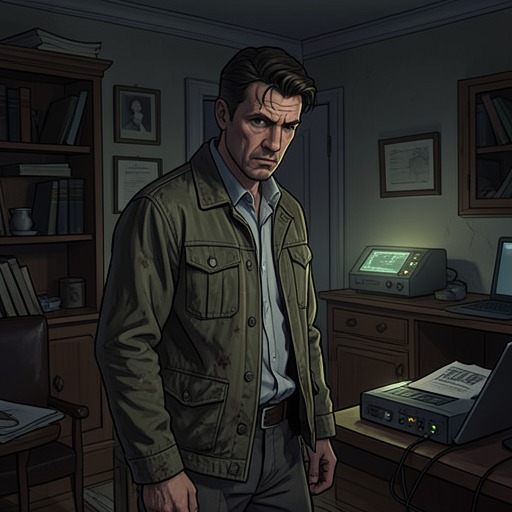
By midafternoon Ernie has cleaned all the rooms and changed the linens, leaving the motel prepared for the late-day arrivals from Interstate 80. He touches up scratches on the oak counter with wood stain, although it is not in poor condition. The task gives him something to do while he waits for customers—and keeps his thoughts occupied. As dusk approaches, his attention turns to the onset of darkness, which he fears intensely. At a quarter past seven, he switches on the NO VACANCY sign, locks the front door, and turns off the office lamps one by one. He retreats toward the stairs to the apartment, trying to reassure himself, but the fear is not of a particular creature hidden in the shadows: darkness itself, the absence of light, is what terrifies him.
The Blocks also maintain the motel through practical work and incremental changes. Ernie describes the property as continually being upgraded. After the diner’s windows are broken, he buys plywood panels from a friend in Elko, cuts them to fit with a portable table saw, and works with Ned and Dom to nail them into place. The repair is completed by noon on Sunday. This labor belongs to the motel’s ordinary upkeep, but it also registers the damage and disruption that have begun to reach the complex.
The July 6 Stay and the Hidden Rooms
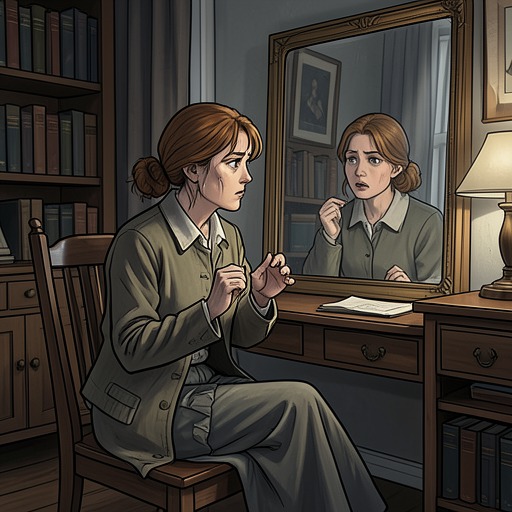
Years before the investigation, Ginger Weiss stays at the Tranquility while traveling across the country. During hypnotic regression, the motel’s name makes her shudder. Asked to locate and describe it, she identifies the property as a twenty-unit motel and grille thirty miles west of Elko, on Interstate 80. The place provokes a bodily response before she can explain why: her hands curl into fists, her muscles become rigid, and she is frightened by the memory she cannot yet reach.
As the regression moves further back, Ginger recalls checking in shortly after eight on Friday, July 6, two summers earlier. It was about an hour before sunset. She was exhausted and wanted dinner, a shower, and bed. She remembers the couple behind the counter well enough to identify them as Faye and Ernie. These details restore an ordinary beginning to a night whose later hours have been removed from her conscious account: a tired traveler arrives, signs the register, and enters a familiar roadside routine.
The recovered facts lead to a darker explanation. Ginger had seen something she was not meant to see on the night of July 6. She was almost certainly detained in a room at the motel, where sophisticated brainwashing concealed the event from her and prevented her from carrying news of it to the outside world. The intervention lasted three days—Saturday, Sunday, and Monday—and she was released on Tuesday with a sanitized recollection. The motel’s rooms, built to offer privacy to passing guests, had also provided a place in which a witness could be held beyond public view.
The guest register later makes the motel’s role legible to Dom Corvaisis. Faye retrieves the registry used during the summer two years earlier and opens it to the entries for July 6 and 7. Dom recognizes his own signature and the Mountainview, Utah, address he used while moving at the time. He remembers checking in, but not driving away that same night in response to an evacuation order. Four entries above his own, he finds Ginger’s name and Boston address. The book places them in the same sequence of arrivals, connecting two people whose missing memories had seemed separate.
The apparent evacuation story is further unsettled by the Blocks’ own recollections. When Dom asks about a tanker-truck accident, Ernie answers in a voice whose unconscious artificiality alarms him. Faye’s speech has the same unnatural quality. Dom recognizes that the couple seem to be following a shared script, rather than drawing independently on ordinary memory. Elsewhere, the Blocks’ account of evacuating to a ranch is judged likely to be false; Ned and Sandy likewise come to doubt their recollection of waiting out the emergency at their trailer. Their memories have not merely faded. They appear to have been shaped into a common, plausible account that conceals their presence at the motel.
The Motel as Evidence and Gathering Place
When Dom returns to the property in winter, the motel itself triggers apprehension. He parks near the office at sunset, feels a cold wind, and stops on his way toward the building with the conviction that something strange happened there. The familiar layout can now be read as evidence: the separate diner, the two wings, the central office, and the rooms where travelers once stayed are no longer neutral features of a roadside business. The landscape and structure give his recovered suspicions a place to attach.
Two anonymous Polaroid photographs deepen the Blocks’ recognition of what occurred. One shows a priest with a zombie-like face seated at a writing desk; the Blocks are certain the picture was taken in one of their rooms. Another shows a blond woman in bed with an intravenous line in her arm. Although the close-up reveals almost none of the room, the Blocks identify the floral bedspread in one corner as a pattern used in some units until ten months earlier. The photographs do not explain the full events, but details of the motel’s furnishings connect the images to the property and its past.
The old registry becomes a working document rather than an archived business record. Dom uses the July 6 page to call people who may have shared the night’s unremembered experiences. He also persuades the Blocks, and later Ned and Sandy, to reconsider the memories they had accepted as proof that they were elsewhere. As the witnesses gather and compare their accounts, the group’s shared presence at the motel places pressure on the implanted memory blocks. The return of memory is uneven and frightening, but it is no longer confined to isolated individuals: the setting allows people to test one recollection against another.
The motel is also a place of recurrence. Dom enters Room 20 and finds that being there intensifies his nightmares, making them more vivid and detailed. Before taking Ginger to the motel, he brings her to a special place more than two hundred yards south of Interstate 80. Later, as the investigation continues, the Blocks close the business to customers and reserve all twenty rooms. Ernie wants no commercial activity to distract him from helping Dom and the others investigate the supposed toxic spill. He thinks of the motel as barracks in a war against an unknown enemy: rooms once assigned to transient guests are held ready for fellow victims who may travel to Elko County.
A Refuge Under Surveillance
Closing the motel for the investigation turns a private family business into a temporary headquarters. Faye switches on the NO VACANCY notice so the group will not be disturbed. The building’s everyday signs and doors acquire a second purpose: they help make the gathering less visible. But the guests are not secure simply because they are under one roof. Jack Twist warns that their conversations can be overheard; he has been listening for nearly an hour and concludes that their opponents may be listening as well. The motel offers rooms and a common place to work, but its relative isolation cannot guarantee secrecy.
The group responds with practical precautions. Jack and Ned brace a plywood panel against a door with a table to prevent eavesdropping. They arrange to keep some vehicles out of sight south of Interstate 80, using the plausible appearance of stranded motorists as cover. Under worsening snow and early darkness, the Tranquility group plans to leave by the rear of the motel and travel overland in four-wheel-drive vehicles. Their departure plan divides them: Ernie, Faye, and Ginger are to head toward Twin Falls and Pocatello before arranging travel to Boston, where Ginger can tell the Hannabys and her Boston Memorial colleagues what was done in Nevada. The place that has helped reunite the witnesses is no longer safe as a permanent base.
The danger is explicit when Colonel Leland Falkirk and Lieutenant Horner arrive with armed DERO corporals during the blizzard. Army transports block the eastbound lanes of Interstate 80, while the westbound lanes are blocked elsewhere in the quarantine zone. At the motel, Horner reports that the rooms are empty: the group has left through the back, with only vague tire tracks visible in the snow. The building has become the center of a search, but its rear approach has allowed the witnesses to escape before the authorities can seize them together.
The motel’s significance continues after the group’s departure because memory returns through testimony about what happened there. Sandy, responding to Parker’s revelation, recalls jets passing low over the roof, one of them nearly taking the top off the building. She remembers that people had come out of the diner and that the ground and air were still shaking. She then recalls Dom turning from the jets, looking back across the diner roof, and shouting about the moon. Her account makes the motel and grille a shared vantage point from which several witnesses saw the same extraordinary event. What had been hidden in separate minds begins to reappear as a scene that can be told, checked, and witnessed together.
The Tranquility Motel therefore changes function without ceasing to be itself. It remains a roadside business with an office counter, guest rooms, a diner, and a view of an immense, empty landscape; at the same time, it becomes the physical record of a night erased from its guests’ memories, a meeting place for those trying to recover the truth, and a refuge they must eventually leave. Its isolation first helps conceal what happened, then gives the returning witnesses a shared ground on which to challenge the concealment.