Sunrise Hospital
StrangersSunrise Hospital becomes the setting for Marcie’s four-day evaluation after her terror of doctors escalates beyond what Jorja can manage at home. The hospital offers tests but no immediate explanation: Marcie panics at the sight of medical staff, and her distress exhausts both child and mother. By the time the tests are complete, the terror has unexpectedly eased, although its cause remains unresolved. The hospital’s role is therefore double-edged: it is where Marcie’s fear is most visible, and where a change begins that neither Jorja nor her doctors can account for.
Referral and Admission
After Marcie’s alarming response during an examination at Dr. Besancourt’s office, he cannot offer Jorja a straightforward diagnosis. He raises possible neurological, brain-related, and psychological disorders and recommends that Marcie spend a few days at Sunrise Hospital undergoing tests. The referral makes the hospital a place of investigation rather than a confirmed treatment for any known condition; at this point, the source of Marcie’s behavior is still an open question.
The admission follows an episode in which even a routine eye examination has intensified Marcie’s terror. At the hospital, however, the problem is not confined to one examination or one doctor. The sight of doctors and nurses is enough to provoke panic, which repeatedly swells into hysteria. Marcie’s responses make the clinical setting itself difficult to tolerate, even as it is where the staff are trying to determine what is wrong.
Marcie’s Four Days There
The episode at Dr. Besancourt’s office proves to be only a beginning. At Sunrise Hospital, Marcie’s panic recurs in fits that end in exhaustion; afterward, she falls into a nearly catatonic trance and needs hours to recover. The pattern gives the stay a punishing rhythm: a medical encounter triggers fear, the fear intensifies, and the resulting collapse takes time to pass. Doctors and nurses are present as caregivers, but their presence also becomes a source of alarm for Marcie.
Jorja takes a week of sick leave from the casino and spends four days virtually living at the hospital. She sleeps on a rollaway bed in Marcie’s room, trying to remain near her daughter while getting little rest herself. By Sunday, December 29, after the fourth night, Jorja is so worried and worn down that she almost needs medical attention. The hospital stay thus measures not only Marcie’s crisis but the strain of watching it without knowing its cause.
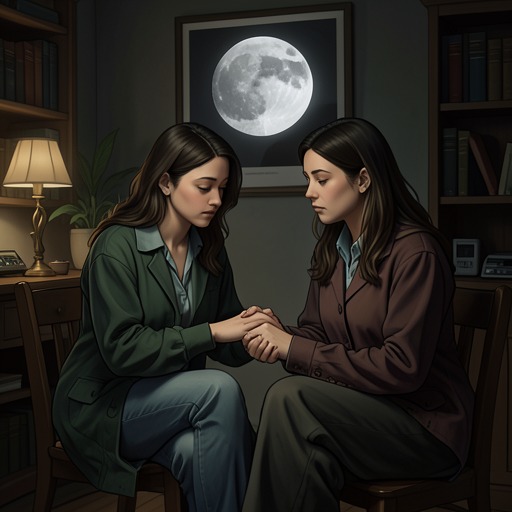
Marcie’s distress continues into sleep. Even when drugged and apparently asleep, she twitches, kicks, whimpers, and cries out about the moon. The repeated lunar reference connects the hospital scenes to a fear that persists beyond waking encounters with medical staff. It does not, by itself, explain the phobia, but it shows that the crisis is not simply a matter of Marcie resisting an examination: her agitation follows her into sleep, where Jorja has to witness it without being able to settle it.
Tests and an Unexplained Reversal
On Monday morning, Marcie’s most extreme terror has abruptly disappeared. She still wants to leave and remains uneasy around doctors and nurses, but she no longer reacts as if the walls will close in on her or strikes people who touch her. Her pallor, nervousness, and watchfulness remain; so does her dislike of being hospitalized. Yet her appetite returns, and she eats everything on her breakfast tray. The change is meaningful precisely because it is partial: the acute panic lifts, while signs of unease remain.
After the final testing, Dr. Besancourt tells Jorja that every test is negative: there are no brain tumors, cerebral lesions, or neurological dysfunction. Jorja’s relief does not supply an explanation for what has happened. Besancourt plans to refer Marcie to child psychologist Ted Coverly, who may identify the cause and any residual anxiety. He also wonders whether Marcie might have been cured without anyone realizing it. His hunch leaves the reversal open to interpretation rather than presenting it as a medical conclusion; the hospital can rule out the conditions tested for, but it cannot establish why the fear began or why it subsided.
Discharge and Aftermath
Marcie is released on Monday, December 30. On the drive home, she is almost her old self, happily finding animal shapes in the clouds. At home, she settles among the piles of Christmas toys she had barely had time to enjoy. She still plays with the Little Ms. Doctor kit, but no longer with the disturbing intensity she had shown on Christmas Day. The contrast between that earlier fixation and her ordinary play marks a further change: the toy remains, but its place in her behavior is no longer so consuming.
Jorja’s parents, whom she had kept away from the hospital for fear of disturbing Marcie’s delicate condition, come to the apartment. Marcie’s good mood at dinner disarms them. For the next three nights, she sleeps in Jorja’s bed in case the anxiety returns, but no attack follows. Her nightmares become less frequent and less powerful, and Jorja is awakened only twice by Marcie’s quieter sleep-talking about the moon. The improvement is real but not absolute: the recurring words remain, now softened from a shout into an almost forlorn call.
Place in the Story
Sunrise Hospital is important less as a source of definitive answers than as the setting where uncertainty takes a concrete form. Its doctors test for serious physical causes, observe Marcie’s intense reactions, and arrange a psychological referral, yet the negative results do not explain her sudden fear or its sudden easing. The hospital therefore frames the limits of what the medical investigation can establish at this point in the story.
The stay also brings Marcie’s fear into view through its effects on both mother and child: the repeated episodes, the long recoveries, Jorja’s sleepless vigil, and the return of ordinary appetite and play after discharge. Its ending offers relief without full resolution. Marcie can leave Sunrise Hospital and resume parts of her home life, but her lingering unease and moon-related sleep-talk keep the episode from reading as a complete or explained recovery.