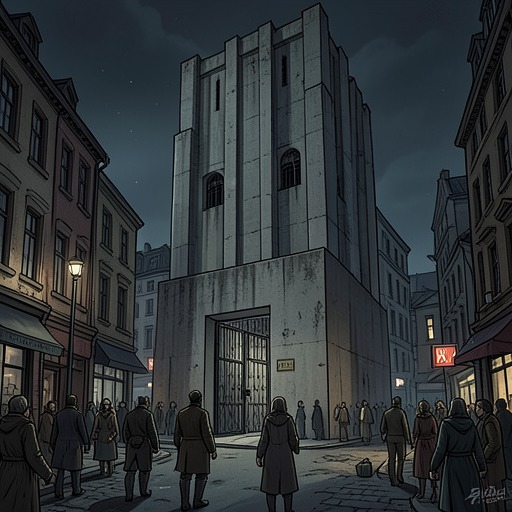
Shenkfield Army Testing Grounds
StrangersShenkfield Army Testing Grounds is an underground military installation in Nevada whose chemical and biological weapons program gives it a plausible place in the official account of the July 6 crisis—and whose use as a red herring makes that account suspect. For Colonel Leland Falkirk, it is both a temporary command post and a base from which to manage public explanations; for Dom and Ginger, it becomes a clue to how the Army diverted attention from what they believed was the real source of the emergency.
Setting and purpose
Shenkfield lies eighteen miles southwest of the Tranquility Motel. Its laboratories, administrative offices, security command center, cafeteria, recreation lounge, and living quarters are all underground. The arrangement is practical in a region of blazing summers and bitter winters: below ground, staff can maintain comfortable temperatures and humidity more easily than in buildings exposed to the Nevada barrens.
The more consequential reason for the underground layout is the installation’s weapons testing. Shenkfield conducts open-air tests of chemical weapons and, at times, biological weapons, studying how sunlight, wind, and other natural forces affect the distribution and potency of gases, powders, and fine mists. A sudden wind shift could carry contamination toward aboveground buildings, turning the base’s own personnel into unwitting test subjects. The facility’s lack of windows and the continuous hiss of piped air and hum of ventilation motors keep that subterranean purpose palpable in daily life.
The July 6 explanation
The account initially recalled by Faye and Ernie Block placed Shenkfield at the center of the crisis. On Friday, July 6, they said, the interstate was closed because a truck carrying dangerous chemicals to the installation had suffered a toxic spill. The motel was shut until Tuesday while the situation was brought under control. Guests were ordered to leave the danger zone in their own cars; Ned and Sandy Sarver were permitted to return to their trailer near Beowawe because it lay outside the quarantine area.
The Army’s response raised questions beyond the stated spill. Army units attached to Shenkfield closed a ten-mile stretch of Interstate 80 and established roadblocks before notifying the Elko County Sheriff or Nevada State Police. Local authorities complained that the military had excluded them from managing the emergency and had taken over decisions that fell outside its authority. The Army’s control of the quarantine line and its refusal to share contingency planning suggested that it trusted its own personnel alone to protect whatever was inside the restricted area.
Ginger’s reasoning about the Domestic Emergency Response Organization (DERO) sharpened that suspicion. She argued that DERO personnel would not have been needed to secure an ordinary chemical spill: the Army had called them in because those manning the roadblocks might see something highly classified, and the organization’s personnel could be trusted to keep silent. In this reading, the containment operation did more than manage a hazard; it controlled who could witness the crisis.
Falkirk’s headquarters
Although Falkirk’s home base was in Grand Junction, Colorado, he was a field officer who usually spent little time behind a desk. At Shenkfield, the low ceilings, windowless rooms, and persistent ventilation noise made the underground quarters feel to him like a tomb. He took aspirin for the headache caused by the air system and waited impatiently for news, eager to leave the facility.
Falkirk could have established temporary headquarters at the Thunder Hill Depository, whose underground caves were larger and higher-ceilinged. He chose Shenkfield instead for two reasons. Moving a fully equipped DERO company toward Thunder Hill might prompt nearby ranchers to wonder what was happening there; Shenkfield also offered a familiar base from which he could direct the same kind of disinformation he had used two summers earlier. He additionally distrusted the people at the Depository, suspecting that some might have been changed.
Shenkfield thus served as more than shelter for Falkirk’s command. It positioned him to manage the public account while keeping forces away from the place whose secret he feared would be noticed. During the renewed crisis, he received reports there about the operation at the Salcoe family’s house in Monterey, where officials were again attempting to alter witnesses’ memories. The facility was one node in a wider effort involving military and civilian agencies, not an isolated testing site acting alone.
Misdirection and significance
As Dom and Ginger examined the Elko Sentinel’s coverage, they concluded that Shenkfield had been used to draw attention away from Thunder Hill. They believed that news about Thunder Hill, elsewhere in the paper and apparently unrelated to the toxic emergency, pointed toward the actual source of their trouble. Their conclusion reframes Shenkfield: the installation’s real weapons program made the spill story credible, while its proximity to the crisis gave the Army a ready-made explanation for roadblocks, evacuation, and military control.
The competing interpretations also expose the uncertainty beneath the official narrative. Falkirk treated the events as a threat to human survival and argued that disclosure could undermine efforts to contain it. Other officials increasingly doubted that the threat justified the cover-up, as reports of healing and telekinetic abilities accumulated and the Salcoe operation faltered. Shenkfield remains the physical anchor of the Army’s explanation, but the novel’s investigation turns that apparent explanation into evidence of deliberate diversion—and makes the facility’s secrecy part of the mystery rather than its solution.