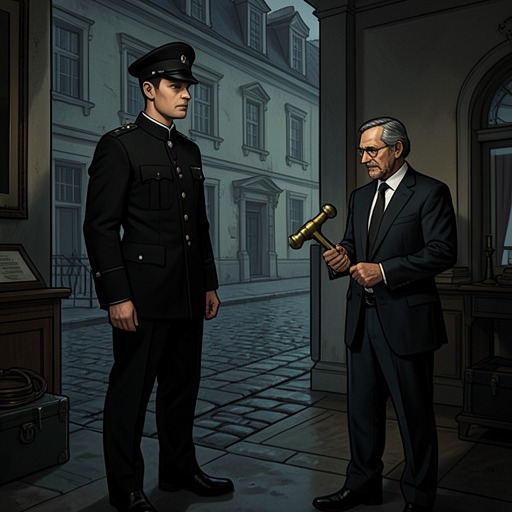
Falkirk's witness-elimination policy
StrangersFalkirk's witness-elimination policy is the lethal edge of the military cover-up surrounding Shenkfield: rather than risk witnesses recovering their memories, Leland Falkirk is willing to treat their survival as a threat to national and even human security. The policy emerges through the survivors’ damaged recollections and their investigation of the official toxic-spill story. Its defining contradiction is that Falkirk sees extreme violence as necessary to contain an existential danger, while other military personnel warn that killing the witnesses would make the secret impossible to contain.
Origins in the Shenkfield cover-up
The policy takes shape against the public account of an emergency on Interstate 80. The motel registry shows that the closure and evacuation began on Friday, July 6, when officials said a truck carrying dangerous chemicals to Shenkfield had caused a toxic spill. The motel remained closed until Tuesday. Guests were ordered out of the danger zone, and Ned Sarver and Sandy Sarver were allowed to return to their trailer near Beowawe because it lay beyond the quarantine boundary. Ernie Block understood Shenkfield to be an isolated testing ground for chemical and biological weapons, making the alleged cargo especially dangerous.
The military response already suggested that the emergency was being managed as a matter of secrecy as well as public safety. United States Army units established roadblocks and closed a ten-mile stretch of Interstate 80 before informing the Elko County Sheriff or Nevada State Police. Civilian authorities complained that the Army excluded them from managing the quarantine and planning for the possibility that the danger might spread. The investigation later treats this unusual concentration of control as evidence that the Army was protecting information, not merely containing a spill. Ginger Weiss reasons that DERO forces were assigned to the quarantine because the people guarding the area might see something highly classified, and the Army would not entrust that task to ordinary soldiers.
Poisoning, detention, and the proposed memory wipe
Dom Corvaisis’s nightmares expose the most direct evidence of Falkirk’s lethal approach. In a recovered memory, men in sealed decontamination suits attend him after he has been poisoned and is struggling to breathe. They discuss how many detainees have been poisoned, estimate that there are at least twelve, and identify Colonel Falkirk as the likely perpetrator. The memory then shows them forcing Dom to drink an emetic and trying to make him vomit the poison. Afterward they inject him, reconnect him to an intravenous line, and discuss Falkirk’s fear that the implanted memory block will eventually fail.
Those men do not regard killing every detainee as a workable solution. They fear that a growing number of bodies would attract reporters and destroy the possibility of keeping the operation secret. Instead, they propose a memory wipe as the more sensible way to prevent disclosure. The distinction matters: witness elimination is not presented as a single, orderly program unanimously followed by everyone involved. It is the lethal option associated with Falkirk, set against subordinates’ calculation that mass killing would produce evidence and public attention. Dom’s recognition that the scenes are memories rather than ordinary dreams makes the proposed erasure and the poisoning part of the same attempt to keep witnesses from speaking about what they saw.
The threat grows as witnesses gather
As the motel group’s memories begin to return, the danger becomes immediate rather than retrospective. After several witnesses experience similar nightmares of being restrained in motel beds and treated by men in decontamination suits, Dom sees the shared investigation as pressure on their implanted memory blocks. Ned Sarver, newly shaken by his own dream, leaves the relative isolation of the trailer near Beowawe and moves into the motel with Sandy. He fears that Falkirk may come to kill them, as he believes Falkirk had wanted to do before. The move gathers the couple closer to the group, but it also makes plain how the witnesses’ attempt to recover the truth changes their sense of safety.
Dom expects the risk to rise further when Brendan Cronin, Jorja Monatella, and possibly other victims join the group at the Tranquility Motel. In his assessment, Falkirk is unlikely to act before more of the people connected to the events are together; once they are gathered, however, they must be ready for trouble. The policy thus exerts pressure even before another attack occurs. Each recovered memory and reunion makes the witnesses more capable of comparing what happened, while increasing their fear that their renewed cooperation could provoke a preemptive strike.
Falkirk’s rationale and the policy’s limits
Falkirk’s own defense reveals how he justifies escalation. In a confrontation with Foster Polnichev, he argues that the government is no longer merely keeping news from the public but protecting humanity from obliteration. He fears that disclosure would provoke political interference just as the authorities might need to use violence against an infection, and that public scrutiny could cost them a war. Polnichev challenges that premise: he doubts that the people with new powers are dangerous, describes Emmy Halbourg as a delightful child rather than a monster, and suggests that the change may be the greatest event in human history. Falkirk interprets even the possibility of accommodation as a means by which an enemy might conquer humanity.
This exchange exposes the policy’s governing logic and its danger. Once Falkirk defines the witnesses and their experiences through the language of infection and species survival, ordinary constraints on force become, in his view, obstacles to defending humanity. Yet the evidence does not present his certainty as shared or confirmed. His colleagues question whether the witnesses are a threat, and the proposed memory wipe shows that even people committed to secrecy recognize a practical limit to killing them. Falkirk's witness-elimination policy is therefore both a method of suppression and a sign of his escalating fear: as the witnesses recover what was done to them, the distinction between protecting the public and protecting the cover-up becomes harder to sustain.