Lomack's house at 1420 Wass Valley Road
StrangersLomack's house at 1420 Wass Valley Road is the secluded Reno bungalow where Zebediah Lomack’s moon fixation became visible in thousands of images—and where Dom Corvaisis’s search for an erased past culminates in an impossible disturbance. The modest house first appears as the aftermath of Lomack’s suicide; Dom’s nighttime visit transforms it into a space where obsession, memory, and unexplained physical force converge.
Setting and History
A professional gambler, Lomack left an estate worth more than $500,000, most of it held in savings and loan accounts and Treasury bills. The house itself, at 1420 Wass Valley Road, was appraised at only $35,000. On Christmas night, police responding to a neighbor’s report of shotgun fire found Lomack dead in the kitchen. Their investigation exposed the scale of his obsession: photographs of the moon covered walls, ceilings, and furniture.
The house stood on a half-acre lot and was a modest bungalow with large porches. Lomack’s sister, Eleanor Wolsey, flew in from Florida after his death, arranged his funeral, and stayed in a hotel because the house was too depressing. She began cleaning it and preparing it for sale. Neighbors described Lomack’s rapid change from a sociable man into a recluse; the moon fixation had apparently begun the summer before last, and the newspaper reported that no one but Lomack had entered the house for more than a year.
Dom’s Visit
After reading the newspaper account several times, Dom decided he had to see the house for himself. At about 9:15, despite being tired, he retrieved his rental car, bought a flashlight at an all-night Save-On drugstore, and drove to 1420 Wass Valley Road, arriving shortly after ten. Reno lay below the snowline, leaving the roads dry and clean; patches of snow remained on the bungalow’s roof and lawn, and its windows were dark. Dom parked across the street and used the flashlight carefully, hooding its beam so it would not attract attention.
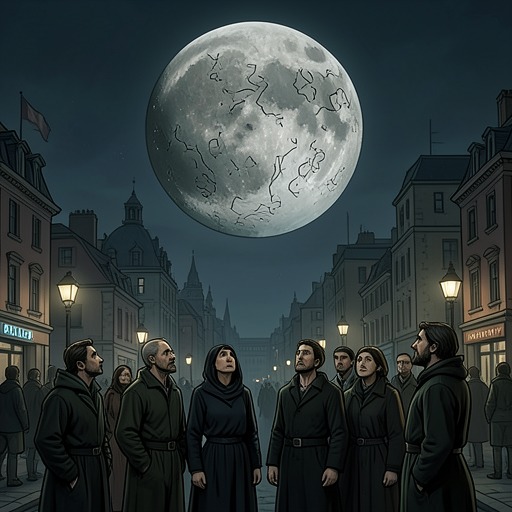
The kitchen had been cleaned since the police found Lomack’s body. The garbage was gone, the counters and floor were spotless, and the air smelled of new paint and Spectracide. There were no moon pictures there, and Dom briefly feared that the cleaning had removed every trace of Lomack’s fixation. But the living room remained covered: large lunar posters papered its walls, ceiling, and windows. In the narrow beam, the images seemed to surround Dom like a disorienting field of cratered worlds. Hundreds more—color and black-and-white, large and small, some overlapping—covered the hallway and both bedrooms, attached with glue, tape, and staples. The repetition made the images seem to have spread through the house into every corner.
The Poster and Its Significance
Among the pictures were handwritten names, including Dom’s. As he looked between the names, a dark memory stirred but stayed beyond his reach. He understood that someone had tampered with his mind, yet the knowledge did not restore what had been removed. Fear gave way to frustration: in the moon-papered house, Dom demanded that he remember and reached toward the poster bearing his name.
Before he touched it, the poster tore loose. Its four strips of masking tape peeled away, and the sheet swept toward him as though driven by wind, forcing him to stagger backward. It stopped a few feet away, unsupported, wavering in the air; Dom’s handwritten name fluttered across the moon’s pocked surface. He thought desperately that it might be a hallucination, leaving the episode unresolved even as the house’s strange display becomes physically active. The scene gives the bungalow a double role: it preserves the evidence of Lomack’s isolation, but also becomes the setting in which Dom’s blocked memory and an apparent force beyond ordinary explanation meet.